[News] Huawei Unveils 7.2Tbps Near-packaged Optics Module, Challenging NVIDIA and Broadcom’s CPO Push
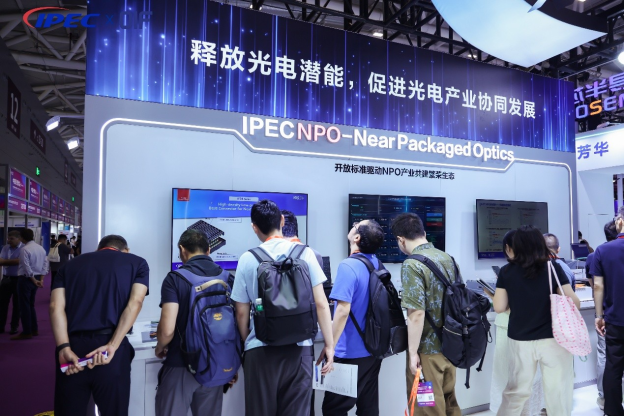
As NVIDIA, Broadcom and TSMC rally behind co-packaged optics (CPO), Huawei is charting a different course with near-packaged optics (NPO). According to Nikkei and the South China Morning Post, the Chinese tech giant unveiled its own NPO standard and debuted a 7.2Tbps solution on Thursday at the China International Optoelectronic Exposition (CIOE).
South China Morning Post, citing Man Jiangwei, director of the company’s advanced optoelectronics laboratory, reports that Huawei’s new module features 36 channels running at 200Gbps each. Notably, the combined 7.2Tbps bandwidth puts Huawei’s module at the forefront of a new wave of high-density optical interconnects for AI infrastructure, alongside Broadcom’s 6.4Tbps optical engines designed for CPO, the report adds.
According to the report, Huawei expects 3.2Tbps NPO modules to enter real-world deployments this year, while the more advanced 7.2Tbps generation could see broader adoption over the next two years.
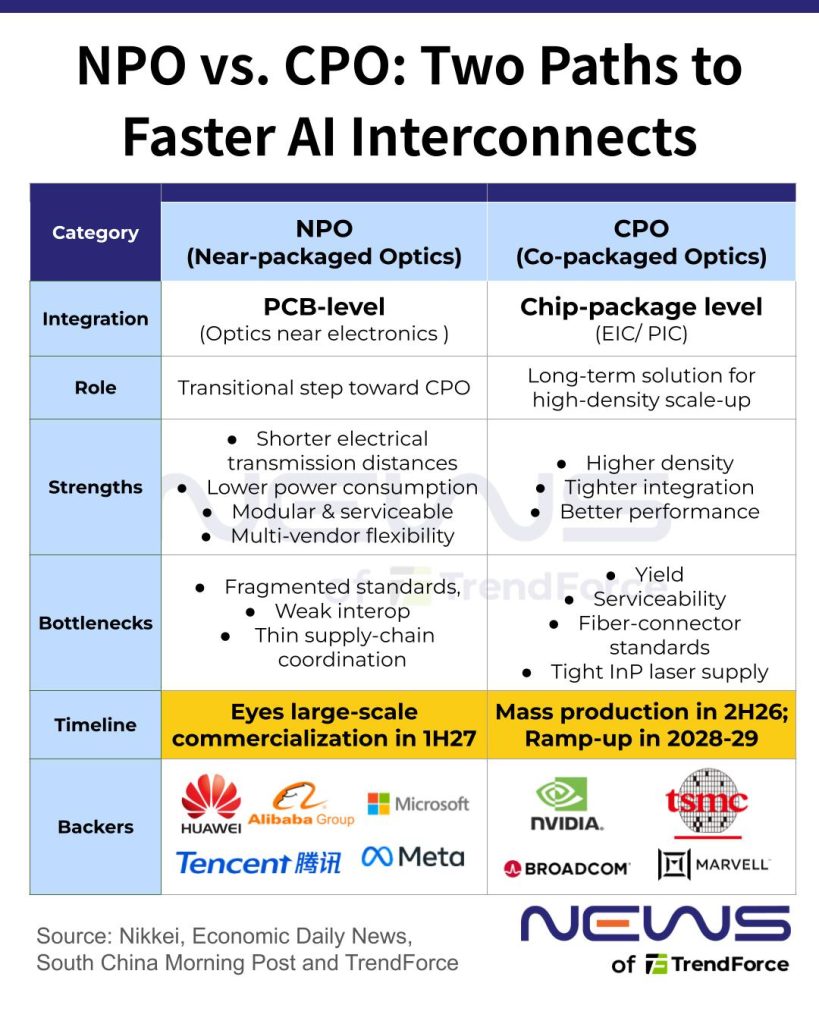
NPO vs. CPO: Two Paths to Faster AI Interconnects
Nikkei notes that CPO integrates optical components alongside electronic circuitry at the chip-package level, cutting transmission latency and signal loss while delivering greater bandwidth in a smaller footprint. The Economic Daily News explains that the solution uses advanced packaging technologies such as 2.5D and 3D to integrate optical engines, including photonic chips, directly with switch ASICs or compute chips on the same substrate.
NPO, by contrast, serves as an intermediate step between conventional pluggable optical modules and CPO. Nikkei adds that Huawei’s NPO, which also brings photonics closer to electronics, integrates at the printed circuit board level rather than within the chip package. As noted by Nikkei, unlike CPO, NPO uses a pluggable architecture, allowing faulty components to be replaced individually.
Against this backdrop, Huawei is moving to turn the technology into a broader industry standard. According to the Economic Daily News, the company has joined China Mobile Research Institute, JD Cloud and more than 20 supply-chain partners to launch the “OPEN NPO” initiative, introducing China’s first NPO optical interconnect Multi-Source Agreement (MSA). Under the current roadmap, the initiative plans to release its first technical specification in Q3 2026, followed by a push for large-scale NPO commercialization in the first half of 2027, the report notes.
But hurdles remain before NPO can scale. The Economic Daily News points to fragmented interface standards, limited interoperability and weak supply-chain coordination as key barriers to broader commercialization.
On the other hand, CPO is already drawing broad support. Beyond NVIDIA and Broadcom, TSMC and Intel are also developing the technology, while Marvell has highlighted high-speed interconnects as critical to scaling increasingly powerful next-generation computing systems, Nikkei notes, adding that CPO solutions built around NVIDIA and Broadcom switch chipsets entered production in the second half of this year.
CPO/NPO Roadmap: A $39 Billion Market by 2030
According to TrendForce, the combined CPO and NPO market is projected to surge from about $100 million in 2025 to more than $39 billion by 2030, as faster AI interconnects push conventional copper links closer to their limits.
TrendForce observes that from a deployment perspective, NPO remains the preferred near- to mid-term transition solution for many CSPs. Chinese CSPs such as Alibaba and Tencent have identified NPO as a core medium-term strategy and are promoting related open standards through the Open Data Center Committee (ODCC).
On the other hand, Meta and Microsoft have likewise prioritized NPO development, leveraging the Open Compute Interconnect Multi-Source Agreement (OCI-MSA) to foster an open optical interconnect ecosystem, according to TrendForce.
Read more
- [News] Huawei Brings Forward Ascend 950DT Deployment to August, DeepSeek V4.2 Seen as Potential Early Adopter
- [News] SK hynix Unveils CPO Roadmap, Looks Beyond HBM to AI Infrastructure
(Photo credit: Huawei)