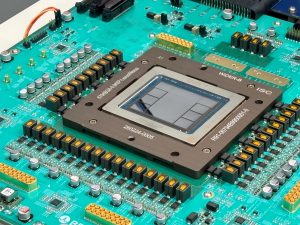
[News] Intel Unveils Three AI Architectures at Hot Chips 2026, Diamond Rapids Taps In-House 18A-P and Packaging

Intel unveiled three AI-focused architectures at Hot Chips 2026. According to ZDNet, the lineup spans Diamond Rapids for data center and agentic AI workloads, Crescent Island for real-time AI inference, and Wildcat Lake for entry-level notebooks and intelligent edge systems. Notably, the next-generation Xeon processor, Diamond Rapids, will use Intel’s 18A-P process, with manufacturing and packaging handled entirely by Intel Foundry. ServeTheHome adds that the Xeon 7 “Diamond Rapids” platform is now slated for 2027 after Intel adjusted its launch timeline earlier this year.
More details on Diamond Rapids’ architecture show how Intel is combining multiple in-house nodes within the package. According to TechPowerUp, the processor combines 16 Intel 18A-P core chiplets, four Intel 3-T compute base tiles, and two Intel 3 Fabric Hub Tiles. Each core chiplet integrates 16 Panther Cove P-cores, bringing the full configuration to 256 cores. Meanwhile, each Intel 3-T base tile carries 320MB of shared L3 cache for 64 cores, bringing total LLC across the package to 1.28GB.
The core chiplets are connected to the base tiles through Foveros Direct 3D hybrid bonding, while substrate copper links connect the base tiles to the Fabric Hub Tiles, ServeTheHome notes. Beyond its chiplet architecture, Diamond Rapids also expands memory and I/O connectivity. According to ZDNet, the processor features 16 memory channels and 128 PCIe 6.0 lanes, targeting environments with dense GPU and external storage deployments.
Intel Expands AI Push With Crescent Island and Wildcat Lake
Crescent Island, meanwhile, is designed as a cost-effective GPU for real-time inference. As noted by ZDNet, it features 32 Xe3P-based GPU cores and consumes up to 350W, allowing it to scale inference capacity within existing air-cooled data centers. TechPowerUp adds that the GPU comes in a PCIe form factor, with Intel’s own card featuring 160GB of LPDDR5X memory and ODM designs supporting up to 480GB.
The Xe3P architecture is optimized specifically for AI inference rather than graphics. According to TechPowerUp, Crescent Island integrates 256 redesigned XMX engines and adds FP4 support alongside FP8, targeting workloads including long-context and agentic AI.
At the other end of Intel’s AI portfolio, the company also detailed Core Series 3, codenamed Wildcat Lake, which targets entry-level notebooks and intelligent edge systems with enhanced AI capabilities, as ZDNet indicates. Built on the Intel 18A process, Wildcat Lake features up to a 6-core CPU, a 17 TOPS NPU, and a GPU supporting XMX acceleration.
Wccftech adds that Wildcat Lake delivers up to 40 platform TOPS and 2.7x higher AI performance, while reducing processor power by 64% compared with the Core 100 Series. Intel has also focused on lowering platform costs through a simpler packaging design. According to Wccftech, the company replaced the Foveros packaging used in Panther Lake with an organic multi-chip package (MCP), eliminating the need for a base die and helping reduce assembly costs and yield losses.
Read more
- [News] Intel May Tap TSMC N2X for Some Razor Lake Chips in 2027, Depending on 18A-P Performance
- [News] Japan’s Socionext Adds Intel’s 18A-P to Foundry Mix Alongside TSMC
(Photo credit: Intel)