[News] Unitree Sees Embodied AI ‘ChatGPT Moment’ in 2–3 Years at Earliest, Flags AI Model Limitations
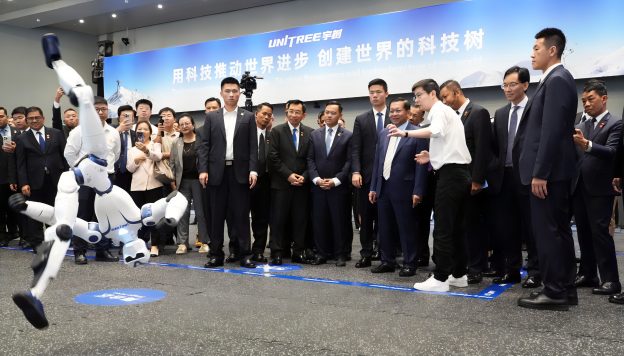
Just a day after its STAR Market listing, Unitree Robotics is striking a cautious note on the next major breakthrough in humanoid robotics. According to EE Times China, Chairman Wang Xingxing said at World Robot Conference that the industry’s long-awaited “ChatGPT moment” for embodied AI could come in two to three years at the earliest, or take five to ten years.
Wang identified limited generalization as the biggest bottleneck for humanoid robots globally, largely due to insufficient alignment between AI model inputs and outputs, the report notes. While models extensively trained for fixed environments can achieve task success rates approaching 100%, even small changes in objects or surroundings can cause performance to drop sharply.
He also offered a benchmark for an industry breakthrough: when a robot can enter an unfamiliar home and autonomously complete around 80% of everyday tasks using only voice or language instructions, embodied AI will have reached a meaningful inflection point that could unlock broader adoption of general-purpose robots.
Limited generalization is holding back large-scale deployment in factories and homes. Wang said Unitree has worked with multiple automakers on production-line applications since 2024 and tested robots in its own factories, but their efficiency still trails human workers and new tasks often require retraining.
Unitree is therefore directing more resources toward robot intelligence. Caiwen notes that AI models are now the company’s largest area of investment. Unitree is pursuing several areas, including world models, robotics data, and what Wang called “physical AI robot self-evolution,” alongside approaches such as vision-language-action (VLA) models. Caiwen adds that another notable direction is Unitree’s effort to use AI in the development of the robots themselves.
China’s Humanoid Robot Push Expands Beyond Unitree
Beyond Unitree, other major Chinese tech companies are showcasing their humanoid robotics technologies at the event. According to 21jingji, Xiaomi founder Lei Jun shared a video of the company’s next-generation humanoid robot, Tieda, interacting with visitors in real time at the 2026 World Robot Conference. The report adds that Tieda’s success rate at a workstation in a Xiaomi factory improved from around 90% in March to about 98% in July. The event also highlights the expanding real-world use of robots. STAR Market Daily notes that robots are already operating across logistics, production lines, inspection, and commercial services, although large-scale deployment remains relatively limited.
As applications expand, the market is entering a critical commercialization phase. TrendForce estimates that China’s humanoid robot market will reach RMB 15 billion in 2026 and grow by at least 60% in 2027 as mass production and deployment accelerate. But turning early deployments into sustainable growth remains the next test. TrendForce suggests focusing on products with confirmed customers and ongoing volume deliveries, particularly whether initial orders translate into repeat purchases. The industry’s next stage will depend not only on technological advances, but also on consistent delivery and profitability.
Read more
- China’s Humanoid Robot Market to Reach CNY 15 Billion in 2026 as Commercial Validation Begins, Says TrendForce
- [News] China’s Robot Maker Unitree Heads for IPO at RMB 60.99B Valuation, Backed by DeepSeek and Tencent
(Photo credit: Unitree Robotics)