[News] SK hynix Unveils CPO Roadmap, Looks Beyond HBM to AI Infrastructure
SK hynix is moving from a memory supplier to a bigger role in the AI infrastructure. According to the company, it has teamed up with leading researchers worldwide to lay out a roadmap for co-packaged optics (CPO) in the journal Nature Electronics.
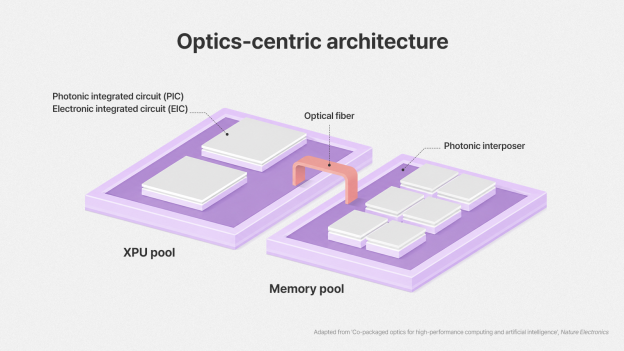
Notably, beyond its HBM leadership, SK hynix’s paper tackles data bottlenecks at the rack and pod levels, outlining an optics-centric architecture that links memory and processors through optical interconnects.
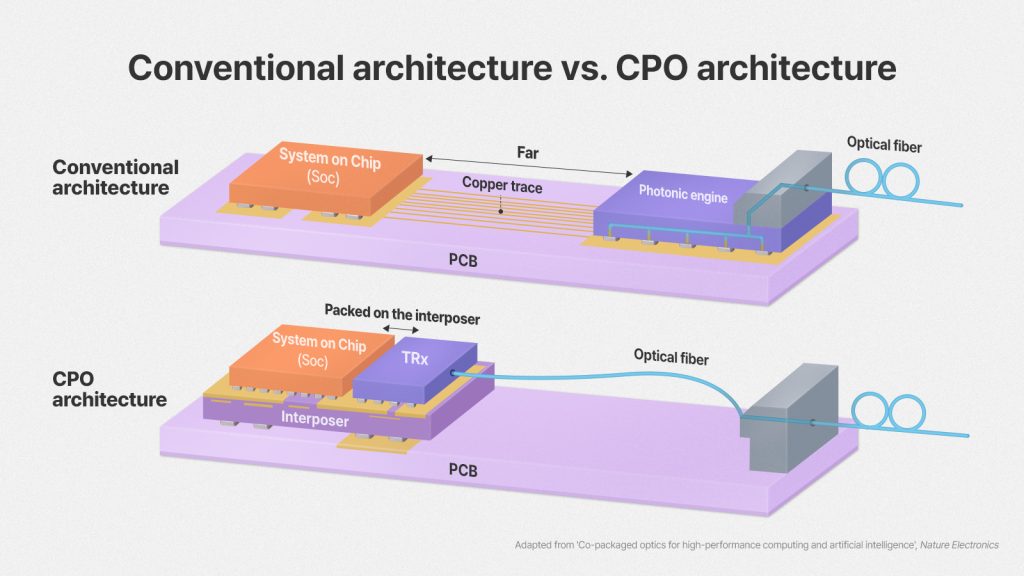
As hyperscale AI clusters scale to thousands of GPUs and HBM stacks, conventional copper links are hitting their limits, with higher speeds and longer distances driving up power consumption, latency and signaling complexity, SK hynix explains, adding that this is creating a new bottleneck: the bandwidth wall, which increasingly constrains data movement across AI systems.
Against this backdrop, CPO addresses the challenge by integrating optical transceivers (TRx) directly into the processor package, shortening high-speed electrical paths while using optical links for longer-distance data transfer.
 (Photo credit: SK hynix)
Bringing Optics Closer to Memory
As noted by SK hynix, in the long term, CPO could extend optical interconnects directly to the memory interface, overcoming the physical limits of conventional packaging. Thus, its proposed optics-centric architecture uses a photonic interposer to directly link memory and processors, improving system-wide data movement efficiency.
This architecture would also allow multiple AI accelerators to share a large memory pool, enabling more flexible data movement and more efficient scaling as AI models continue to grow in size and complexity, SK hynix said.
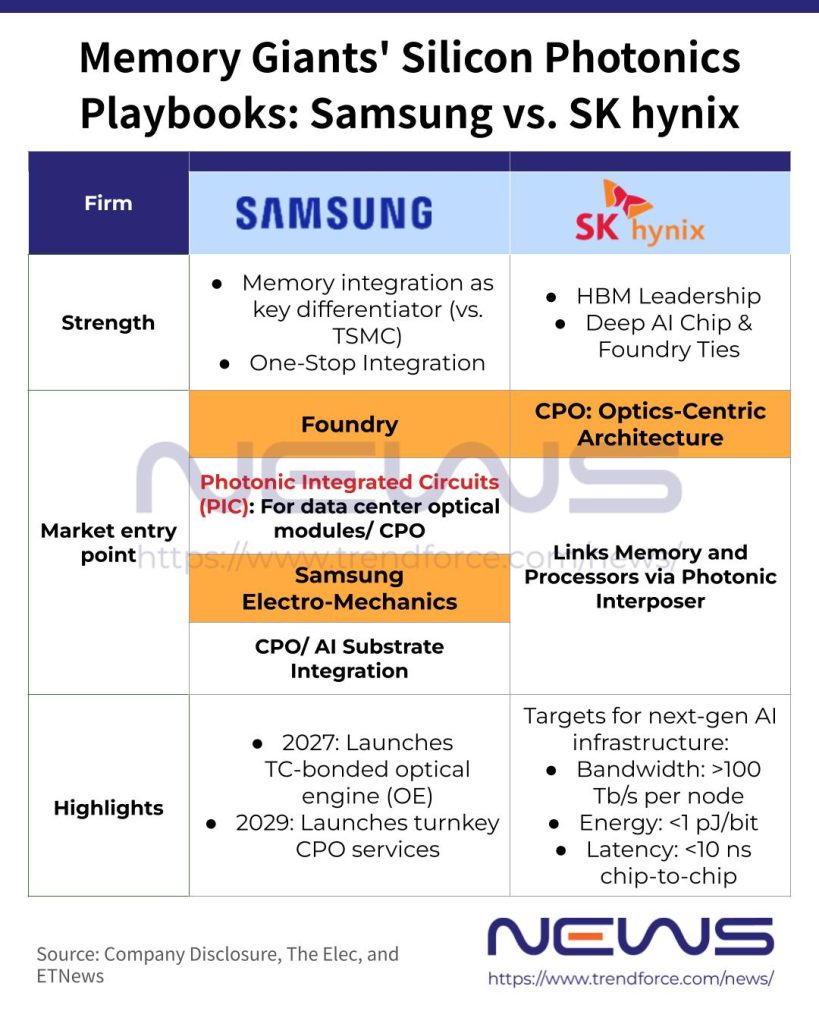
As highlighted by ZDNet, SK hynix’s paper also sets clear targets for next-generation AI infrastructure, including over 100 Tb/s bandwidth per node, sub-1 pJ/bit energy efficiency and chip-to-chip latency below 10ns. The roadmap spans 2D packaging, 2.5D interposers and 3D heterogeneous integration, while outlining key technical challenges on the path to commercialization, the report adds.
SK hynix’s Next Step in CPO
University of Virginia (UVA) Professor Kyusang Lee, who co-led the research with SK hynix, noted that optical interconnects are poised to become a foundational connectivity technology for next-generation AI infrastructure, and the technology has already moved beyond the lab and entered the early stages of commercialization. According to Lee, the research team will continue working with industry partners to push energy efficiency even further through innovations such as ultrathin photonic materials and massively parallel optical interconnects using microLED (µLED) technology.
Meanwhile, Seunghoon Hong, SK hynix AI Infra Team Lead, pointed to the company’s expanding role in AI infrastructure. As AI systems scale, Hong said optical interconnects will become increasingly critical, while memory makers are moving beyond component supply to become strategic partners in boosting customers’ overall system performance, with CPO emerging as a key technology.
Read more
- [News] TSMC Targets 2H26 COUPE on Substrate; NVIDIA Could Eye Long-Term Substrate Deals Amid CPO Push
- [News] Samsung Foundry Reportedly Wins Optical Module Order, Steps Up Silicon Photonics and CPO Drive
(Photo credit: SK hynix)