[News] China’s Dongfang Suanxin Unveils HBM-Free 14nm AI Chip, Claims Higher Memory Bandwidth Than NVIDIA H200
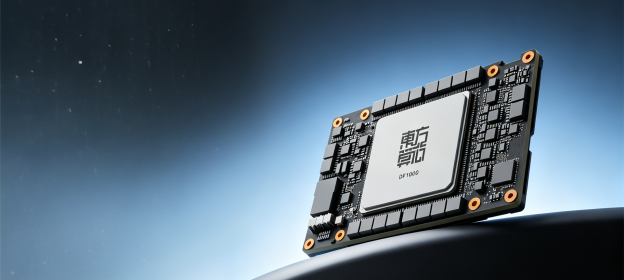
A Shanghai-based semiconductor start-up is betting on a new chip architecture to overcome U.S. restrictions on advanced chipmaking technologies. According to South China Morning Post, Dongfang Suanxin has outlined an ambitious strategy to challenge NVIDIA through an alternative chip architecture. The company says the approach could reduce reliance on advanced processes and cutting-edge HBM subject to U.S. export controls.
As the report notes, the company unveiled its flagship DF1000, a 14nm AI chip claimed to deliver 520 teraflops of BF16 computing performance, a standard widely used for training large AI models. According to the company’s specifications, the chip offers 6.4 TB/s of memory bandwidth and 900 GB/s of scale-up bandwidth for inter-chip communication. The company said the DF1000 is ready for mass production, with shipments expected by the end of 2026. Jiemian News adds that the entire DF1000 supply chain is domestically sourced.
For comparison, ICSmart notes that the DF1000 delivers approximately 52.6% of the per-chip computing performance of NVIDIA’s Hopper-based 4nm H100/H200. The report also claims that the chip performs more strongly in terms of memory bandwidth, reaching 6.4 TB/s—nearly twice that of NVIDIA’s H100 and approximately 33% higher than the H200.
Software-Defined Architecture and Near-Memory Computing
The chip follows a different technological path from mainstream AI processors. According to Jiemian News, Dongfang Suanxin founder Wei Shaojun said that amid restricted access to advanced processes, the company has adopted software-defined chips combined with 3D-stacked near-memory computing. The software-defined architecture increases hardware utilization through spatial parallelism and time-division multiplexing. It is paired with a 3D-stacked near-memory computing architecture that vertically integrates computing and memory units, allowing conventional memory to replace HBM while reducing memory and bandwidth bottlenecks through shorter interconnects.
Roadmap and Challenges Ahead
The company has outlined an ambitious roadmap to compete with NVIDIA. According to South China Morning Post, Dongfang Suanxin plans to launch the DF2000 in 4Q26, with the second-generation chip expected to deliver twice the performance of the DF1000 and surpass NVIDIA’s H200. A third-generation chip, the DF3000, is targeted for late 2027, with the company aiming to double performance again to compete with NVIDIA’s B300.
Despite outlining an ambitious roadmap, Wei acknowledged, as cited by South China Morning Post, that 3D stacking alone has its limitations. He said stacking multiple silicon layers often lowers manufacturing yields, while limited access to advanced nodes remains the domestic industry’s fundamental constraint and ultimate performance ceiling.
Dongfang Suanxin is backed by several prominent investors. According to Securities Times, the company reached a valuation of RMB 12.3 billion following its Series A+ funding round in April 2026. The report adds that shareholders include the National AI Industry Investment Fund, while investment funds affiliated with Meituan, Xiaomi, and Didi also participated in the financing.
Read more
- [News] Huawei Expands Tau Scaling Law V2 Paper, Highlighting LogicFolding Path to Ascend AI Chips in 2030
- [News] China’s Yuanjiwei Eyes 5nm-Equivalent Chips Without EUV by 2029, Debuts 2D Semiconductor Pilot Line
(Photo credit: Dongfang Suanxin)