[News] 15 New Integrated Circuit-Related Companies Established in China

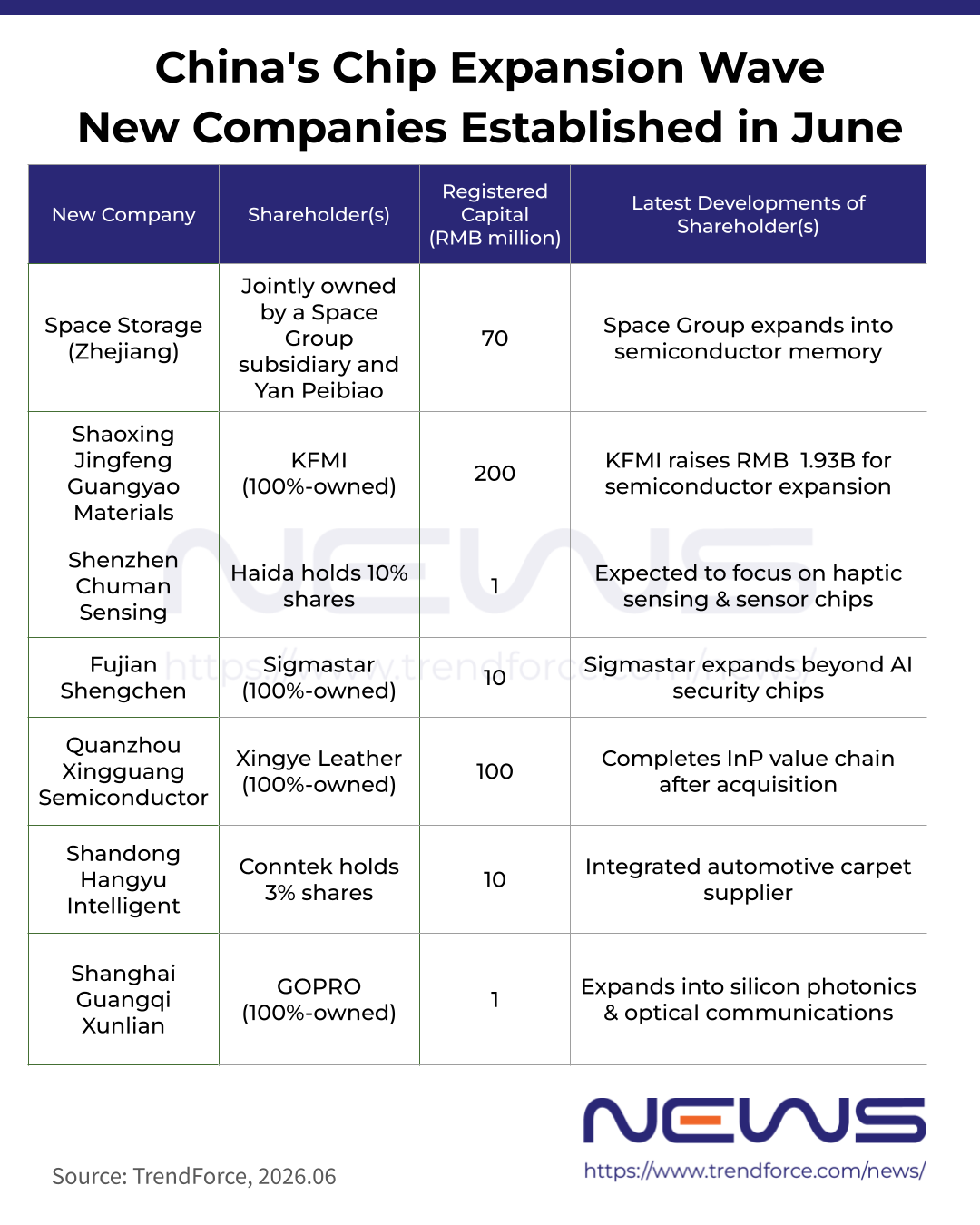
China’s integrated circuit industry saw a fresh wave of semiconductor expansion in the second quarter of 2026, driven by both cross-sector entrants and incumbent companies extending into adjacent businesses.
Companies including Konfoong Materials International (KFMI), Longsys, GOPRO, Sunlord, Chipsea, JoulWatt, and Innostar move further up the semiconductor value chain based on their existing technological strengths. Their newly established entities typically carry registered capital ranging from CNY 50-200 million and are often backed by private placements or strategic partnerships, underscoring clear technology synergies and well-defined commercialization roadmaps.
By contrast, iFLYTEK, Phancy, Haida, and Conntek are primarily application-driven, targeting AI foundation models, automotive electronics, and haptic technologies. These companies have entered the chip and computing hardware market through new subsidiaries or minority equity investments, with registered capital generally between CNY 10-20 million. Most retain relatively small ownership stakes—Haida, for example, holds just 10%—suggesting that these ventures are unlikely to make a meaningful earnings contribution in the near term and instead serve to strengthen broader ecosystem integration.
Meanwhile, Space Group, Hangzhou Hi-Tech Innovation Group, Xingye Leather, and Laplace—whose core businesses have limited overlap with semiconductors—have entered the sector through acquisitions, joint ventures, or major asset restructurings, highlighting a more opportunistic approach to diversification.
Recent developments surrounding these newly established companies and related investments point to three themes worth watching.
First is the commercialization of technology-driven capacity expansion. Whether KFMI can bring its electrostatic chuck production line into meaningful volume production, and whether Longsys can commercialize its general-purpose chip design platform by the end of 2026, will be key tests of the viability of their adjacent-growth strategies.
Second is the depth of AI-semiconductor integration. Whether Sigmastar’s multimodal SoC and Chipsea’s ] AI MCU can evolve from proof-of-concept products into large-scale commercial deployments could determine the next wave of growth in edge AI.
Third is the execution of ecosystem collaboration. Whether the JoulWatt–Innostar partnership can deliver an integrated power management and memory solution, and whether GOPRO can combine chip design with optical engine packaging into a one-stop offering for customers, will be critical in determining the long-term sustainability of their joint venture models.
(Photo credit: FREEPIK)