[News] South Korea Chip Export Volume Falls Yet Revenue Surges; May DRAM +370%, NAND +207%
Rising memory prices are creating an unusual divergence in South Korea’s semiconductor export data. As noted by Seoul Economic Daily, export revenue is rising sharply even as export volume by weight declines, highlighting growing demand for lightweight, high-value chips such as HBM.
As the report notes, according to data released by the Korea International Trade Association (KITA), semiconductor export volume totaled 3,242 tons in April, down 11.9% from a year earlier. Export volume also recorded year-over-year declines in February and March. In contrast, semiconductor exports reached US$31.895 billion (approximately KRW 47.98 trillion) in April, up 173.5% from a year earlier. While export volume declined by more than 10% on a weight basis, export revenue rose to more than 2.7 times the level recorded a year earlier.
The report notes that memory products account for roughly 75% of South Korea’s semiconductor exports, far exceeding the shares of system semiconductors (20%) and wafers/components (5%). As a result, memory price movements have a significant impact on overall export performance.
Strong memory demand continued to drive South Korea’s semiconductor exports higher. According to KITA data, DRAM exports reached US$18.6 billion in May, up 369.8% from a year earlier, while NAND exports rose 206.8% to US$1.7 billion.
The trend appears to be extending into June. According to Maeil Business Newspaper, strong semiconductor demand helped lift South Korea’s exports to a record US$28.6 billion in the first ten days of the month, up 85.9% from a year earlier and surpassing the previous high of US$25.2 billion recorded in April.
Semiconductor exports, led by Samsung Electronics and SK hynix, increased roughly 30% from the same period last month. Exports to China jumped 101.4%, marking the strongest growth among major export destinations, as noted by Maeil Business Newspaper.
Higher-Value Memory Drives More Value from Less Volume
Measured by weight, the improvement is even more pronounced. According to Seoul Economic Daily, the semiconductor industry generated 3.1 times more export value per unit of weight than a year earlier, driven primarily by next-generation server DRAM and HBM products.
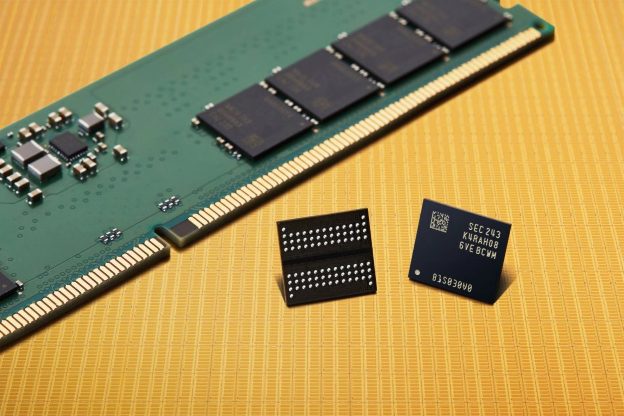
The report notes that fixed contract price of a server-grade DDR5 16Gb (4800/5600) DRAM chip recently reached US$42 (approximately KRW 63,000), up sevenfold from US$6 a year ago. At roughly 0.2 grams each, the chips are valued at about KRW 315,000 per gram, well above the roughly KRW 220,000 per gram price of pure gold. The report notes that this allows semiconductor exporters to maintain strong profitability even as shipment volumes decline.
Meanwhile, with capacity constrained, chipmakers are increasingly prioritizing higher-margin products such as HBM. The report notes that shifting production from DDR4 to higher-value memory like HBM3E and DDR5 can reduce shipment volume and export weight while boosting export revenue. An industry source said the trend reflects a move toward more profitable products amid tight supply rather than weakening demand.
The trend is also evident in memory makers’ capacity plans. TrendForce estimates that HBM wafer input at the three leading suppliers will account for approximately 18%, 22%, and 30% of total DRAM wafer input by the end of 2025, 2026, and 2027, respectively.
Read more
- Tight DRAM Supply Gives Suppliers Greater Pricing Power in HBM, with HBM Contract Prices Expected to Surge Multiples Higher in 2027, Says TrendForce
- [News] SK hynix to Supply Memory for NVIDIA Vera CPU as Partnership Deepens; Samsung Meeting in Spotlight
(Photo credit: Samsung)