[Sponsored Content] OpenClaw’s Popularity Ignites the AI Agent Trend: Advantech and D8AI Join Forces to Lower Barriers and Accelerate Enterprise Adoption
The open-source AI assistant OpenClaw—popularly known as “Lobster”—has recently sparked a craze across the internet, with users rushing to “raise” their own AI Agents. Simultaneously, at the GTC conference, NVIDIA CEO Jensen Huang unveiled NemoClaw, an open-source framework for AI agents, predicting that traditional software and apps will be gradually replaced by AI Agents in the coming years. As AI Agents move from tech circles into mainstream applications, a critical question arises: “Can AI Agents truly be applied in enterprises to solve real-world problems?”
Dr. Hsiung Hui, Chairman of D8AI—one of the few Taiwanese firms specializing in enterprise AI services—draws from frontline experience to break down the key path for companies to adopt AI Agents.
From “Answering” to “Acting”: The Inevitable Evolution of AI Agents
A decade ago, AlphaGo’s victory over Lee Sedol marked a new chapter for AI. In 2017, the Transformer architecture was born, laying the foundation for modern Large Language Models (LLMs). BERT followed, enabling AI to understand human language, and ChatGPT brought conversational capabilities. AI has steadily evolved from comprehension to generation.
Reflecting on this evolution, Dr. Hsiung stated: “The emergence of AI Agents is not an accident; it is the inevitable result of AI development.”
Founded in 2017, D8AI entered the then-immature field of Natural Language Processing (NLP). Hsiung noted that by 2024, the industry began to realize that simply answering questions is not enough. AI must be able to handle automated workflows to truly meet commercial and industrial needs—driving the rise of AI Agents.
Hsiung believes the core of an AI Agent is “process automation.” The popularity of OpenClaw brought this concept into the public eye. Its success lies not in technical innovation, but in User Experience (UX). By using a familiar chat interface (similar to LINE or WhatsApp), maintaining memory of user interactions, and proactively executing tasks, it makes AI feel like a persistent assistant. “These technologies have existed for a while, but OpenClaw made AI Agents accessible to everyone,” he emphasized.
However, when this model enters a corporate setting, new challenges surface.
Enterprise AI Agents: A Different Technical Track
The biggest difference between an enterprise and an individual user is that enterprises cannot afford to make mistakes.
Adopting AI Agents in a business context requires satisfying three criteria: Accuracy, Reliability, and Security. The challenge of accuracy stems from the nature of Generative AI—LLMs are essentially probabilistic models that predict the next word, making “hallucinations” unavoidable. Hsiung pointed out: “A slight error in a travel recommendation is fine, but in a banking or legal scenario, a 0.1% error can result in massive losses.”
Regarding reliability, enterprise systems must run 24/7 without downtime. For security, sectors like finance and government often require on-premise deployment due to strict data privacy regulations. These factors make enterprise AI Agent implementation far more complex than consumer apps.
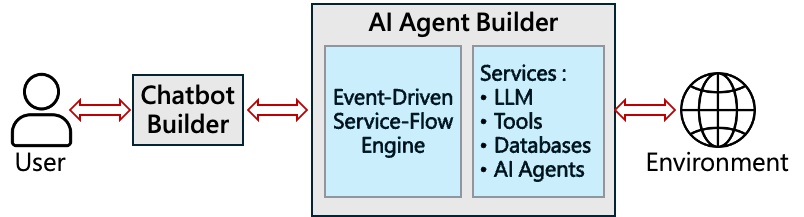
Many AI Agents use LLMs as the “brain” for planning and decision-making. Hsiung believes this is the root of most errors: “The more complex the process, the more steps the LLM has to guess, increasing the cumulative chance of failure.” Instead, D8AI utilizes a different path: digitizing existing SOPs and using a deterministic process framework to command the AI, rather than letting the model decide the steps. In this architecture, the LLM is treated as a tool to be called upon only when needed. He stated bluntly: “Corporate processes are inherently fixed; there is no need for AI to guess what to do next.”
To lower the barrier to entry, D8AI developed a visual “AI Agent Builder Platform,” allowing companies to build workflows via a drag-and-drop interface without writing code. The platform also incorporates a “Human-in-the-loop” mechanism, ensuring that human staff can intervene and verify AI actions within a controllable range.
D8AI Agent Builder:
General Agent:
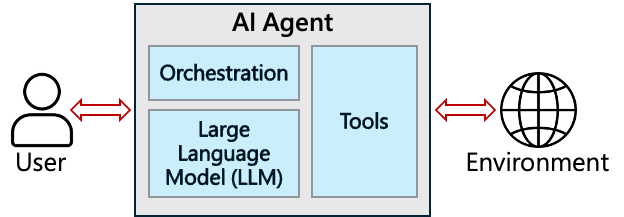
▲ Architectural differences between a general AI Agent and a D8AI Enterprise AI Agent. (Source: Provided by D8AI)
A New Future Driven by AI Agent Technology
Rapid shifts in technology have drastically improved development efficiency. Hsiung recalled a 2022 collaboration with the New Taipei City Fire Department to develop a virtual assistant for 119 dispatchers, which won a Smart City Innovation Award. At the time, such a system took six months to a year to develop. Today, he estimates that an application of similar complexity can be completed in just a few weeks, significantly reducing costs and time-to-market.
However, Hsiung stressed: “The core value of an AI Agent is not to replace people, but to increase overall productivity.”
Citing government and banking clients, he noted that AI customer service hasn’t reduced headcount but has significantly increased service volume by filling gaps during off-hours. “People who wanted to inquire at midnight simply couldn’t get service before; now they can.”
This model extends to retail and healthcare. In retail, AI Agents can provide precise recommendations based on weather, location, and sales data. In healthcare, they assist with patient follow-ups and post-operative care. In the content industry, AI Agents can automate the entire newsletter production process—from data collection and summarization to layout and distribution.
Lower Hardware Costs: AI Landing for SMEs
Historically, high hardware costs were a major barrier to AI adoption. However, the rapid advancement of open-source models has changed the landscape. Hsiung noted that while there used to be a massive gap between open-source and top-tier proprietary models, architectural optimizations in the past year have allowed small models to rival the performance of large ones. This means not every company needs a massive data center or million-dollar chips to run AI.

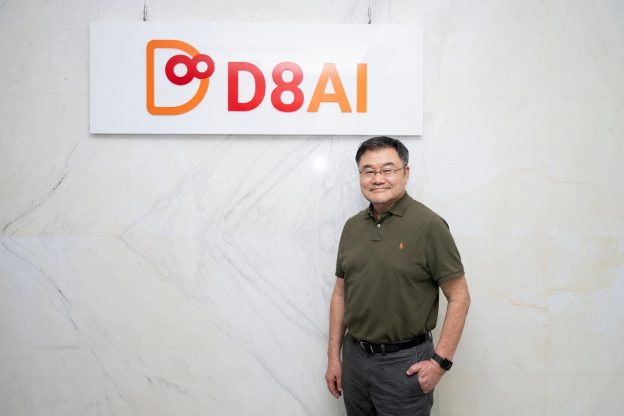
▲ Dr. Hsiung Hui, Chairman of D8AI, states that with a single NVIDIA RTX PRO 6000-class graphics card, enterprises can now run AI Agents capable of practical applications. (Source: TechNews)
In practice, to lower the threshold, D8AI and Advantech launched the “AI in Box”—an integrated hardware-software solution for on-premise deployment. It utilizes the Advantech HPC-7485 server paired with NVIDIA RTX PRO 6000 Blackwell Workstation Edition GPUs. This setup provides enterprise-grade computing power at an affordable price point. On the software side, D8AI’s visual interface allows companies to import internal data and build custom knowledge management systems and AI Agents through no-code tools.
By building knowledge bases from first-hand data, companies can continuously accumulate expertise to serve customers and train employees, all while keeping data on-site to eliminate the risk of leaks.
Moving Beyond “Cost-Cutting”: Finding Growth in Efficiency
“Many companies adopt AI out of FOMO (Fear of Missing Out) or a desire to simply cut costs,” Hsiung observed. However, he believes transformation should focus on value creation. Rather than blindly following trends, he suggests companies list their “top ten most inefficient tasks” and consider how AI can solve those specific labor-intensive bottlenecks.
He encourages leaders to look past initial hardware costs and focus on ROI. If AI can solve a single repetitive, high-labor core pain point, the value and competitive advantage it generates will far outweigh the initial investment.
The era of the AI Agent has arrived. With the wave of open-source models and mature hardware solutions, the barrier to entry has dropped significantly. AI Agents are no longer just personal assistants for booking flights or “arms races” for tech giants; they have become essential tools for businesses of all sizes to boost digital competitiveness. Advantech and D8AI’s “AI in Box” aims to turn AI from a concept into a tangible productivity tool, forming the new foundation for the digital age.
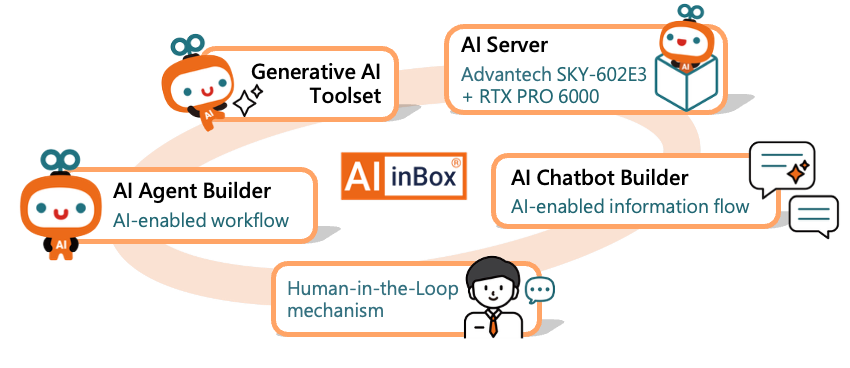 ▲ Enterprise-grade AI hardware–software integrated solution jointly developed by D8AI and Advantech. ( Source:D8AI)
To learn more about Advantech AI solutions ▲ Edge AI Systems – Advantech
To consult with an Advantech expert ▲ Contact Us
(Cover Photo: TechNews)