[News] Select DDR5 Kits Reportedly Slide Over 20% in U.S. Retail Amid Google’s TurboQuant Debate
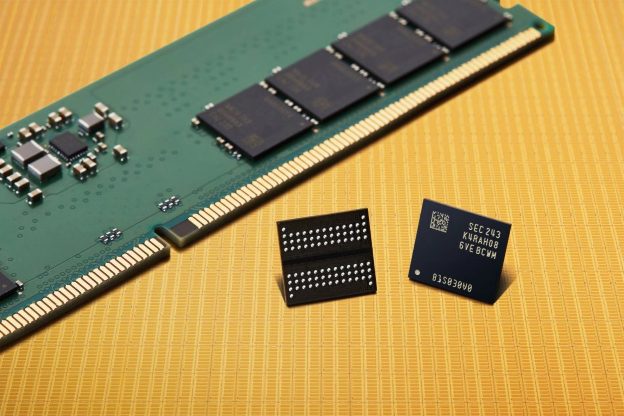
After months of relentless gains, the memory market might be showing early signs of a turning point. According to Wccftech, DDR5 prices have recently started to ease across several major U.S. retail channels, with some kits now trading more than 20% below their recent peak.
In particular, the report notes that Corsair’s VENGEANCE 32GB DDR5 kit has declined to about $379.99—more than 20% below its recent peak of $490—while 16GB modules have also been adjusted downward from $260 to $219.99.
The recent price weakness has been partly linked to Google’s “TurboQuant,” a training-free compression technique that is said to reduce KV cache memory usage by at least sixfold, according to IT Chosun and Wccftech.
While KV cache is widely regarded as one of the key bottlenecks in large language model (LLM) inference, the reports suggest that if TurboQuant is eventually commercialized at scale, it could significantly reduce the overall memory capacity required for AI infrastructure.
Given the steady upward trajectory of DDR5 prices driven by expanding demand from AI servers, the recent downturn is being viewed as a notable shift in market sentiment, IT Chosun adds.
Still at Historical Highs
However, as highlighted by Tom’s Hardware, high-capacity memory kits—particularly DDR5—are among the most severely supply-constrained segments, often commanding significant price premiums amid persistent shortages.
Reflecting this supply-demand imbalance, even though pricing has seen revisions lately, DDR5 prices still remain elevated: the report suggests that over the past quarter, prices have surged dramatically, in some cases tripling or even quadrupling. For example, a standard 32GB (2×16GB) DDR5 kit, which was priced in the $100–$200 range in October 2025, now starts at around $350.
Is a Memory Price Downturn Really Emerging?
Against this backdrop of still-elevated prices, the key question becomes whether the recent softness marks the beginning of a genuine correction—or merely a temporary blip. As cautioned by IT Chosun, the recent softness in DDR5 pricing has been confined to select product segments, while underlying demand—particularly for high-performance server memory—remains fundamentally strong.
Furthermore, the report highlights that memory pricing is shaped by a range of factors beyond simple demand dynamics, including inventory conditions, supplier output strategies, and discount policies across distribution channels. Against this backdrop, it cannot be ruled out that the current decline is merely a temporary adjustment or a promotion-driven fluctuation rather than a sustained trend, according to IT Chosun.
In terms of the impact of Google’s TurboQuant on memory, Morgan Stanley points out that the technology does not affect model weights (HBM usage on GPUs/TPUs) or training workloads. Instead, it allows systems to handle 4–8x longer context windows or significantly larger batch sizes on the same hardware without running out of memory. In other words, it is less about reducing total memory needs and more about improving efficiency.
Read more
- [Insights] Memory Spot Price Update: DRAM Spot Momentum Constrained as March Contracts Hold, DDR4 Weakest
- [News] While DDR5 Margins Reportedly Surpass HBM: What’s Next for Memory Giants?
(Photo credit: Samsung)