[News] First Look at ZAM: SAIMEMORY Unveils Memory to Address Thermal Issues at Intel’s Japan Event
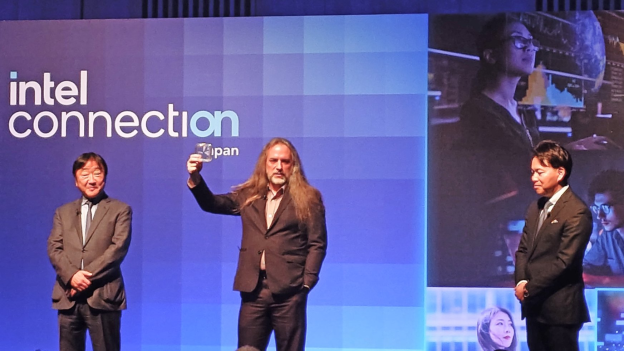
Shortly after Intel announced the partnership with SoftBank’s subsidiary SAIMEMORY to develop Z-Angle Memory (ZAM), the product made its first public appearance when SAIMEMORY unveiled it at Intel Connection Japan 2026 on February 3, PC Watch reports.
Notably, while the full impact of ZAM versus HBM remains to be seen, early reports hint at some game-changing advantages. Wccftech notes the memory could cut power use by 40–50%, streamline production with Z-Angle interconnects, and pack up to 512 GB per chip. Intel added in a blog post that prototypes are slated for 2027, with a full-scale rollout expected by 2030.
According to PC Watch, SAIMEMORY—founded in December 2024 and officially launched in June 2025—is a joint venture between SoftBank, Intel, and the University of Tokyo. At Intel Connection Japan 2026, the company, led by President and CEO Hideya Yamaguchi, unveiled ZAM, a next-generation memory designed for the AI market.
The event also drew top Intel executives, including Fellow and CTO of Intel Government Technologies Joshua Fryman and Intel Japan CEO Makoto Onho, Wccftech reports.
Breaking Memory Limits
PC Watch elaborates more details on the product, noting that while traditional memory has been built using a planar stacked structure, this approach is reaching its limits due to power and heat constraints. Current designs have already pushed 16 layers close to the maximum, with 20 layers considered the upper limit, the report notes.
In contrast, ZAM—named after the Z-axis—stacks dies vertically. As explained by PC Watch, this design promises lower power consumption, higher capacity, and wider bandwidth compared with conventional DRAM. By stacking dies vertically, heat from each die is conducted upward evenly, addressing thermal challenges that have long plagued planar stacking, the report suggests.
Echoing this, Wccftech, citing Intel, notes that this architecture’s primary advantage lies in its superior thermal management.
For now, the new memory product under development is expected to leverage Intel’s Next Generation DRAM Bonding (NGDB) initiative, according to EE Times Japan. A January update from Sandia National Laboratories explained that today, high-bandwidth memory often trades improved bandwidth for lower performance in other areas, like capacity. NGDB, on the other hand, aims to remove much of this tradeoff, bridging the gap between HBM and conventional DDR DRAM while delivering significantly better energy efficiency.
It is worth noting that Intel may not be the only global partner for SAIMEMORY. According to PC Watch, SAIMEMORY emphasizes its strong partnerships, including collaboration with SoftBank and Intel, as well as a network of domestic and international investors and supply chain partners.
Read more
(Photo credit: Intel Japan’s X)
Please note that this article cites information from PC Watch, Wccftech, EE Times Japan, Sandia National Laboratories and Intel.