[News] Microsoft Vows Greater Push for In-House Chips to Cut NVIDIA Reliance Amid Development Concerns
As cloud giants push forward with self-designed AI hardware to cut reliance on NVIDIA, Microsoft is aiming high. According to CNBC, the tech giant plans to increasingly use its own custom silicon in data centers, with the long-term goal of relying primarily on its in-house chips.
Speaking at Italian Tech Week, Microsoft CTO Kevin Scott told CNBC the company isn’t married to any single processor. While NVIDIA has delivered the best price-performance for years, Scott emphasized Microsoft is open to “literally anything” to ensure it has enough compute capacity to meet surging AI demand.
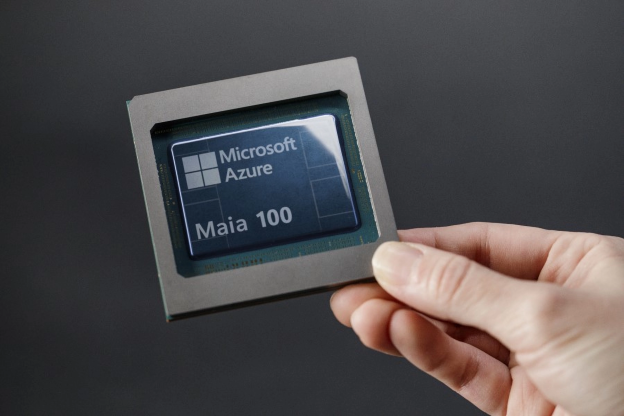
Scott reportedly emphasized that Microsoft aims to lean more on its own custom processors in data centers, a move that could reduce reliance on giants like NVIDIA and AMD. CNBC notes the company is already on that path: in 2023, it launched the Azure Maia AI Accelerator for AI workloads and the Cobalt CPU.
On the other hand, Microsoft is even working on other next-generation semiconductors which could be leveraged in the AI era. Last week, the company showcased new “microfluid” cooling technology aimed at tackling chip overheating. According to its press release, Microsoft’s lab-scale tests showed microfluidics performed up to three times better than cold plates at removing heat, depending on workloads and configurations involved.
Microfluidics also reduced the maximum temperature rise of the silicon inside a GPU by 65 percent, though this will vary by the type of chip, the company stated.
Chip Ambitions Hitting a Snag?
However, concerns have emerged over Microsoft’s AI chip roadmap. In July, Wccftech, citing The Information, reported that Microsoft is delaying its AI chip plans and intends to launch an interim chip in 2027, likely called Maia 280, which is expected to pair two Braga chips for a performance boost. Braga itself was designed to succeed Microsoft’s April 2024 Maia chip, built on TSMC’s 5nm process, Wccfech noted.
TrendForce observes that Microsoft still primarily relies on NVIDIA GPU-based solutions for its AI infrastructure, while progress on its in-house ASIC development has remained relatively slow. Its next-generation Maia chips are expected to begin ramping up in 2026, according to TrendForce.
Read more
- [News] Microsoft Reportedly Eyes 2027 Interim AI Chip Amid In-House Design Delays and NVIDIA Pressure
- Geopolitical Tensions and US Export Restrictions Slightly Temper AI Server Shipment Growth in 2025, Says TrendForce
(Photo credit: Microsoft)
Please note that this article cites information from CNBC, Wccftech, The Information, and Microsoft.