[News] Applied Materials Reportedly Flags Minimal Effect of U.S. Incentives, Offers Nuanced View on China
While TSMC, Samsung, and other semiconductor giants ramp up U.S. investments under the government’s reshoring push, chip equipment leader Applied Materials is taking a different stance. According to Wccftech and Investing.com, CFO Brice Hill noted at the Deutsche Bank Tech Conference that U.S. incentives are having minimal impact.
As Wccftech highlights, the company downplays the impact of U.S. incentives. According to the transcript from Investing.com, Hill said that “at the highest level, demand is driven by PCs, data centers, smartphones, and all that those incentives do is have a customer instead of building in Taiwan, they’re going to build in the U.S. So the view was it mattered a little bit at the margin, but it didn’t matter in total.”
Still, as Wccftech points out, Applied Materials plans to pour roughly $200 million into its Arizona operations, adding to over $400 million already invested in the U.S. to expand domestic manufacturing capacity.
China Headwinds Loom
Applied Materials had previously warned of a fourth-quarter revenue dip, citing weak demand in China and erratic orders amid tariff-related uncertainty, Reuters reported. At the recent Deutsche Bank Tech Conference, the company offered more insight.
According to Investing.com, CFO Brice Hill expected Applied’s 2026 growth to be powered by AI in DRAM and leading logic, along with rising demand for advanced packaging. The main headwinds, he noted, remain China’s mature-node market—14nm and larger analog chips used in IoT, communications, automotive, and power sensors.
As Hill explained, despite strong end-market growth, China’s heavy investments in 2023–2024 have built up ample capacity, and while Applied Materials is still adding customers and expanding capacity, growth will remain modest over the next few quarters.
Notably, as per Investing.com, Hill cautioned that “with policy, trade, and tariff uncertainties, customers often wait until the last minute to place orders.” In early 2025, Applied Materials saw $400 million of backlog went unfulfilled due to entity-listed customers in China, reflecting share losses tied to U.S. regulations, Bloomberg reported.
Hill also reportedly observed that while recent years saw China’s semiconductor expansion focus on mature nodes—40nm, 45nm, and 60nm—much of the growth over the next few years is expected to shift to 28nm. With a strong 28nm footprint, Applied Materials anticipates many new customers will adopt the same equipment sets used by major foundries, giving the company a strategic advantage, he added.
China’s share of Applied’s sales, as per its press release, jumped to 35% in Q3 FY2025 (ended July 27) from 25% in the previous quarter, underscoring the company’s reliance on the market.
Strong momentum at 2nm, GAA tools
With major clients TSMC and Intel (18A) set to enter 2nm mass production by year-end, Applied Materials CFO Bryce Hill, cited by Investing.com, projected around 300,000 wafer starts per month for gate-all-around (GAA) nodes—larger than previous generations. He reportedly described 2nm as a “good landing spot,” expected to attract more designs and deliver greater scale, unlike interim nodes such as 10nm.
According to Hill, Applied Materials sold $2.5 billion in GAA equipment in 2024 and project $4.5 billion in 2025—totaling $7 billion, or 50% of its $14 billion SAM (Serviceable Available Market) figure.
Read more
- [News] Applied Materials Warns of Q4 Revenue Drop on China Slowdown, Tariff Worries
- [News] Applied Materials Faces $400M Revenue Loss as Part of Maintenance Services Halted in China
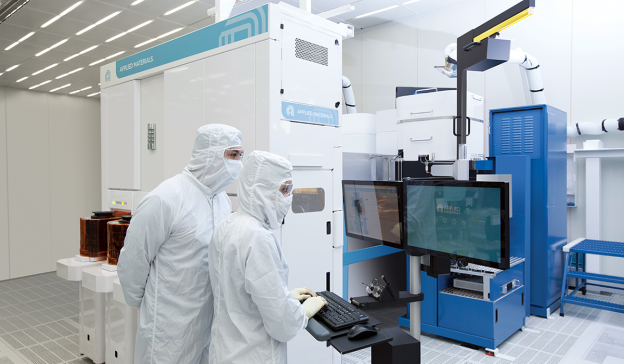
(Photo credit: Applied Materials)
Please note that this article cites information from Wccftech, Investing.com, Reuters, Bloomberg, and Applied Materials.