[Sponsored Content] When AI Is No Longer Just a Model: Advantech and Spingence Build a Practical “Closed-Loop Path” for AI Deployment
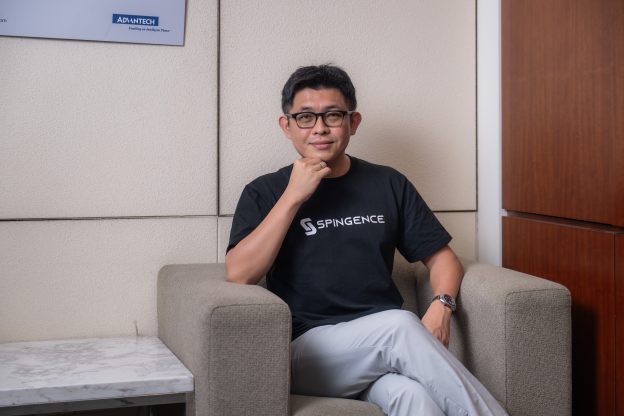
While most enterprises are still discussing whether they should adopt AI, some pioneers have already stepped onto factory floors and into real-world operations to tackle a far more practical question: how can AI truly become affordable, sustainable, and genuinely useful?
Advantech and Spingence are among those leading this journey. Originally rooted in factory automation integration services, Spingence has long been a hands-on practitioner in industrial AI transformation. Closely following the rapid evolution of AI technologies, from lightweight CNN models to LLMs, agentic AI, and now Physical AI, the company has continuously transformed emerging technologies into practical tools, and then brought those tools into real industrial environments.
Through its deep collaboration with Advantech, Spingence is now attempting something even more transformative: building an AI deployment closed loop that can be replicated, scaled, and continuously self-optimized.
Helping Customers Discover and Solve Problems Together — Lowering the Barriers to AI Defect Inspection Adoption
Founded in 2015, Spingence emerged at the perfect moment when CNN and GPU technologies were rapidly converging. Recognizing the potential of AI in manufacturing, the company fully committed to AI-powered defect inspection as early as 2016.
According to Spingence CEO Jesse Chen, while AI appears powerful in theory, there remains a significant gap between technology and real-world value creation. For most enterprises, emerging AI technologies are still unfamiliar territory. Whether discussing CNNs, LLMs, or AI Agents, customers ultimately share the same goal: solving real operational problems.
For this reason, Spingence initially positioned itself as more than just a technology provider. The company took on the role of an AI evangelist, guiding customers on how to leverage AI effectively to address their own challenges. More importantly, Spingence continued to work alongside customers throughout the process — identifying problems together, solving them collaboratively, and ultimately building highly accurate and stable AI defect inspection models. In doing so, the company became a crucial bridge helping manufacturers successfully adopt next-generation technologies.
Years of accumulated experience eventually evolved into AINavi — a platform designed not simply to “perform inspections,” but to fundamentally redesign the entire AI deployment workflow. From image labeling and model training to parameter tuning, AINavi transforms processes that once heavily relied on manpower and experience into standardized and automated operations. What previously required up to eight months of implementation can now be completed in as little as six weeks.
In the second half of 2023, the upgraded version of AINavi introduced new features that significantly lowered adoption barriers, accelerated deployment timelines, and optimized software workflows. This enabled manufacturers to move beyond standardized AI applications toward more customized implementations tailored to specific production needs.
Today, AINavi has been successfully deployed across precision manufacturing sectors including semiconductors, connectors, and automotive electronics. In 2025, Spingence further expanded its impact by entering a comprehensive partnership with a globally leading thermal solutions manufacturer, enabling real-time inspection of 20,000 to 40,000 high-end products per month. This represents not only a leap in operational efficiency, but also the beginning of a new definition of manufacturing quality.
Seamless On-Premises LLM Deployment Unlocks the Full Potential of Multi-Agent Autonomous Decision-Making
As generative AI enters the enterprise world, the first challenge is often not the technology itself, but trust. Can companies safely hand their data over to AI? Can AI truly participate in decision-making processes? For many enterprises, these questions remain difficult barriers to overcome.
Recognizing this challenge, Spingence chose a different path — keeping AI within the enterprise environment. Through its Edgestar platform, businesses can deploy LLMs on-premises, balancing both performance and security while maintaining full control over how AI operates.
On manufacturing lines, Spingence enables CNN models to first “identify defects,” while LLMs further analyze, interpret, and provide real-time feedback to frontline personnel. AI is no longer just a supporting tool; it becomes part of the decision-making process itself, transforming smart manufacturing from a concept into operational reality.
To further improve AI accuracy, Spingence also leverages AI-driven synthetic data generation technologies to address the challenge of insufficient training data in specific scenarios. By augmenting models with generated datasets, the company successfully enhanced model capabilities. In one connector manufacturing case, the solution not only overcame inspection difficulties caused by products of different colors, but also improved inspection accuracy by 20% while reducing model evaluation time by 25%.
As AI capabilities continue to evolve, its role within organizations is changing as well — from a supportive assistant to an autonomous AI Agent capable of taking action independently. This shift introduces a new challenge for enterprises: how to balance efficiency with operational risk.
By combining the Edgestar on-premises model deployment platform with RAG (Retrieval-Augmented Generation) technology, AI systems can securely access and utilize internal enterprise knowledge within a protected framework. This enables applications such as contract review and other knowledge-intensive workflows, delivering faster and more accurate decision-making.
Building on this foundation, a Multi-Agent architecture allows enterprises to orchestrate multiple AI agents with specialized responsibilities, enabling collaborative problem-solving, improving operational efficiency, and enhancing decision-making flexibility. In this model, AI evolves beyond a standalone tool and becomes a true organizational capability.
Advancing Toward “Simulator-to-Real”: Minimizing the Cost of Trial and Error
Following the launch of the NVIDIA Omniverse™ platform, digital twin technology — once largely limited to conceptual demonstrations and dashboard-style “Real-to-Simulator” applications — has entered a new era of “Simulator-to-Real” deployment. Under this framework, Physical AI systems can first undergo large-scale training and simulation in virtual environments, continuously refining and optimizing behavioral strategies before being deployed into real-world operations. This approach provides a new solution for digital twin applications that were previously constrained by high costs, long development cycles, and limited scalability.
Building on this trend, Spingence introduced SpinZone, a virtual-physical integrated development platform powered by NVIDIA Omniverse and the Cosmos world model. The platform helps enterprises rapidly create virtual environments such as 3D digital factories, while enabling the configuration of physical parameters including dimensions, weight, and material properties, allowing simulations to more accurately reflect real operational conditions.
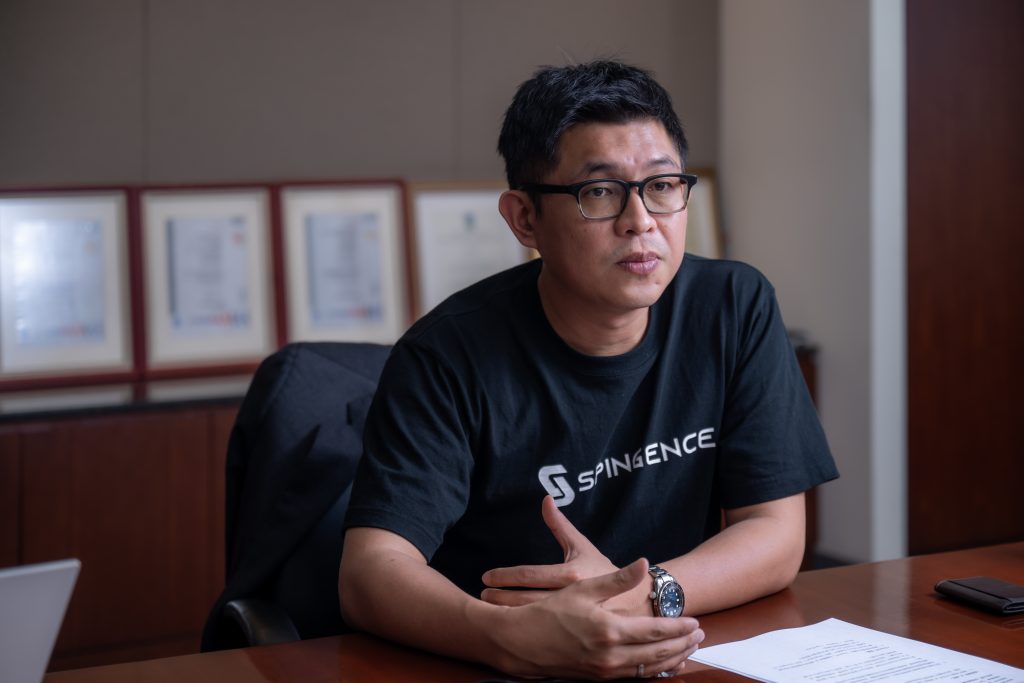
To support a globally leading thermal solutions manufacturer in its international expansion and factory construction initiatives worldwide, Spingence partnered with Advantech to launch a digital twin modeling project.
For example, in the United States, factory construction faces significant regulatory and labor-related challenges, making the cost of trial and error extremely high. Poor factory design or construction mistakes can lead to severe financial losses if flaws are only discovered after the facility has already been built. Through NVIDIA Omniverse technologies, Spingence successfully created highly realistic factory equipment models and simulated optimal workstation layouts and production workflows. This not only enabled the customer to execute its factory expansion plans more effectively, but also helped establish a scalable best-practice model for future facility development.
Beyond manufacturing, Spingence and Advantech have also expanded Physical AI applications into smart retail environments. Together, they assisted Unicorn in testing and training service robots within a virtual retail environment before successfully deploying them into physical stores for replenishment and inventory arrangement tasks.
Through repeated simulation and real-world validation, the collaboration significantly reduced the gap between virtual and physical operations, further demonstrating the practical feasibility of Physical AI in retail automation.
Perfectly Aligned with NVIDIA’s “Three Computers” Vision: Spingence Empowers Enterprises Through Three Core Business Divisions and Solutions
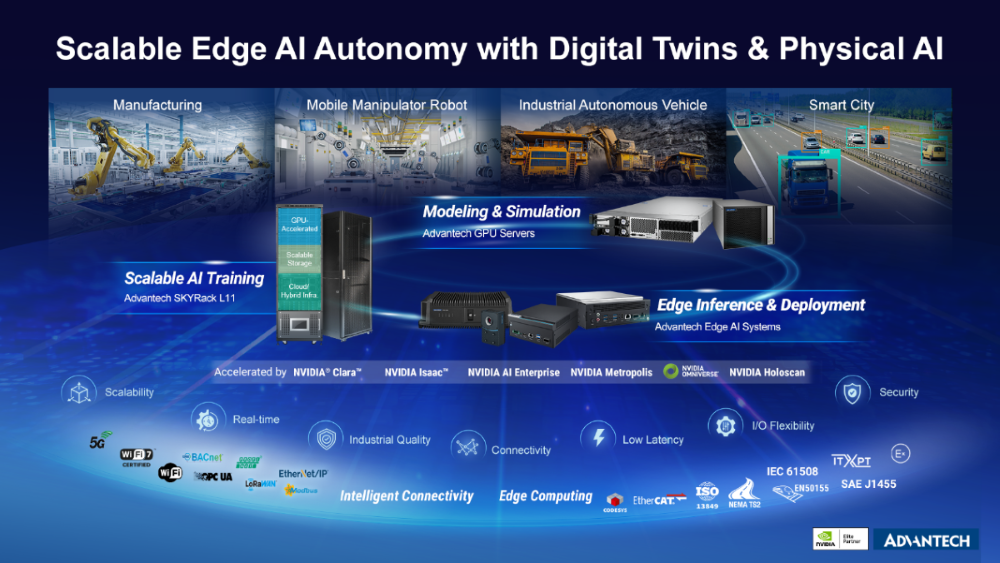
To accelerate the development of the Physical AI and robotics ecosystem, NVIDIA introduced its “Three Computers” solution framework, establishing a complete AI infrastructure spanning training, simulation, and deployment. Within this architecture, DGX supercomputers are responsible for AI model training, NVIDIA Omniverse and RTX PRO servers handle virtual simulation and validation, while NVIDIA® Jetson Thor™ edge devices deploy AI into real-world environments — forming a complete pipeline from “AI learning” to “on-site decision-making.”
According to Jesse, the first step toward effective AI adoption is not the model itself, but data organization — especially the fragmented data distributed across different factory machines. More importantly, breaking down the information silos created during manufacturing automation and intelligent transformation requires more than additional equipment; it requires a complete AI infrastructure. NVIDIA’s “Three Computers” framework serves as an ideal reference architecture for building such a foundation.
To align with this framework, Spingence developed SPAK (Spingence Physical AI Kernal), an on-premises full-stack AI platform specifically designed for manufacturing environments. Through an integrated and highly compatible AI architecture, SPAK aims to help enterprises achieve autonomous AI-driven smart factory operations.
To further expand these solutions, Spingence completed a brand strategy upgrade in 2024 and officially established three core business divisions:
- The AI Adoption Enabler Division, focused on precision manufacturing defect inspection and accelerating practical AI deployment directly on production lines.
- The Edge AI Accelerator Division, dedicated to building enterprise-specific on-premises AI infrastructure.
- The Innovation Division, focused on enabling virtual-physical AI integration for smart factories.
These three divisions correspond respectively to Spingence’s core platforms — AINavi, Edgestar, and SpinZone, collectively supporting NVIDIA’s “Three Computers” architecture.
Together, the platforms create a continuous AI workflow in which synthetic data generated through simulation trains vision models, visual inspection systems collect operational data for language models to analyze and make decisions, and those insights are then fed back into the simulation environment for further optimization. Through this cycle, AI capabilities continuously evolve over time, gradually forming a sustainable and self-optimizing AI closed-loop system.
Jesse further emphasized that the true value of a “simulation-first” strategy lies in its real-world impact. The higher the cost of trial and error in decision-making, the more valuable simulation becomes. In high-risk scenarios such as overseas factory construction, virtual simulation enables enterprises to validate plans in advance, significantly reducing physical errors and resource waste, while allowing AI to become a reliable foundation for enterprise decision-making.
Advantech and Spingence Join Forces to Maximize the Synergy of Deep Software-Hardware Integration
As AI architectures continue to mature, the final piece of the puzzle is reliable deployment. Beyond Spingence’s software solutions, Advantech provides the critical hardware foundation that enables stable real-world implementation.
From the NVIDIA® Jetson T5000™ -powered MIC-743 edge computing platform, to the SKY-622G4 GPU server supporting NVIDIA Omniverse simulations — capable of supporting up to four NVIDIA RTX PRO™ 6000 Blackwell Server Edition GPUs — as well as the integrated SKYRack AI infrastructure, Advantech enables AI workloads to scale from real-time production line decision-making to virtual simulation and large-scale computing. This allows AI to operate seamlessly within enterprises’ everyday operations.
Through years of collaboration, Spingence and Advantech have evolved beyond simple technology integration. Instead, they function as deeply connected partners that continuously validate and optimize solutions across diverse industrial environments. Starting from real production line requirements, both companies continuously refine hardware and software configurations to ensure AI systems are not only functional, but capable of operating reliably for long periods under demanding industrial conditions.
According to Jesse, this level of integration is made possible by Advantech’s long-standing expertise in industrial computing — particularly its ability to balance performance and stability, providing the essential foundation required to sustain continuous AI operations.
As software, hardware, and real-world deployment experience increasingly converge, a scalable and repeatable AI blueprint is gradually taking shape.
From model training and on-site decision-making to virtual optimization, AI is no longer just a standalone implementation project. It is becoming a continuously evolving operational system — and this represents the next-generation competitive advantage that Spingence and Advantech aim to bring to enterprises worldwide.
To learn more about Advantech AI solutions 👉 Edge AI Systems–Advantech
To consult with an Advantech expert 👉 Contact Us
(Cover Photo: TechNews)