[News] Chinese Researchers Advance Wafer-Scale Integration of Single-Crystal 2D Semiconductors
A research team led by Professor Kong Wei at Westlake University has achieved wafer-scale, damage-free integration of single-crystal molybdenum disulfide (MoS₂) films onto flexible substrates, marking a shift in transfer and integration technology from conventional “wet” processes to a “dry” route. The results, published in Nature Electronics, offer a promising pathway to overcome long-standing bottlenecks in high-performance flexible electronics.
MoS₂ consists of a single layer of molybdenum atoms sandwiched between two layers of sulfur atoms, with a thickness of only about 0.6 nanometers—effectively at the atomic scale. This extreme thinness endows the material with exceptional mechanical flexibility, allowing it to withstand repeated bending without performance degradation.
Beyond its mechanical advantages, MoS₂ also exhibits compelling electronic properties. As an intrinsic semiconductor, it can regulate current flow—switching it on and off—much like silicon, enabling its use as a fundamental building block for logic devices that underpin modern integrated circuits.
As the semiconductor industry approaches the physical limits of Moore’s Law, continued transistor scaling in silicon is increasingly constrained by leakage currents. Atomically thin MoS₂ offers a potential solution: its ultrathin body enables superior electrostatic gate control, making it a strong candidate for extending device scaling beyond the 2nm technology node.
Despite these advantages, integrating single-crystal 2D materials into flexible systems without compromising their properties has remained a major challenge. Achieving clean, high-quality, and scalable transfer processes has proven particularly difficult.
Traditionally, such materials are grown epitaxially on sapphire substrates via chemical vapor deposition and then transferred onto flexible substrates using “wet transfer” methods. These approaches typically involve polymers, water, or organic solvents, which can leave behind residues that degrade material performance.
To address this, Kong’s team developed an oxide-based dry transfer process. The method begins with the deposition of an ultrathin aluminum oxide (Al₂O₃) layer via electron beam evaporation to enhance interfacial adhesion with MoS₂. This is followed by an additional Al₂O₃ layer covered by atomic layer deposition, forming a high-quality, high-k gate dielectric. Crucially, the entire process avoids direct contact between MoS₂ and polymers, water, or solvents, thereby preserving the material’s intrinsic properties.
Based on this approach, the researchers fabricated wafer-scale, high-density flexible transistor arrays that demonstrated several key performance metrics: an ultrahigh on/off current ratio of 10¹²; a carrier mobility of up to 117 cm²/V·s, among the highest reported for flexible materials; and a subthreshold swing as low as 68.8 mV/dec, approaching the theoretical limit of 60 mV/dec.
The team further integrated the transistor arrays into an active-matrix tactile sensing system mounted on the surface of a soft robotic gripper. The system is capable of real-time pressure mapping, enabling the robot to detect the shape, position, and size of objects with enhanced precision.
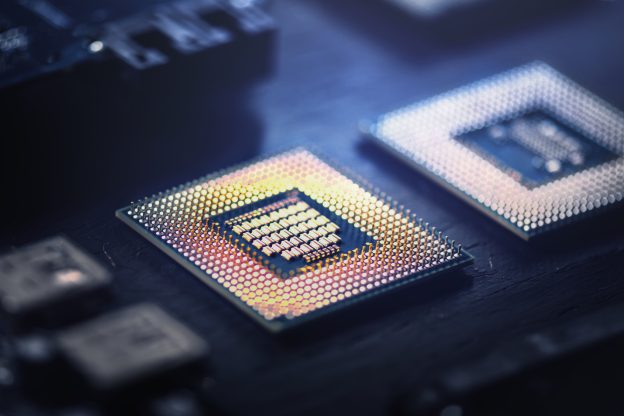
(Photo credit: FREEPIK)