[News] AMD Lifts Server CPU Outlook to 35%+ CAGR, $120B by 2030; Warns on Memory-Driven PC, Gaming Weakness
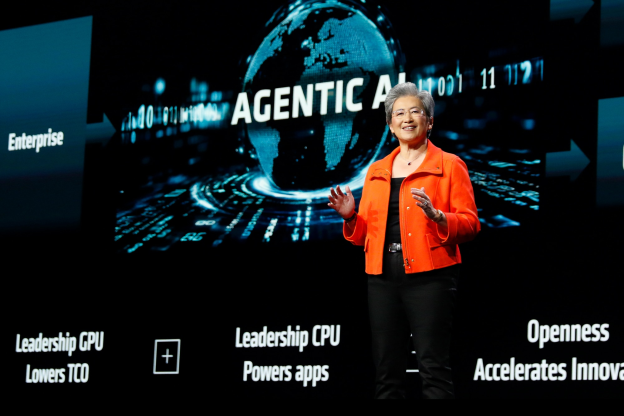
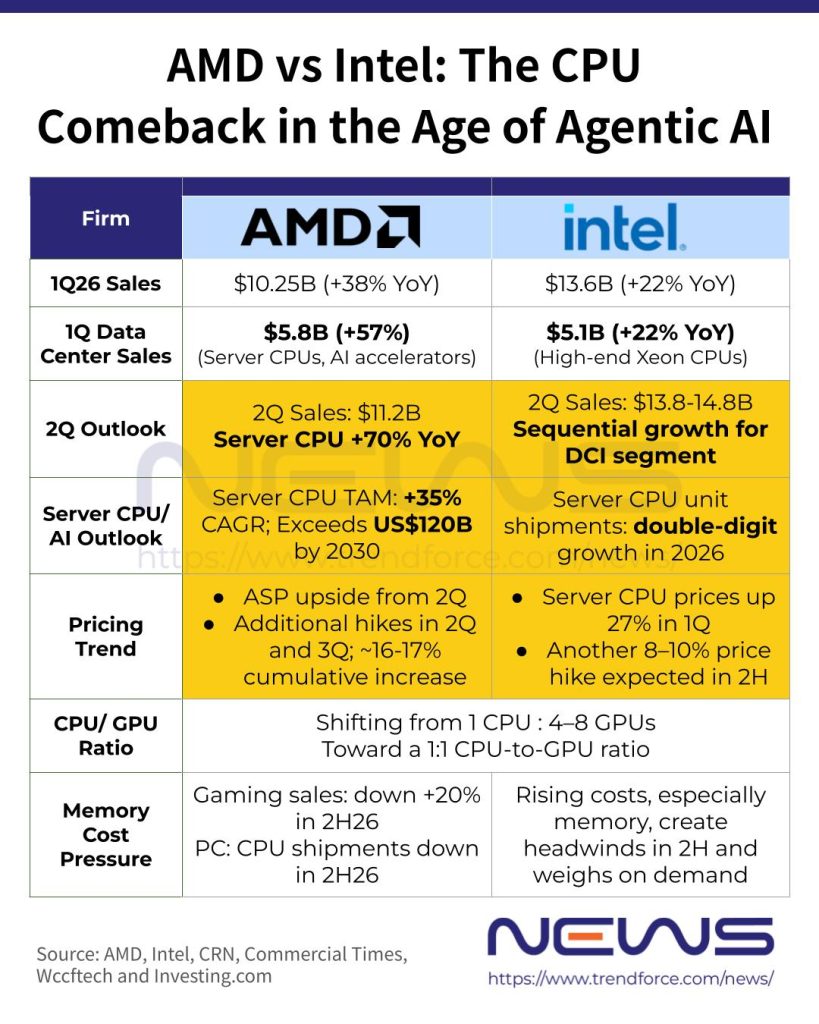
As inference AI fuels a fresh wave of CPU demand, chip giant AMD posted a 57% YoY jump in first-quarter data center revenue—covering both server CPUs and AI accelerators—to US$5.8 billion. Notably, according to Reuters, CEO Lisa Su now sees the server CPU addressable market expanding at more than 35% annually to exceed US$120 billion by 2030.
This, as per Reuters, suggests a sharp step-up from the 18% CAGR forecast AMD gave just last November. To put the scale into perspective, CRN notes the size is already more than triple the combined data center revenue generated by AMD and Intel in 2025.
Echoing comments made by Lip-Bu Tan during Intel’s late-April earnings call, Lisa Su said the rise of agentic AI is becoming a key driver. According to an Investing.com transcript, she noted the industry is shifting from its long-standing norm of one CPU for every four to eight GPUs toward a far denser 1:1 CPU-to-GPU ratio in next-generation data centers.
More Units, Gradual ASP Upside
Amid surging CPU demand, attention is also turning to AMD’s pricing dynamics. According to Investing.com, first-quarter server growth was largely driven by unit shipments, even as both ASPs and volumes rose year over year.
It is worth noting that Su also highlighted broad-based demand beyond the high-end EPYC Turin lineup, as the company is seeing strong momentum in its more established EPYC Genoa products based on the Zen architecture.
Looking ahead to the second quarter and beyond, AMD is guiding for significant growth momentum. Su, according to Investing.com, flagged that as ASPs will contribute modestly, pricing is being shaped by a tight supply chain and rising cost pressures, which are being partially passed through to customers.
As previously reported by Commercial Times, ODMs indicate that since March, consumer and server CPU prices have risen by 5%–10% and 10%–20%, respectively. Another Nikkei report suggested that AMD is also reportedly planning price increases across its server CPU lineup this year, with one round expected in the second quarter and another in the third, for a cumulative increase of around 16% to 17%.
Memory Costs Weigh on PC, Gaming
However, as memory and component costs rise, AMD has flagged overall PC and gaming demand to soften in the second half of the year. CFO Jean Hu, according to the Investing.com transcript, added that gaming revenue is now projected to decline by more than 20% in 2H26 sequentially from the first half.
In line with the trend, Wccftech reports that Microsoft and Sony have already raised prices for their current-generation consoles, including the PlayStation 5 and Xbox Series platforms. With further increases expected in component costs, additional price hikes on consoles could follow, the report adds.
Meanwhile, AMD’s Ryzen CPU shipments are expected to decline in the second half of the year, according to Wccftech. Industry sources cited by the report also point to an imminent round of price increases, adding to the roughly 10% hike already implemented on consumer chips.
New CPU, GPU Waves Lean on TSMC
Amid the rising CPU and GPU demand, AMD is also expected to ramp up new products. Wccftech notes that the chip giant’s upcoming EPYC Venice generation will adopt the Zen 6 architecture and is expected to be manufactured on TSMC’s 2nm process.
The company also highlighted EPYC Verano during its earnings call, with CEO Lisa Su describing it as a CPU purpose-built for AI infrastructure, Wccftech suggests. Slated for 2027 on the SP7 platform, Verano is expected to target a more cost-optimized segment of the market, the report says.
On the GPU front, the report notes that AMD is gaining strong traction in AI accelerators as well, with its Instinct MI450, built on TSMC’s 2nm, now in customer sampling and expected to ramp into large-scale deployments in 2H26.
Driven by demand from major players including OpenAI and Meta, and potentially Anthropic, adoption is reportedly running ahead of earlier 2027 expectations, with momentum spanning both training and inference workloads, according to Wccftech.
Notably, Reuters, citing analyst, points out that AMD may need to accelerate qualification of Intel as a future supplier sooner rather than later, as additional capacity becomes increasingly critical amid the faster-than-expected progress of NVIDIA’s AI roadmap.
AMD has issued a stronger-than-expected outlook, guiding second-quarter revenue of US$11.2 billion ± US$300 million, well above consensus of US$10.52 billion, while projecting server CPU revenue to rise more than 70% YoY, Reuters reports. The company also sees adjusted gross margin around 56%, slightly ahead of Street expectations at 55.4%, according to Reuters.
For the first quarter, AMD posted adjusted EPS of US$1.37 on revenue of US$10.25 billion, beating analyst estimates of US$1.29 per share and US$9.89 billion in revenue, the report adds.
Read more
- [News] Intel Reportedly Sells Chips Typically Scrapped as CPU Demand Surges; 1Q26 Server CPU ASPs Up 27%
- [News] Intel Says AI Inference Pushes CPU Ratio From 1:8 Toward 1:1; 18A Yield Target Advanced to Mid-Year
(Photo credit: AMD)