[News] SanDisk Long-Term Deals Gain Scale: Over One-Third of FY27 Bits Reportedly Locked, 50% in Sight; HBF Advances
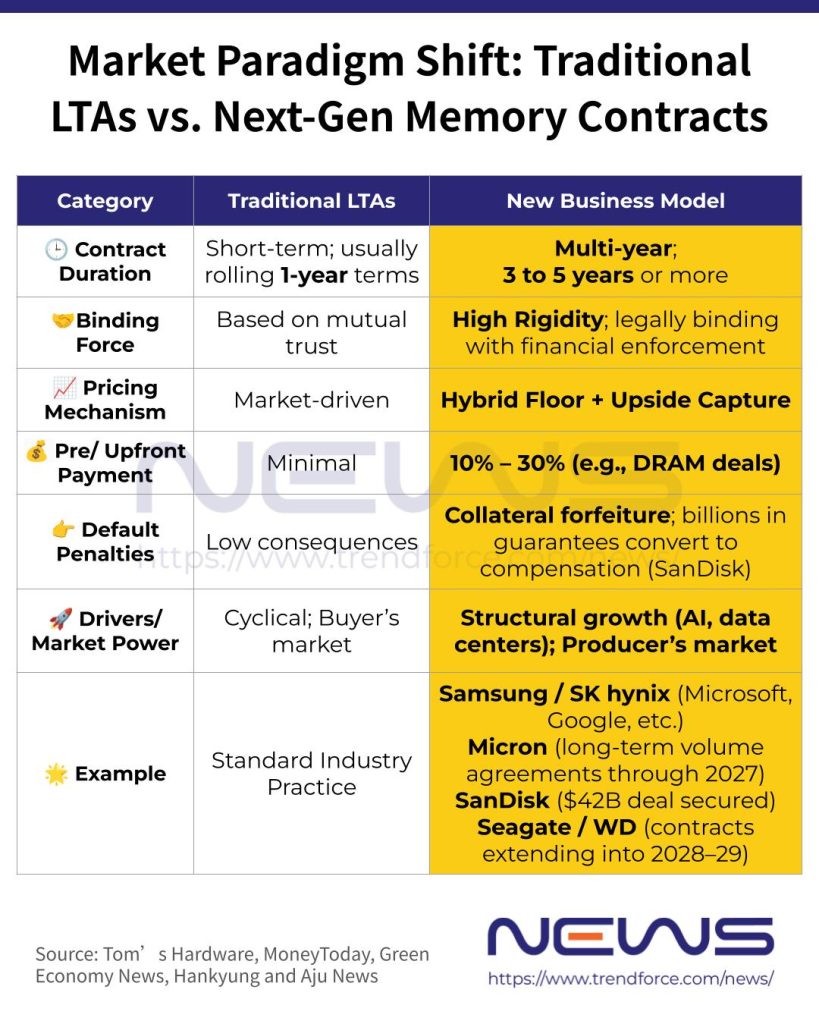
Long-term agreements are no longer confined to upstream memory suppliers such as Samsung Electronics and SK hynix. At its latest earnings call, SanDisk outlined a clearer picture of its New Business Model (NBM) with customers. According to the transcript from Investing.com, the company has already secured five such long-term contracts, which are expected to account for more than one-third of SanDisk’s bit shipments in fiscal 2027.
CEO David Goeckeler, as per the transcript, noted that while guidance initially pointed to “at least one-third,” the figure has already exceeded that level and is set to rise further over the coming quarters—potentially moving beyond 50% as additional deals are finalized.
According to CFO Luis Visoso, SanDisk signed three agreements in the third quarter and added two more so far in the fourth quarter, while also remaining in active negotiations with additional customers. Contract durations vary, with the longest extending up to five years, he added.
For reference, the company’s 10-Q filing shows that the three contracts signed in the third quarter carry a minimum contractual revenue of approximately $42 billion, as per the transcript.
Tom’s Hardware explains that backed by multi-year contracts and locked-in demand, players like SanDisk, Seagate and Western Digital are now more prepared to pour billions into fab expansions, backend capacity, and next-generation technologies such as higher-layer NAND and HAMR.
A Clearer Picture of The New Business Model
It is noteworthy that while customer names have not been disclosed, SanDisk management still provides a relatively clear picture of the structure behind these agreements. According to Investing.com, aggregate volume commitments are set to ramp over the life of the contracts, structured around quarterly targets alongside a mix of fixed and variable pricing.
SanDisk noted that the variable pricing mechanism is designed to capture upside when market prices rise, while still allowing customers to benefit from partial downside protection when prices decline over time. According to the company, short-term portions are more heavily weighted toward fixed pricing, while longer-dated commitments include a higher variable component.
On the collateral and risk mitigation side, the company also said that customers have posted billions of dollars in collateral backed by various financial instruments designed to remain in place over the full contract duration. If they fail to meet quarterly purchase obligations, the financial guarantees would immediately convert into compensation for unmet commitments.
As highlighted by MoneyToday, SanDisk’s example suggests that this round of long-term contracts marks a structural shift from the past. According to the report, Samsung, as its earnings call last week, emphasized that unlike traditional supply agreements based on mutual trust, this structure carries much stronger binding force.
The agreements, as noted by the report, now increasingly incorporate mechanisms previously uncommon in the industry, including prepayments, minimum revenue guarantees, and broader financial collateral structures—significantly raising contract rigidity.
SanDisk on HBF Progress and Nanya Tech Investment
Another point drawing market attention is SanDisk’s progress on High Bandwidth Flash (HBF). As previously reported by ETNews, the company has begun engaging materials, components, and equipment partners to establish an ecosystem for an HBF prototype production line. It is targeting prototype introduction in the second half of this year, with Japan emerging as a leading candidate for the production site, the report added.
CEO David Goeckeler, as per the transcript, confirmed that SanDisk is actively engaging with customers on how they plan to deploy the technology. On the development side, the firm is building out the full stack, including the NAND die itself as well as the controller.
According to Goeckeler, SanDisk remains on its previously communicated timeline, with NAND silicon expected by late 2026, followed by a more complete system-level solution integrating the controller in early to mid-2027.
Notably, in March, Taiwanese DRAM maker Nanya Technology raised $2.5 billion via a private placement backed by SanDisk, Kioxia, SK hynix subsidiary Solidigm, and networking giant Cisco Systems. At its earnings call, SanDisk said the partnership includes an equity investment and secures preferential access to DRAM supply, framing it as a key strategic rationale behind the deal.
Read more
- [News] Samsung, SK hynix Deepen LTAs as Buyers Pay Premiums to Secure Supply, May Drive Memory Prices Higher
- [News] SanDisk Reportedly Eyes 2H26 HBF Pilot Line; May Advance Previously Announced Timeline by Half a Year
(Photo credit: SanDisk)