[News] China’s DDR5 Price Drop Driven by Secondary-Market Modules; Impact Confined to Niche Channel

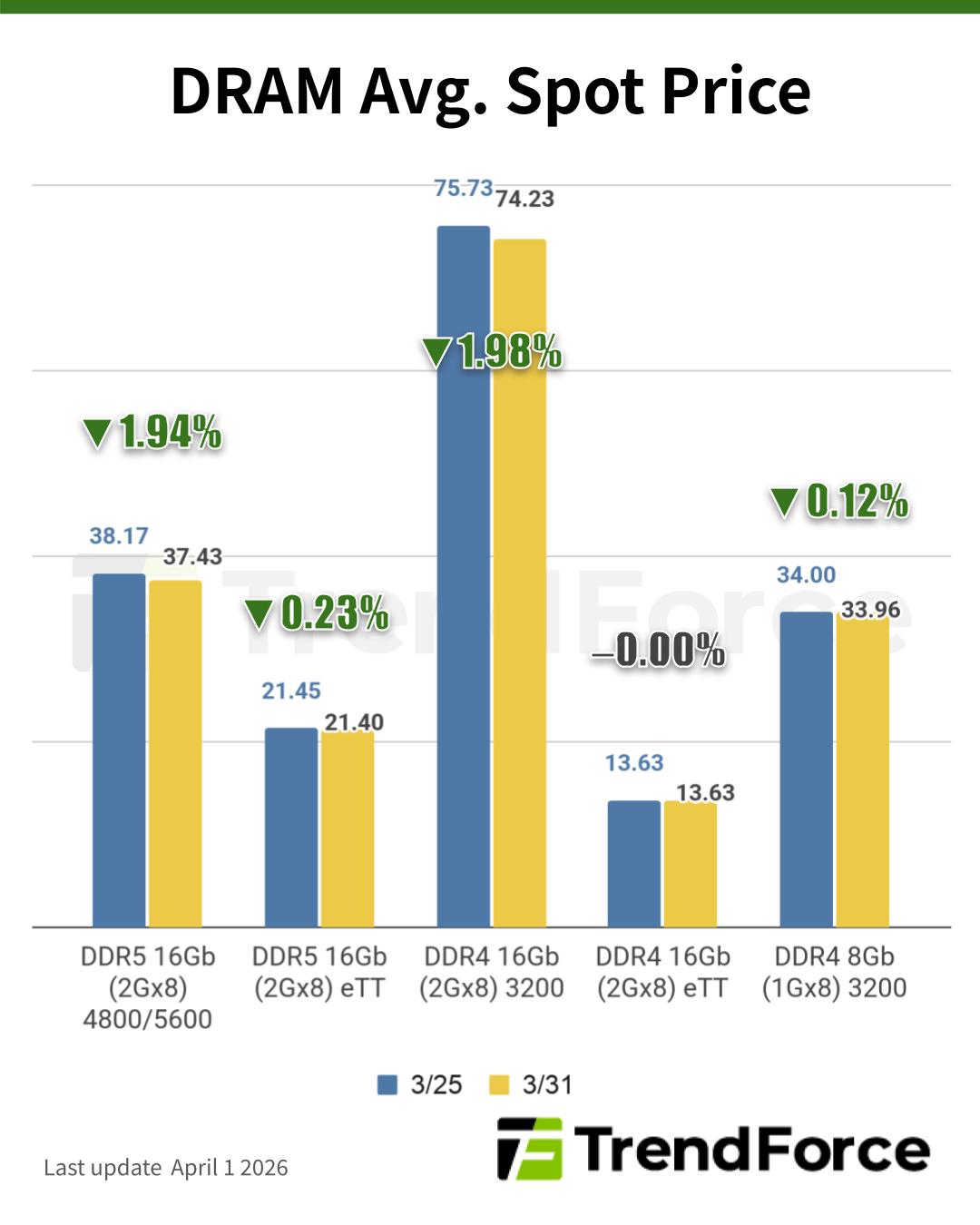
The recent DDR5 price correction in China’s retail market has triggered heated debate, with Calian Press reporting sharp spot-price declines of around 30% in Shenzhen’s Huaqiangbei Electronics Market, a key electronics trading hub. However, industry sources suggest the prices quoted by retailers to media inquiries are largely reflecting secondary-market, decommissioned server DRAM.
Sources indicate that in Shenzhen, the price decline is mainly seen in spot-traded pulled-down (de-soldered) memory modules, while prices for original IC-based modules have remained stable.
Current estimates from industry sources suggest 1G DDR5 modules from major memory vendors are trading in the US$5–7.5 range, largely reflecting used or recycled IC supply in the secondary market.
Notably, Richard’s Research Blog points out that Spot-market DRAM chips and modules account for only about 1–5% of the overall DRAM market. Against this backdrop, the recent “cliff-like crash” observed in China’s retail segment may reflect a more concentrated movement within a relatively niche channel.
According to Calian Press, a 32GB DDR5 module that was priced near RMB 3,000 last week has since fallen by RMB 500–1,050, with some traders clearing inventory at around RMB 2,500 per unit. In more aggressive cases, fire-sale pricing has dropped as low as RMB 1,950.
Meanwhile, chinastarmarket.cn reports on March 30 that prices for mainstream 16GB DDR5-5600/6000 modules on local e-commerce platforms have fallen from a peak of around RMB 1,300 in January–February to roughly RMB 1,000, representing a cumulative decline of 25%–30%.
Behind the Recent DRAM Price Decline
The price softness seen in China’s spot market recently seems to be less a demand shock than a market correction. According to Richard’s Research Blog, PC DRAM and mobile DRAM spot and retail prices have been easing since February–March, prompting retailers, resellers, and traders who accumulated inventory during the earlier rally to lock in profits and unwind positions.
One widely cited catalyst is Google’s TurboQuant, which some have speculated could suppress memory demand. Richard’s Research Blog pushes back on this narrative, arguing that TurboQuant is fundamentally an AI data center inference technology with little direct bearing on PC DIMM pricing — except in niche AI PC scenarios.
He added that contract prices have remained strong while PC DIMM spot prices fell first, suggesting the move is largely sentiment-driven, with traders and inventory holders locking in profits amid negative news flow.
Read more
- [News] DDR5 Retail Prices Pullback Amid Market Correction, but Industry Players Cite Stable Contract Trends
- [News] Select DDR5 Kits Reportedly Slide Over 20% in U.S. Retail Amid Google’s TurboQuant Debate
(Photo credit: Samsung)