Popular Keywords



About TrendForce News
TrendForce News operates independently from our research team, curating key semiconductor and tech updates to support timely, informed decisions.
[News] “Everyone Raising a Lobster”: How OpenClaw Reshapes the Computing and Chip Landscape

In the spring of 2026, OpenClaw becomes an instant hit. Originating within developer communities, it rapidly spread across the tech ecosystem and has emerged as a landmark product in the AI Agent sector. In the meantime, multiple Chinese cities have introduced dedicated policy support, while global technology giants including NVIDIA, Zhipu AI, and ByteDance have accelerated strategic deployments, which promotes an industry transformation driven by AI Agents.
What is OpenClaw?
OpenClaw is neither a proprietary product owned by a single company nor a generic technical term. Instead, it is an open-source AI agent framework capable of autonomously understanding tasks, orchestrating tools, and completing closed-loop execution. The framework can directly interface with operating systems and a wide range of plugins, enabling deployment in real-world business scenarios.
The name “Claw” refers to one of the sharp curved nails on the end of an animal’s or a bird’s foot, and since the project adopted a lobster as its early mascot, the community has humorously nicknamed it “the lobster.”
Alongside the rise of OpenClaw, a lightweight entrepreneurial model known as OPC (One-Person Company) has begun to gain traction. Leveraging the framework, individuals can rapidly launch business operations on their own.
In terms of core capabilities, traditional AI often functions primarily as a conversational assistant—an entity that “talks.” OpenClaw, by contrast, acts as an agent that can “do.” Running locally with system-level permissions, it can autonomously chain tools together and execute complete tasks without manual intervention—for instance, organizing data or operating software. In essence, it functions more like a dedicated digital employee. Put simply, if conventional large AI models tell users how to think, OpenClaw helps them get things done.
The development of OpenClaw is accelerating the adoption of AI Agents. This trend is driving new demand for computing power while also speeding up iterations in chip adaptation technologies, creating fresh opportunities for the semiconductor industry.
Local Governments Roll Out Policy Support for AI Agents
The explosive growth of OpenClaw has quickly prompted policy responses from local governments. Cities such as Shenzhen, Wuxi, and Changshu have taken the lead in introducing targeted measures, followed by Nanjing and Hangzhou with similar initiatives. Across these regions, dedicated funding programs are being deployed to support the development of open-source intelligent agent ecosystems.
For example, Shenzhen’s Longgang District released the “Several Measures to Support the Development of OpenClaw & OPC (Draft for Public Consultation)” on March 7—widely referred to as the “Lobster Ten Policies.” Centered on the concept of “zero-cost entrepreneurship,” the initiative focuses on AI agent developers and one-person companies. Under the policy, enterprises contributing core code to the ecosystem may receive subsidies of up to CNY 2 million, while the “OpenClaw Digital Employee Application Voucher” program provides subsidies covering up to 40% of deployment costs.
Global Tech Firms Move to Tap the AI Agent Market
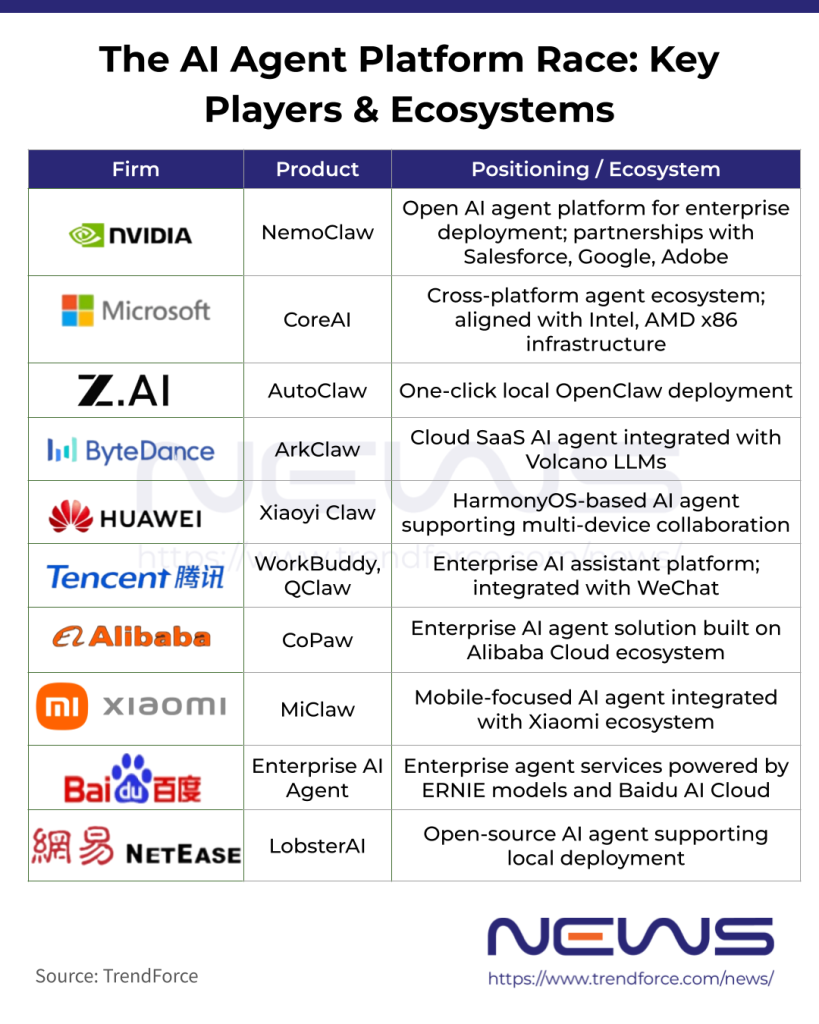
According to industry sources, Nvidia is preparing to launch an open-source AI agent platform named NemoClaw, enabling enterprises to deploy intelligent agents within their own workflows without being tied into Nvidia chips. The company has reportedly reached preliminary cooperation agreements with industry leaders including Salesforce, Google, and Adobe, with the platform expected to debut around its annual developer conference.
Meanwhile, Microsoft has established a CoreAI division, positioning itself as an “AI Agent factory” aimed at building a cross-platform collaborative ecosystem where “everything becomes an agent.” Such a strategy will require massive cloud computing clusters alongside edge computing nodes. This shift could create new adaptation opportunities for x86 chipmakers such as Intel and AMD, while also fueling technological iterations in low-power edge processors.
Chinese technology firms are also acting proactively. Zhipu AI has launched AutoClaw, the first domestic local version of OpenClaw that supports one-click installation. Its lightweight deployment model is already driving instruction-set compatibility and power-efficiency optimization for domestic chip platforms such as Loongson Technology and Rockchip.
ByteDance, through its cloud platform Volcano Engine, has introduced ArkClaw, a cloud-based SaaS service emphasizing “zero configuration and out-of-the-box deployment.” Deeply integrated with domestic large language models, ArkClaw adopts an end-cloud collaborative architecture that simultaneously boosts demand for both cloud computing power and edge-side chips. Localized computing support is provided by Sugon through its liquid-cooled intelligent computing clusters, further strengthening the ecosystem around “AI Agent + domestic computing infrastructure.”
Huawei has launched Xiaoyi Claw based on the HarmonyOS ecosystem, currently in beta testing; Tencent Cloud has introduced WorkBuddy; Alibaba Group has unveiled CoPaw; Xiaomi is conducting internal testing for MiClaw; and Baidu is developing enterprise-level AI Agent solutions powered by its ERNIE large model.
OpenClaw Drives Computing Restructuring and Chip Adaptation
The rise of OpenClaw starts to reshape computing architectures and chip form factors.
Among Chinese domestic vendors, Sugon completed trial operations and acceptance testing of its scaleX ultra-large computing cluster on March 7. The cluster’s liquid-cooled AI servers adopt immersion phase-change cooling technology and have already been integrated with localized deployment requirements for ByteDance’s ArkClaw platform, providing high-density computing support for its cloud SaaS services.
In the AI chip segment, T-Head Semiconductor has recently optimized the compiler for its Xuantie 810E training-and-inference integrated processor and launched a corresponding AI server module capable of directly supporting OpenClaw inference scheduling. The solution has already secured partnerships with several domestic AI Agent developers.
Cambricon Technologies announced on March 9 that it had restructured the compiler stack of its MLU (Siyuan) series chips, enabling associated servers to run OpenClaw without code modifications. Thanks to its low-latency advantages, the solution has entered pilot deployments in the financial sector.
Hidden Risks Behind the Boom
Despite the rapid growth of the AI Agent ecosystem driven by OpenClaw, potential risks—particularly security vulnerabilities and compliance challenges—are beginning to emerge. Regulatory authorities have already issued risk alerts, signaling growing scrutiny of the technology.
On March 10, China’s National Computer Network Emergency Response Technical Team/Coordination Center of China (CNCERT/CC) released a security advisory highlighting risks associated with OpenClaw deployments. The report pointed to issues such as flawed default security configurations and the potential abuse of high-level system permissions, noting that several real-world security incidents have already occurred.
For the industry, the key challenge now lies in balancing technological innovation with security and regulatory compliance. Establishing robust risk management frameworks will be essential for OpenClaw’s sustainable development. Looking ahead, competition will increasingly focus on upgrading AI Agent computing architectures, optimizing hardware compatibility, strengthening ecosystem collaboration, and building comprehensive security and compliance systems.
(Photo credit: NVIDIA)