Popular Keywords



About TrendForce News
TrendForce News operates independently from our research team, curating key semiconductor and tech updates to support timely, informed decisions.
[News] GigaDevice Goes Public in Hong Kong: Founder Bets on China’s Memory Future
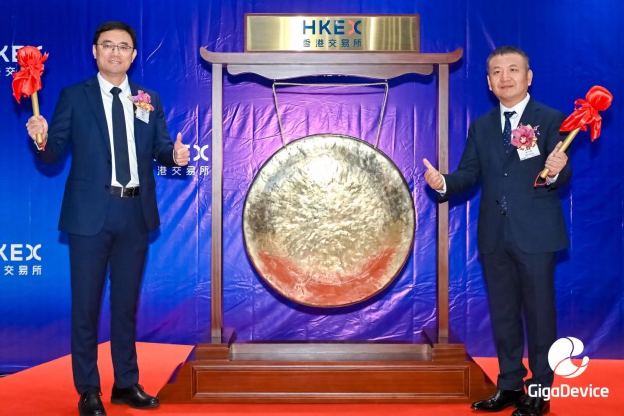
Chinese chipmaker GigaDevice, founded in 2005 and claims to be the world’s second-largest SPI NOR Flash supplier, made its Hong Kong market debut on January 13. According to EE Times China, the company offered 28.92 million H-shares in the IPO. Priced at HK$162 per share, the offering reportedly raised up to HK$4.684 billion (roughly US$600 million).
Notably, Sina, citing chidu.com, underscores that GigaDevice is both a shareholder and a sister company of domestic DRAM giant CXMT, with both companies founded by the same entrepreneur, Yiming Zhu.
As 36Kr previously reported, GigaDevice has racked up more than RMB 21.2 billion in revenue from 2022 to 2024 and sold 4.3 billion chips in a single year. In 2024, specialty memory chips drove over 70% of the company’s total revenue, MCUs accounted for 23%, and sensor chips 6.1%, the report suggests.
EE Times China highlights that before its Hong Kong debut, GigaDevice had already listed its A-shares on the Shanghai Stock Exchange in 2016, and today the company carries a market capitalization of roughly RMB 184 billion.
The Founder Who Bet on China’s Memory Future
Zhu’s entrepreneurial journey is worth highlighting. According to EE Times China, he earned a Bachelor’s in Modern Applied Physics from Tsinghua University in 1994, followed by a Master’s in Engineering from the same school, and later a Master’s in Electrical Engineering from the State University of New York at Stony Brook in 2000.
Sina reports that in 2004, Zhu, then a project manager at a U.S.-listed memory firm, resigned to launch his own venture. Observing the memory industry’s shift from the U.S. to Japan, then South Korea and Taiwan, he saw an opportunity for China to rise as a key player—potentially even producing a “Chinese Samsung,” the report notes.
According to Sina, Zhu Yiming and his team launched China’s first domestically designed 180nm SPI NOR Flash chip in 2008. But the timing proved challenging: the global financial crisis hit, and investors tightened funding, putting the company back into a precarious position.
The report further notes that amid the turmoil, two U.S. companies approached Zhu with acquisition offers. ISSI’s CEO even flew to Beijing with a $10 million bid, while another suitor, Spansion, offered more—both were firmly rejected, the report adds.
Then in 2008, Samsung strategically exited the NOR Flash market, giving GigaDevice the opportunity it needed, as noted by Sina. The company quickly filled the gap, emerging as a globally recognized NOR Flash player.
Second Momentum
However, Sina also points out as a niche segment, the NOR Flash market offered limited growth potential. To expand, Zhu thus turned to a new frontier: microcontrollers (MCUs). The report notes that in 2013, GigaDevice launched its first domestically produced MCU based on the Arm Cortex-M3.
It is interesting to note that, as per Sina, Zhu initially aimed to enter the DRAM market through Gigadevice. Just a month after its IPO in Shanghai, the company announced plans to acquire Beijing’s Integrated Silicon Solution Inc, then the world’s second-largest SRAM producer and the eighth-largest DRAM maker globally.
However, the deal fell through, and Beijing SiCheng was eventually acquired by Ingenic Semiconductor, the report notes.
Read more
(Photo credit: GigaDevice’s LinkedIn)
Please note that this article cites information from EE Times China, Sina and 36Kr.