Popular Keywords



About TrendForce News
TrendForce News operates independently from our research team, curating key semiconductor and tech updates to support timely, informed decisions.
[News] ASUS to Raise Prices on Selected PC Lines from Jan. 5 Amid Memory Cost Surge, Following Dell

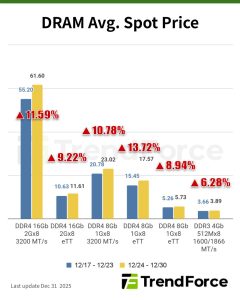
With memory prices surging, PC makers are accelerating price increases. Dell is said to have kicked off the latest round by lifting prices across its commercial portfolio from December 17, with increases ranging from 10% to 30%, as reported by Business Insider.
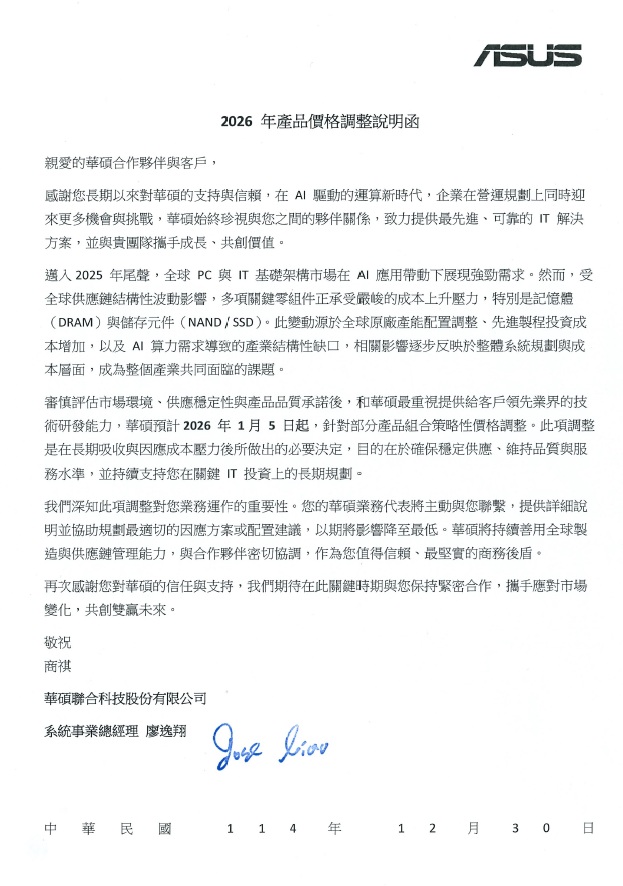
Notably, ASUS is now poised to follow suit, becoming the first PC vendor to raise prices in the new year, with the adjustment set to take effect on January 5, 2026, according to a notice obtained by industry sources.
ASUS explained in the notice that structural shifts in the global supply chain are driving unprecedented cost pressure on key components — especially memory (DRAM) and storage such as NAND and SSDs. The company attributed the increase to capacity realignments, heavier spending on advanced processes, and booming AI demand, which together are creating a structural supply gap now rippling through system costs across the industry.
The company said it will begin rolling out targeted price adjustments across parts of its product portfolio starting January 5, 2026, in a move aimed at safeguarding supply stability and maintaining product quality.
The move may be arriving slightly ahead of schedule, but it is hardly unexpected. As reported earlier by Commercial Times, Taiwan’s Acer and ASUS have both acknowledged that passing on soaring memory costs has become an industry-wide consensus. The market now widely expects that, starting January 2026, the MSRP for both consumer and business PCs will fully reflect the rising component costs, the report added.
ASUS Co-CEO Samson Hu told Commercial Times that memory prices are unlikely to ease before the first half of next year, reinforcing the rationale behind the price adjustments. He added that ASUS plans to dynamically adjust its product mix, specifications, and pricing based on market conditions, channel demand, and consumer needs, taking action at the most strategic moment.
Rising Memory Costs Threaten Notebook Shipments
The impact of rising memory costs on PC prices is one to watch closely. TrendForce’s latest analysis shows that, amid a sluggish economic recovery and cautious consumer spending, surging memory prices are squeezing notebook brands’ profit margins and limiting their pricing flexibility. As a result, TrendForce has revised its 2026 global notebook shipment forecast, now projecting a 5.4% year-on-year decline — down from the previous estimate of a 2.4% drop — totaling roughly 173 million units.
If memory price increases fail to ease significantly by the second quarter of 2026, and brands are unable to fully pass on higher costs, demand for entry-level and consumer notebooks could weaken further. Under this scenario, TrendForce warns that full-year 2026 shipments could fall as much as 10.1% year-on-year.
Read more
- [News] Acer and ASUS Reportedly to Pass Surging Memory Costs to PCs in 1Q26, Hot on Dell’s Heels
- [News] Dell Reportedly Plans 10–30% Hikes on Commercial PCs From Dec. 17 as Memory Prices Surge
- [Exclusive] Memory Crunch Hits PCs: Dell Hikes Prices 15-20% Mid-December, Lenovo from January 2026
(Photo credit: ASUS)
Please note that this article cites information from Business Insider and Commercial Times.