Popular Keywords



About TrendForce News
TrendForce News operates independently from our research team, curating key semiconductor and tech updates to support timely, informed decisions.
[News] Memory Shortage Reportedly Triggers Order Caution from Smartphone Clients, Pressuring SMIC
China’s foundry giant SMIC reported robust Q3 results with profits surging 29% year-on-year, but surprised markets by revealing an unexpected ripple effect: tight memory chip supplies are making smartphone clients increasingly cautious with orders, according to chinastarmarket.cn.
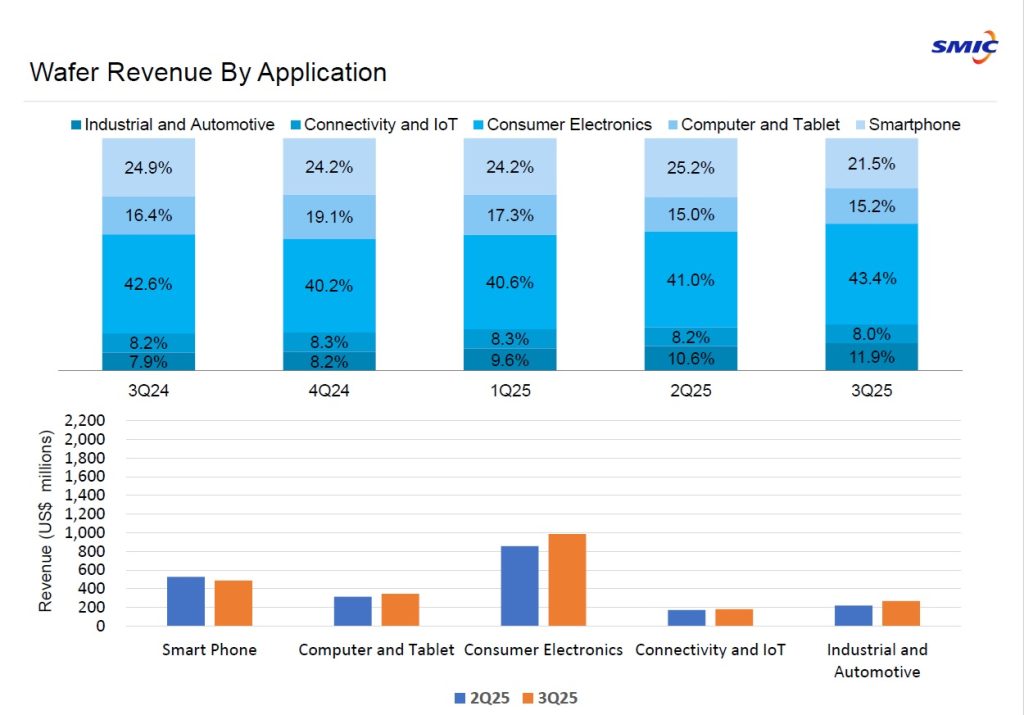
Notably, SMIC’s latest press release shows that smartphones made up 21.5% of its third-quarter revenue, down from 25.2% in Q2, marking the only segment to see a significant decline.
(Credit: SMIC)
Co-CEO Haijun Zhao, cited by the report, further explained the trend: memory chip shortages are creating a supply chain bottleneck—even when other components are available, smartphone makers cannot complete assembly without sufficient memory. Meanwhile, with handset prices holding steady, negotiations are underway on whether other chip prices can drop in 2026 to offset surging memory costs, according to Zhao.
As a result, SMIC reportedly adjusted production priorities to focus on urgent orders and supply-constrained products, temporarily delaying smartphone-related shipments with customer approval, the report adds.
However, Reuters suggests the impact may be far broader. Citing Zhao, the report suggests that clients are hesitant to commit to Q1 orders in 2026. “The memory supply outlook remains uncertain—no one knows how many chips will actually arrive, or how many phones, cars, and other products can ultimately be assembled,” SMIC Co-CEO Haijun Zhao reportedly said during the earnings call.
Ripple Effects Threaten Foundry Sector
The memory crisis is already hitting smartphone makers hard. Xiaomi founder Lei Jun described recent memory price surges as “overwhelming,” while President Lu Weibing confirmed that soaring costs—far exceeding expectations—are now baked into new product pricing, according to EE Times China.
Supply constraints are worsening. Commercial Times reported in late October that DRAM and NAND lead times have ballooned, with LPDDR5X now taking 26–39 weeks, meaning orders placed today won’t arrive until mid-2026, citing smartphone manufacturers.
SMIC Co-CEO Haijun Zhao expressed concern that prolonged shortages could force smartphone clients into conservative production planning through next year, as per chinastarmarket.cn. He warned of a potential squeeze: while memory prices surge, customers may intensify pressure on non-memory chip suppliers to cut prices in 2026, heightening competition across the sector.
Read more
(Photo credit: SMIC)
Please note that this article cites information from chinastarmarket.cn, Reuters, EE Times China, Commercial Times and SMIC.