Popular Keywords



About TrendForce News
TrendForce News operates independently from our research team, curating key semiconductor and tech updates to support timely, informed decisions.
[News] US to End TSMC Nanjing Waiver by End-2025: Decoding the Impact on the Foundry and Supply Chain
Hot on the heels of similar moves against Samsung and SK hynix, Washington has now targeted TSMC—informing the chipmaker it will revoke the Nanjing fab’s “validated end user” (VEU) status by December 31, 2025, Bloomberg reported, citing a company statement.
As Central News Agency explains, in 2024 the U.S. Department of Commerce granted TSMC’s Nanjing fab a formal VEU authorization, replacing temporary approvals in place since October 2022. The VEU allowed U.S.-controlled items and services to flow to the plant without individual licenses, keeping production steady. With the VEU now set for revocation, the Nanjing site faces greater operational uncertainty.
What does this mean for the world’s top foundry, its supply chain, and its Chinese rivals? Here are the key takeaways.
Impact on TSMC: Limited Profit Contribution
According to the Commercial Times, Taiwan’s Ministry of Economic Affairs said that only TSMC’s Nanjing fab—home to its 16nm technology—currently falls under BIS export controls. The plant represents roughly 3% of TSMC’s global capacity, a share likely to decline further, leading officials to conclude the impact on Taiwan’s chip competitiveness will be minimal, the report adds.
By comparison, Samsung produces around 20% of its DRAM in China, and SK hynix about 40%, making them far more exposed to U.S. restrictions, as Commercial Times indicates.
The Economic Daily News points out that TSMC runs two fabs in China: an 8-inch facility in Songjiang, Shanghai, focused on mature 0.13-micron processes, and a 300mm plant in Nanjing. The Nanjing fab initially produced 16/12nm chips but shifted strategy as U.S. export controls tightened, with the board approving nearly NT$80 billion to expand 28nm capacity, the report notes.
As per the report, the Nanjing fab now runs about 20,000 wafers per month at 16/12nm and 40,000 wafers per month at 28/22nm, largely serving specialty demand such as automotive chips.
As noted by Liberty Times, in the first half of this year, TSMC’s China subsidiary posted NT$5.596 billion in after-tax net income, while the Nanjing plant contributed NT$14.439 billion—together accounting for about 2.6% of TSMC’s total profits. Thus, the market expects minimal effect on TSMC’s operations going forward.
TSMC’s China Supply Chain and Competitor Gains
What would the impact be on TSMC’s China supply chain and its local rivals? According to Tom’s Hardware, Chinese clients contributed about 11% of TSMC’s $90.08 billion in 2024 sales, or roughly $9.9 billion, though the company does not disclose how much of that came directly from Fab 16 (the Nanjing fab).
As the report highlights, one option for TSMC to keep its Nanjing Fab 16 running without U.S. equipment is to substitute some imported tools with locally made Chinese alternatives. However, whether this is feasible—particularly for lithography—remains uncertain.
While Chinese firms like AMEC, Kingsemi, Naura, and Piotech have advanced in cleaning, deposition, and etching tools, they still lack complete equipment capable of meeting the yield and precision required for commercial 16nm production, as per Tom’s Hardware. For now, no Chinese company is known to offer lithography systems suitable for 16nm nodes, the report notes.
On the other hand, the report suggests that if TSMC gradually scales back production in Nanjing, Chinese foundries could benefit. Customers may shift orders to SMIC, which handles 14nm and 28nm, or Hua Hong, which offers 28nm, boosting their utilization and revenues—assuming they have enough capacity to meet the demand, the report notes.
Read more
- [News] U.S. Revokes China Chipmaking Tool Licenses for Samsung, SK hynix: Decoding Market Impact
- [News] If US Revokes Chip Tool Exemptions: Unpacking TSMC, Samsung, and SK hynix’s China Operations
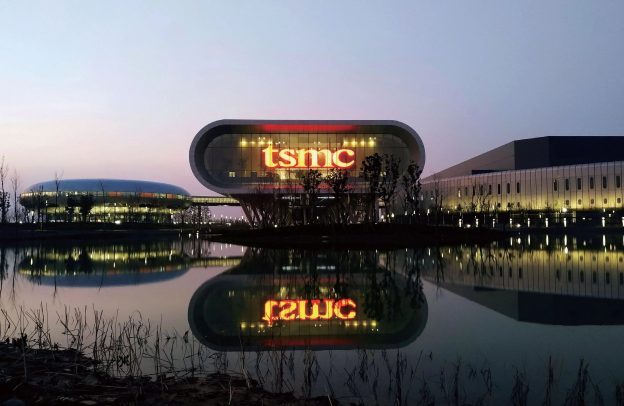
(Photo credit: TSMC)
Please note that this article cites information from Bloomberg, Central News Agency, Commercial Times, Economic Daily News, Liberty Times, and Tom’s Hardware.