Popular Keywords



About TrendForce News
TrendForce News operates independently from our research team, curating key semiconductor and tech updates to support timely, informed decisions.
[News] Huawei to Unveil CloudMatrix 384, Rumored to Deliver 2× NVIDIA GB200 NVL72 Throughput
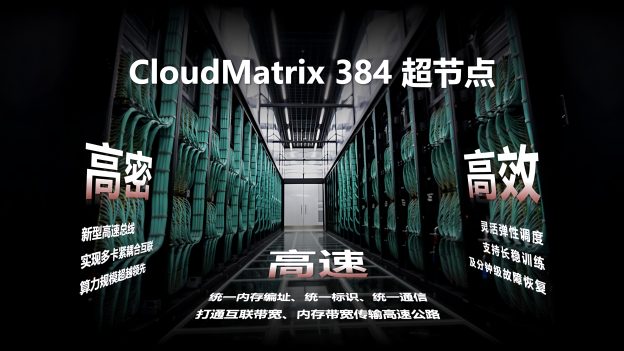
Huawei is reportedly set to unveil its CloudMatrix 384 system for the first time at the 2025 World Artificial Intelligence Conference (WAIC), which opens on the 26th in Shanghai, according to Economic Daily News. As highlighted by Tom’s Hardware, the CloudMatrix 384 is a rack-scale AI system composed of 384 Ascend 910C processors, interconnected through a fully optical, all-to-all mesh network.
Although a single Ascend 910C chip delivers only about one-third the performance of NVIDIA Blackwell, the report notes that Huawei offsets this limitation by deploying a much larger number of chips per system. This approach allows the CloudMatrix 384 to achieve around 300 PFLOPs of dense BF16 compute—nearly twice the throughput of NVIDIA’s GB200 NVL72, which offers about 180 PFLOPs, as the report highlights.
Tom’s Hardware also notes that the system provides 2.1 times the total memory bandwidth and over 3.6 times the HBM capacity, while relying on HBM2E memory.
Meanwhile, unlike conventional systems that rely on copper wiring for interconnects, CloudMatrix uses a fully optical infrastructure for both intra- and inter-rack communication, allowing for exceptionally high total bandwidth. The CloudMatrix 384 is a scalable, enterprise-grade system equipped with fault-tolerant features, making it suitable for demanding AI workloads, as Tom’s Hardware notes.
Efficiency Challenges of CloudMatrix 384
However, it is less efficient: it is 2.3 times less power-efficient per FLOP, 1.8 times less efficient per terabyte per second of memory bandwidth, and 1.1 times less efficient per terabyte of HBM memory compared to NVIDIA’s solution, as Tom’s Hardware states. Despite this, Tom’s Hardware points out that in China, where energy is plentiful but access to advanced silicon is limited, Huawei’s AI strategy appears to be well aligned with local conditions.
As indicated by Igor’s Lab, citing Financial Times, the CloudMatrix 384 is priced at USD 8 million per unit. Its steep cost and substantial power requirements make it inaccessible to smaller companies. As a result, the system is expected to remain a premium solution for large enterprises. The report also states that reportedly ten major Chinese firms have adopted the system and integrated it into their existing data center infrastructure.
Read more
- [News] Huawei Reportedly Looks to Sell Ascend 910B in UAE, Saudi Arabia, and Thailand
- [News] Huawei Mate 80 Reportedly to Feature Kirin 9030 with 20% Boost, Rumored to Stay on 7nm
(Photo credit: Huawei)
Please note that this article cites information from Economic Daily News, Tom’s Hardware, Igor’s Lab, and Financial Times.