





 Download Report
 Contact Us
2026 China AI Chip Industry: Opportunities and Challenges for Domestic Substitution Amid Geopolitical Risk

Last Modified
2026-06-26

Update Frequency
Not

Format
The AI industry entered a critical transition period in 2025, marked by the rapid expansion of LLMs and the large-scale commercialization of AI applications. For China’s semiconductor industry, this represents not only an opportunity to narrow the technological gap but also a battle for computing sovereignty under intense geopolitical pressure. The country’s AI chip industry is facing unprecedented pressure from two sides as the U.S. Bureau of Industry and Security (BIS) continues to tighten and refine its export controls on China,
On the one hand, China’s Eastern Data Western Compute (EDWC) initiative and the massive investments in AI infrastructure made by leading internet companies are driving enormous demand for computing power. On the other hand, access to critical technologies, including advanced logic manufacturing, high-bandwidth memory (HBM), and CoWoS advanced packaging, remains severely constrained, thereby creating a growing imbalance between demand and supply.
Key Highlights
- 2025 marks a critical transition for the AI industry, driven by rapid LLM expansion and large-scale AI commercialization.
- China's semiconductor sector faces dual pressure: an opportunity to narrow the tech gap, yet also a battle for computing sovereignty amid geopolitical tension.
- U.S. BIS continues tightening and refining export controls on China.
- Domestic demand surges via the Eastern Data Western Compute initiative and heavy AI infrastructure investment from leading internet firms.
- Access to critical technologies—advanced logic manufacturing, HBM, and CoWoS packaging—remains severely constrained.
- Resulting imbalance between computing demand and supply continues to widen.
Table of Contents
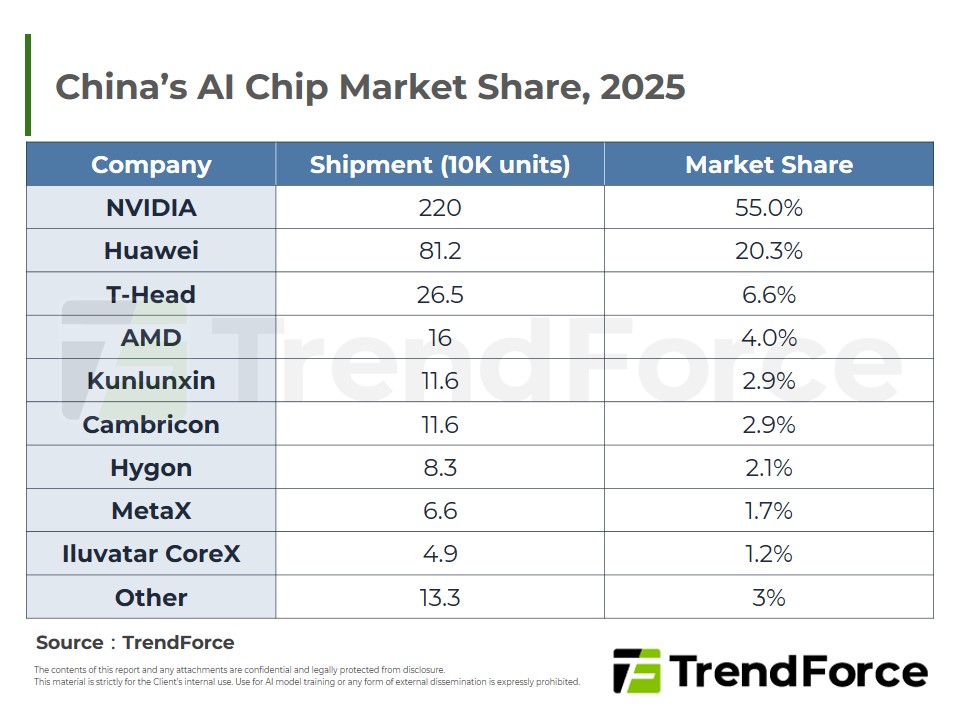
- Table 1: China’s AI Chip Market Share, 2025
- China’s AI Compute Market: Macroeconomic Demand and Structural Supply Gap
- The Opportunities and Challenges Created by the U.S.–China AI Computing Race Under Geopolitical Risk
- Table 2: Impact Analysis of China’s Protection of Domestic AI Chips
- The Conflict Between China’s AI Chip Design Capabilities and Foundry Capacity
- Analysis of China’s Three Major AI Chip Camps
- Table 3: Classification of China’s Three Major Domestic AI Chip Camps
- Table 4: Comparison of Huawei Ascend 950 Series Variants
- Figure 1: Huawei Ascend Chip Roadmap (Overview)
- Table 5: Core Specifications of the Zhenwu Series
- Figure 2: Alibaba’s “Tong-Yun-Ge” Golden Triangle
- Table 6: P800 Specifications and Positioning
- Table 7: M-Series Dual-Track Roadmap
- Table 8: Tianchi Supernode Strategy
- Figure 3: Kunlunxin Product Roadmap
- Figure 4: Moore Threads Product Ecosystem
- Figure 5: Biren Technology Hardware Platform Migration Framework
- Table 9: Iluvatar CoreX’s Fourth-Generation Architecture Roadmap
- Figure 6: Iluvatar CoreX’s Product Ecosystem
- Figure 7: MetaX Product Roadmap
- Table 10: Cambricon’s Historic Profitability Inflection Point
- Figure 8: Cambricon Product Ecosystem
- Figure 9: Enflame Technology Product Ecosystem
- Figure 10: Hygon DCU Series Product Roadmap
- Table 11: Representative Chinese AI Chip Vendors
- TRI’s View
<Total Pages: 32>

Spotlight Report
-

AI Wave & DRAM Deficits: 2027 Global DRAM Outlook
2026/07/28
Selected Topics
PDF
-

AI Surge Drives NOR Flash Deficit: 2026 Industry Outlook
2026/09/10
Selected Topics
PDF
-

iPhone 18: Modest Hardware Gains, Pricing and AI Drive Sales
2026/09/02
Selected Topics
PDF
-

AI Server Boom Outpaces U.S. Grid Buildout
2026/09/07
Selected Topics
PDF
-

US Data Center Buildout Faces Midterm Risks
2026/10/07
Selected Topics
PDF
-

AI Server Value Surges on Pricing and Capex Boom
2026/10/08
Selected Topics
PDF
Selected TopicsRelated Reports

Download Report
2,500

Membership
- Selected Topics
- Selected Topics-199_Opportunities and Challenges for China’s Domestic AI Compute Chips
Spotlight Report
-
AI Wave & DRAM Deficits: 2027 Global DRAM Outlook
2026/07/28
Selected Topics
PDF
-
AI Surge Drives NOR Flash Deficit: 2026 Industry Outlook
2026/09/10
Selected Topics
PDF
-
iPhone 18: Modest Hardware Gains, Pricing and AI Drive Sales
2026/09/02
Selected Topics
PDF
-
AI Server Boom Outpaces U.S. Grid Buildout
2026/09/07
Selected Topics
PDF
-
US Data Center Buildout Faces Midterm Risks
2026/10/07
Selected Topics
PDF
-
AI Server Value Surges on Pricing and Capex Boom
2026/10/08
Selected Topics
PDF