





 Download Report
 Contact Us
Policy Drivers, Technology Development, and Challenges for Solar Adoption in Buildings

Last Modified
2026-08-13

Update Frequency
Not

Format
The building sector is a key area for global decarbonization, with policies promoting solar adoption in buildings gradually shifting from incentives and subsidies toward mandatory installation. Rooftop solar remains the most widely adopted solution, while building-integrated photovoltaics (BIPV), which incorporate solar modules into façades, windows, and other building materials, are growing rapidly.
In addition to conventional crystalline silicon, perovskite solar cells are regarded as a promising technology for BIPV due to their lightweight, thin, semi-transparent, and flexible characteristics, as well as continued advances in conversion efficiency. Key challenges include balancing power-generation efficiency with architectural aesthetics, high upfront installation costs, and structural load-bearing and waterproofing requirements for existing buildings.
Meanwhile, solar adoption in buildings is also driving business models toward integrated services combining power generation, energy storage, electricity consumption, and grid interaction—creating new opportunities for the industry.
Key Highlights
- Building-sector solar policy is shifting from subsidies toward mandatory installation, making it a key area for global decarbonization.
- Rooftop solar remains the dominant application, while building-integrated photovoltaics (BIPV, combining modules with façades, windows, and other building materials) is growing rapidly.
- Perovskite solar cells are seen as a promising BIPV technology for their lightweight, semi-transparent, flexible properties and continually improving conversion efficiency.
- Key challenges include balancing power-generation efficiency with architectural aesthetics, high upfront installation costs, and structural load-bearing and waterproofing requirements for existing buildings.
- Building solar adoption is also driving business models toward integrated services combining power generation, energy storage, electricity consumption, and grid interaction—creating new opportunities for the industry.
Table of Contents
- Policy Drivers and Trends in Solar Adoption for Buildings
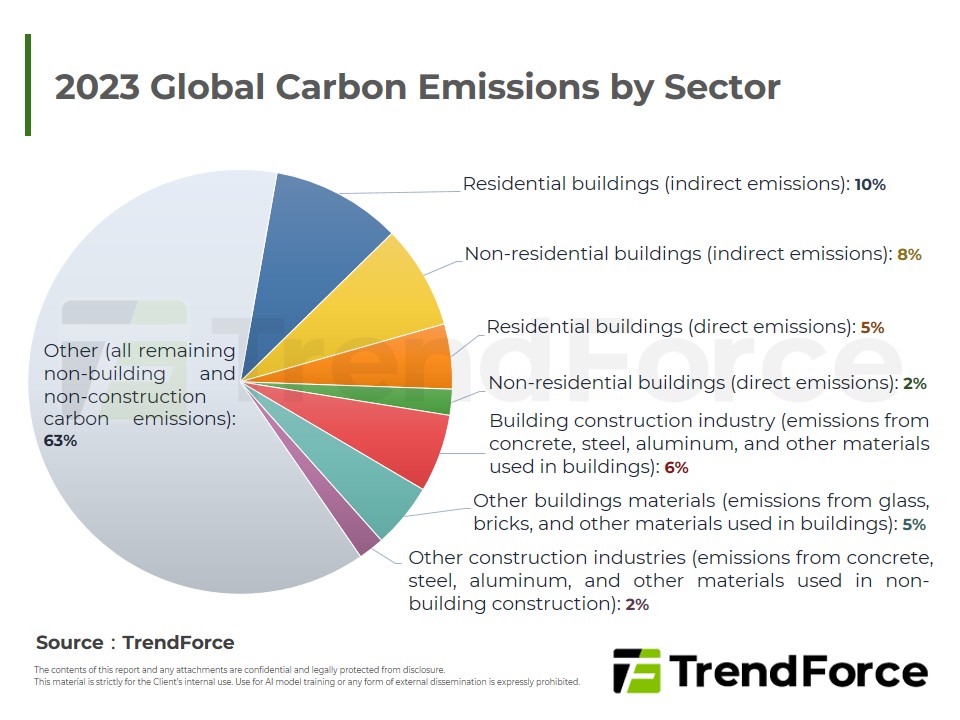
- Figure 1: 2023 Global Carbon Emissions by Sector
- Figure 2: Taiwan’s 2050 Net-Zero Building Roadmap
- Technology Trends in Building Solar Integration
- Figure 3: Elevated Canopy Solar System
- Figure 4: Flush-Mounted Solar System
- Figure 5: BIPV Application
- Challenges in Adopting Solar Technologies in Buildings
- TRI’s View
<Total Pages: 22>

Spotlight Report
-

AI Wave & DRAM Deficits: 2027 Global DRAM Outlook
2026/07/28
Selected Topics
PDF
-

AI Surge Drives NOR Flash Deficit: 2026 Industry Outlook
2026/09/10
Selected Topics
PDF
-

AI Server Boom Outpaces U.S. Grid Buildout
2026/09/07
Selected Topics
PDF
-

iPhone 18: Modest Hardware Gains, Pricing and AI Drive Sales
2026/09/02
Selected Topics
PDF
-

US Data Center Buildout Faces Midterm Risks
2026/10/07
Selected Topics
PDF
-

AI Server Value Surges on Pricing and Capex Boom
2026/10/08
Selected Topics
PDF
Selected TopicsRelated Reports


Download Report
2,500

Membership
- Selected Topics
- Selected Topics-212_Policy Drivers, Technology Development, and Challenges for Solar Adoption in Buildings New
Spotlight Report
-
AI Wave & DRAM Deficits: 2027 Global DRAM Outlook
2026/07/28
Selected Topics
PDF
-
AI Surge Drives NOR Flash Deficit: 2026 Industry Outlook
2026/09/10
Selected Topics
PDF
-
AI Server Boom Outpaces U.S. Grid Buildout
2026/09/07
Selected Topics
PDF
-
iPhone 18: Modest Hardware Gains, Pricing and AI Drive Sales
2026/09/02
Selected Topics
PDF
-
US Data Center Buildout Faces Midterm Risks
2026/10/07
Selected Topics
PDF
-
AI Server Value Surges on Pricing and Capex Boom
2026/10/08
Selected Topics
PDF