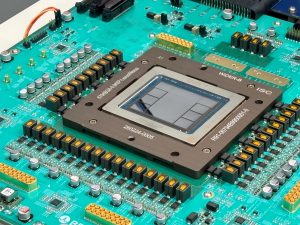
[News] Huawei Brings Forward Ascend 950DT Deployment to August, DeepSeek V4.2 Seen as Potential Early Adopter
DeepSeek V4 is already running on Huawei’s Ascend 950 AI computing platform, as Huawei’s AI chip roadmap appears to be accelerating. According to Mydrivers, Huawei Vice President and President of Huawei Cloud China Chen Lin said Huawei plans to deploy the next-generation Ascend 950DT on Huawei Cloud in August, earlier than its previously expected fourth-quarter launch.
Beyond Huawei’s own platforms, DeepSeek is expected to be among the first companies to deploy the Ascend 950DT. Based on the reported timeline, following the release of DeepSeek V4.1 in June, DeepSeek V4.2 could potentially launch as early as August, as Mydrivers notes.
Chen Lin also said Ascend chips are advancing at a pace of one new generation per year, with computing performance doubling with each generation, as Guancha.cn indicates. Compared with the previous generation, the Ascend 950DT delivers significant gains in vector computing performance, memory bandwidth, and interconnect bandwidth.
As Guancha.cn states, Chen Lin said the chip is more developer-friendly, simplifies model optimization, and is better suited for autonomous-driving applications. He also noted that tightening global compute supply and rising storage costs are creating new challenges for AI model, and efficient data processing and storage have become key factors in maintaining a competitive edge in autonomous-driving models.
Huawei Cloud is also strengthening the infrastructure behind large-scale AI development. According to Guancha.cn, the company uses its LingQu architecture to enable high-speed interconnects within supernodes, improving training efficiency. The company has also built a global computing network spanning 34 regions and 102 availability zones worldwide, based on its in-house chips, the report notes.
According to the report from Guancha.cn, more than 2 million autonomous-driving vehicles connect to Huawei Cloud each day. Huawei Cloud also provides access to over 100,000 Ascend accelerator cards, supporting the continuous training and refinement of customers’ autonomous-driving algorithms.
Ascend 950DT Boosts Bandwidth Through HiZQ 2.0 Memory Design
As Mydrivers explains, Huawei’s Ascend 950 family includes two variants: the Ascend 950PR and Ascend 950DT. While both are built on the same processor core, they feature different memory architectures tailored to different AI workloads. The Ascend 950PR pairs the Ascend 950 core with Huawei’s HiBL 1.0 memory system and is primarily designed for inference prefill workloads, helping lower costs compared with solutions based on higher-performance but more expensive HBM3E and HBM4E.
The Ascend 950DT, meanwhile, is optimized for inference decode and training workloads, which place greater demands on memory bandwidth and interconnect performance. To meet these requirements, Huawei developed its HiZQ 2.0 memory architecture, a proprietary HBM technology. Under this design, memory capacity increases from 128GB to 144GB, while bandwidth rises from 1.6TB/s to 4TB/s. The Ascend 950DT also supports FP8, MXFP8, MXFP4, and HiF8 data formats, the report adds.
Regarding the manufacturing process, Eastmoney.com notes that the chip is likely based on SMIC’s N+3 node.
Read more
- [News] Peking Univ. Unveils EDA for Huawei LogicFolding; Kirin 2026 Reportedly Eyes 3nm-Class Performance
- [News] Huawei Ascend, Cambricon and Hygon Completed Day 0 Adaptation to DeepSeek-V4
(Photo credit: Huawei)