[Insights] NVIDIA’s US$2B Marvell Deal: What’s the Strategic Significance for CPO and AI Interconnects?
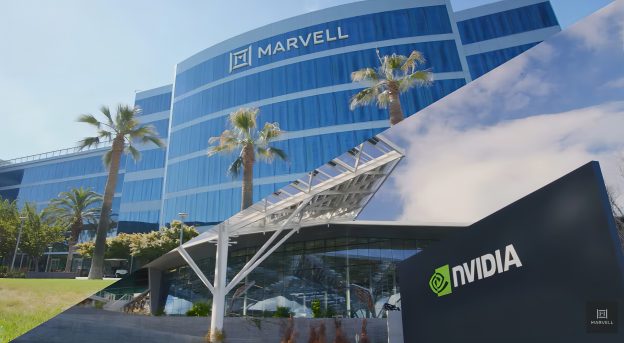
NVIDIA announced on March 31, 2026 that it has entered a strategic partnership with Marvell and will invest US$2 billion, a move expected to support the development of next-generation AI and optical interconnect technologies. According to TrendForce, the collaboration goes beyond Marvell joining the NVLink Fusion ecosystem, with the two companies set to jointly develop silicon photonics.
TrendForce notes that NVIDIA is integrating optical communications, lasers, silicon photonics, customized XPUs, and scale-up networking into its portfolio, signaling that optical transmission is no longer a next-phase option, but an ongoing upgrade in AI infrastructure.
NVIDIA’s Bet on CPO: From Switches to Full AI Rack Architectures
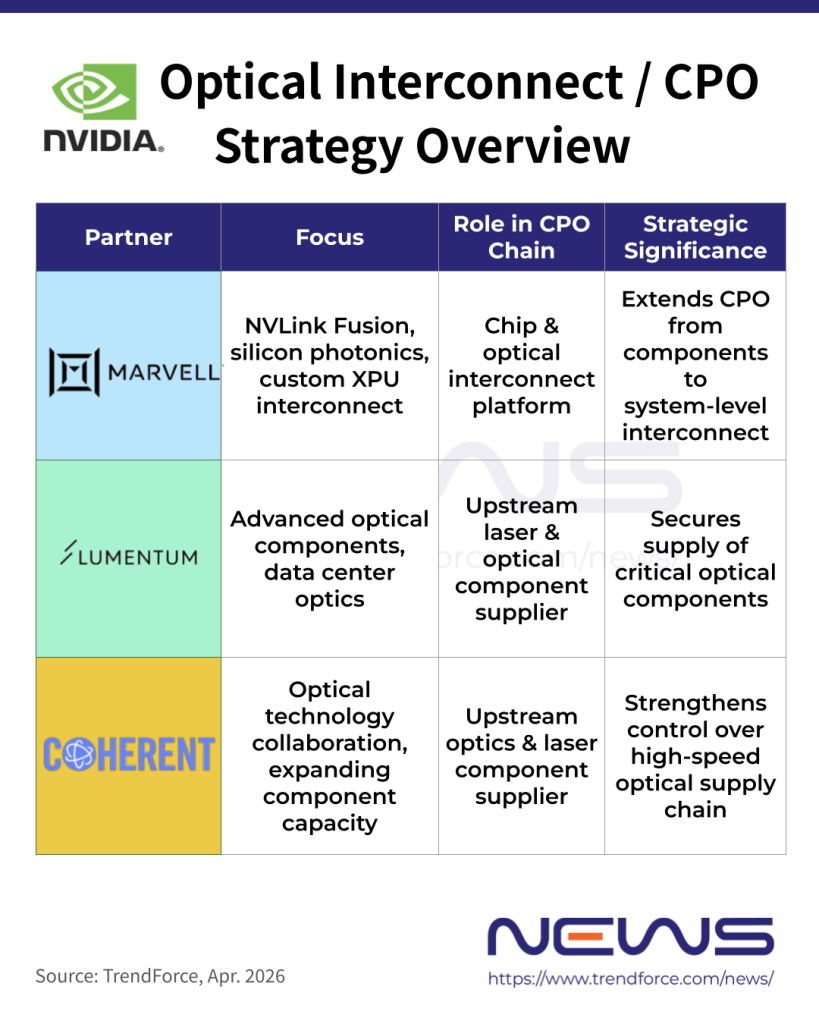
Based on the scope of the collaboration, NVIDIA is not merely taking a stake in a networking or ASIC company, but is formally integrating Marvell into its NVLink Fusion architecture. As TrendForce notes, Marvell will provide custom XPUs and NVLink Fusion-compatible scale-up networking, while NVIDIA will contribute its Vera CPU, ConnectX NICs, BlueField DPUs, NVLink interconnect, Spectrum-X switches, and rack-scale AI compute. This suggests NVIDIA is pursuing a broader strategy to enable more customized AI infrastructure to be built on its own interconnect frameworks.
Focusing on CPO, the strategic significance of this investment lies in Marvell’s ability to extend CPO beyond switches into the domain of custom AI accelerators. Marvell has previously showcased a CPO architecture tailored for custom AI accelerators, emphasizing its ability to scale XPU connectivity from dozens of units within a single rack to hundreds across multiple racks. Marvell said its silicon photonics technology has been shipped commercially for over eight years. For NVIDIA, this effectively brings the interconnect layer—one of the most likely bottlenecks in future AI rack architectures—into a technology stack under its own architectural control.
NVIDIA Builds a Full Optical Interconnect Stack, Beginning with Lumentum and Coherent
Looking back, NVIDIA had already announced separate US$2 billion investments in Lumentum and Coherent, with the partnerships including access to future capacity for advanced laser components. This reflects a shift in NVIDIA’s approach to optical communications, moving from simply procuring components to securing supply through capital investment and orders. Against this backdrop, TrendForce notes that the investment in Marvell is not an isolated move but part of a broader strategy. Lumentum and Coherent focus on upstream lasers and key optical components, while Marvell adds platform capabilities in custom silicon, optical interconnect, and scale up networking.
In other words, NVIDIA is systematically securing the most critical interconnect assets of the AI era—from components and optical engines to system architecture. According to TrendForce, the true significance of NVIDIA’s investment in Marvell lies in ensuring that, even as CSPs adopt custom XPUs, AI ASICs, and diverse accelerators, these systems will continue to be built on NVIDIA-defined interconnect, switching, and optical communication frameworks. For the supply chain, strategic focus will extend beyond GPU packaging and manufacturing to include silicon photonics, optical engines, optical switches, rack-scale scale-up networking, and overall CPO mass production integration capabilities.
Read more
- [News] Silicon Photonics Race Intensifies as TSMC Targets 2026 COUPE Production, Samsung Eyes 2029 CPO Turnkey
- NVIDIA Compute Architecture Paves the Way for Scale-Up Optical Interconnects; CPO Penetration in AI Data Centers Expected to Rise Steadily, Says TrendForce
(Photo credit: Marvell)