[News] Two Key Breakthroughs Advance Full-Color Micro LED Microdisplays
Amid rising demand for AR/VR devices, Micro LED microdisplay technology is accelerating its transition from lab-scale development to commercialization. On one hand, chip dimensions are approaching the submicron level, raising requirements for processes and materials. On the other, full-color technologies, like quantum dot (QD) color conversion and vertically stacked RGB architectures, continue to make progress. Recently, two developments from Europe, spanning both industry and academia, are expected to accelerate breakthroughs toward full-color Micro LED microdisplays.
Industry: Polar Light Advances Dual-Color Micro LED Microdisplay Project
It’s reported that Swedish Micro LED company Polar Light Technologies has recently secured Euro 1.1 million in funding under the EU Eurostars program, in collaboration with die bonding specialist Finetech. The project, named “2ndGenMicroLED,” will run for 18 months and aims to develop a dual-color Micro LED microdisplay prototype with higher integration density enabled by advanced process technologies.
In this project, Polar Light will use its proprietary bottom-up mask-based deposition process to develop dual-color Micro LED devices. Compared with conventional epitaxy-and-etch approaches, this method offers advantages in nanoscale size control and material utilization. Finetech will provide high-precision die bonding solutions to support efficient chip integration.
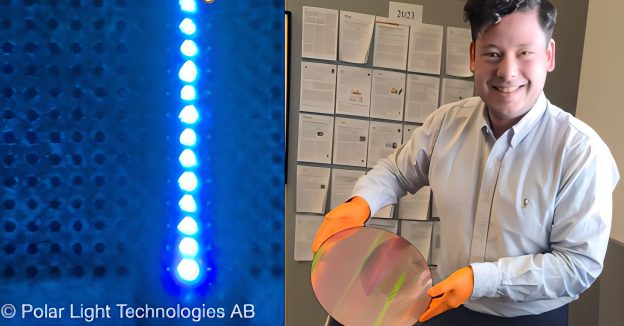
Polar Light began developing monolithic full-color technology since 2014 and identified an InGaN-based pyramidal Micro LED structure as a promising solution. In May 2025, the company unveiled its first Micro LED microdisplay prototype and has since continued optimizing device size and emission performance.
In early 2026, Polar Light announced the successful fabrication of InGaN LED devices with dimensions of 500nm and below, which it described as the smallest LEDs demonstrated to date. The company plans to launch its first commercial products in 2026, initially focusing on monochrome Micro LED microdisplays before gradually expanding to multi-color and full-color solutions.
On the financing front, Polar Light has also gained continued market recognition. In January this year, the company completed a new funding round exceeding Euro 5 million, bringing its total funding to Euro 13 million.
Polar Light introduced its plan to initiate a pilot production line for monochrome green displays in 4Q26. The solution involves fabricating its proprietary 5μm etch-free pyramidal Micro LED structures using InGaN materials on CMOS substrates.
Meanwhile, the company continues to advance its monolithic full-color technology roadmap, targeting full-color product launches by 2028. This aligns with TrendForce forecasts that full-color LEDoS devices will enter mature commercialization between 2027 and 2028, alongside strong growth in AR smart glasses demand.
Research: CEA-Leti Addresses Submicron Micro LED Color Conversion Challenges
On the materials front, France-based research institute CEA-Leti recently reported a key breakthrough: the development of green and red-emitting thin-film perovskite color conversion layers (CCLs) using pulsed laser deposition (PLD), offering a new pathway for high-resolution microdisplays.
Currently, quantum dots are widely used for Micro LED color conversion, but their relatively low absorption requires thicknesses of 3–10μm to achieve effective conversion—posing a major limitation as pixel sizes shrink.
To address this, CEA-Leti introduced inorganic halide perovskite materials—CsPbBr₃ for green and CsPbI₂Br for red—and utilized pulsed laser deposition (PLD) to achieve uniform deposition on 200 mm wafers at room temperature. These materials feature a direct bandgap, high absorption coefficient (~10⁵ cm⁻¹), and narrow emission bandwidths (17 nm at 516 nm for green and 31 nm at 640 nm for red).
The perovskite CCL achieves an absorption coefficient of up to 6.4 × 10⁴ cm⁻¹ at 450nm, several to up to 20 times higher than that of InP quantum dots. This enables approximately 90% blue light absorption with film thicknesses of just 500nm (green) or 360nm (red), significantly reducing thickness requirements and supporting Micro LED designs with pixel pitches below 1μm.
When combined with color filters, the solution can theoretically cover around 90% of the Rec.2020 color gamut, approaching high-end display standards. Moreover, the tunable composition of perovskites allows further optimization of emission wavelengths.
Preliminary results show that CsPbBr₃ films maintain stable emission wavelength and full width at half maximum across excitation power densities ranging from 0.06 to 715 W/cm²—well above the brightness levels required for AR/MR applications (typically ~1 W/cm² corresponding to 100,000 nits). This indicates strong potential for high-brightness applications, although long-term stability still requires further validation.
Conclusion
Recent developments from Polar Light and CEA-Leti highlight new pathways toward full-color Micro LED microdisplays, spanning both manufacturing processes and material innovations. Looking ahead, with continued efforts across the global supply chain and strong momentum from end-market brands, Micro LED microdisplays are expected to accelerate from proof-of-concept toward large-scale commercialization as key technologies mature and costs improve.
(Photo credit: Polar Light)