[Insights] NVIDIA Expands Robotics Ecosystem at GTC as Physical AI Moves Toward Large-Scale Deployment
NVIDIA showcased its robotics technologies at GTC 2026. According to TrendForce, the company integrated Cosmos, Isaac, and GR00T to link virtual simulation with real-world training and deployment, helping reduce training costs and accelerate commercialization as simulation advances. TrendForce notes that NVIDIA is also building a chip and mechatronics ecosystem with Infineon, NXP, and TI to strengthen safety and control. Looking ahead, GR00T N2 and medical applications are expected to further enhance generalization and regulatory standards, supporting large-scale deployment.
Physical AI Platform Takes Shape: A Key Leap from Simulation to Real-World Deployment
A review of NVIDIA GTC 2026 shows that Physical AI remains the event’s central theme. TrendForce notes that newly introduced technologies—including the Cosmos world model, the Isaac robotics development framework, and the GR00T series of robot foundation models—aim to build a comprehensive Physical AI platform, enabling AI to move beyond the digital realm and power a wide range of physical machines.
Through Omniverse digital twins and the Isaac simulation environment, developers can train and validate robot strategies in virtual settings before deploying them in real-world systems, significantly reducing development costs and risks. Major industrial robot makers, including ABB, FANUC, and KUKA, have adopted these technologies to narrow the simulation-to-real gap and accelerate deployment across manufacturing, logistics, and service applications.
Focusing on humanoid robotics, TrendForce points out that GTC 2026 introduced more tools geared toward commercialization. GR00T N1.7 is available in early access with commercial licensing, featuring advanced dexterous control for mass-produced robots. Isaac Lab 3.0, also in early access, is built on the new Newton physics engine 1.0 and adds reinforcement learning for physical simulation and complex dexterous tasks, enabling large-scale robot training on DGX-class infrastructure.
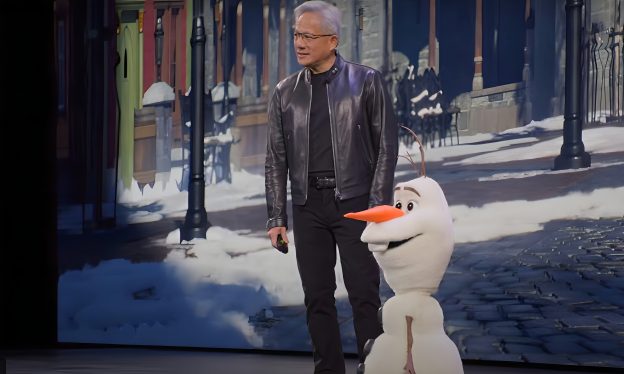
TrendForce notes that major players—including 1X, AgiBot, Agility, Boston Dynamics, Figure, and Hexagon Robotics—have adopted Cosmos, Isaac Sim, and Isaac Lab for development and validation. As simulation technologies advance, training costs for humanoid robots are expected to decline rapidly, suggesting that scenarios like the “Olaf” companion highlighted in the GTC keynote may not be far off.
Emerging Chip–Mechatronics Ecosystem; Safety Control the Key Battleground
In terms of industry collaboration, TrendForce notes that, ahead of GTC 2026, NVIDIA unveiled humanoid robotics hardware partnerships with several semiconductor companies. Infineon is integrating its PSOC and AURIX MCUs into the NVIDIA Holoscan Sensor Bridge to enable efficient and safe precision motion control. NXP is focusing on real time, full body data processing and low latency networking, leveraging its i.MX 95 processors and S32J TSN switches to build a comprehensive robotic sensing architecture. Texas Instruments (TI), meanwhile, is incorporating its millimeter wave radar into the Jetson Thor platform, enabling robots to safely perceive their surroundings even in dense fog and low light conditions.
Overall, NVIDIA’s processors serve as the “brain,” while European players provide key “body” components, including safety electronics, sensing, and motion control, forming a complementary architecture.
Looking ahead, TrendForce highlights that NVIDIA plans to launch the GR00T N2 model by end 2026. Built on its in-house DreamZero World Action Model architecture, it is expected to more than double the success rate of robots performing new tasks in unfamiliar environments compared with existing vision language action models, accelerating the shift from specialized systems to general-purpose platforms.
Another key development, as TrendForce notes, is NVIDIA’s expansion of Physical AI into medical robotics. The company is collaborating with surgical robot makers to integrate AI and simulation technologies to enhance precision and safety. Given stringent standards such as FDA certification, ISO 13485, and IEC 62304, which impose near-zero tolerance for software errors, these efforts are expected to accelerate the maturation of safety and certification systems, paving the way for large-scale commercialization of Physical AI.
(Photo credit: NVIDIA)