[News] U.S. Reportedly Mulls Tiered AI Chip Export Rules, 200K+ Units Need Investment, Official Assurances
Amid uncertainty surrounding exports of NVIDIA’s H200 GPU to China, U.S. officials are reportedly weighing a new framework to tighten oversight of AI chip shipments. According to Reuters, Washington is considering rules that could require foreign governments to commit to investing in U.S. AI data centers or provide security assurances in order to secure exports of 200,000 chips or more, citing a document it reviewed.
The report says that if enacted, the proposal would be the first U.S. effort to control AI chip flows to allies since Trump’s administration scrapped the previous “AI diffusion” rules. It would also give Washington leverage to demand more AI investment domestically while determining each country’s AI processor allocation, Reuters adds.
Notably, Reuters highlights the approach marks a clear shift from Biden’s framework, which assumed close allies could import advanced AI chips with minimal limits, while keeping existing bans on blacklisted countries, like Russia, intact. Meanwhile, China—previously restricted—was cleared in December to buy NVIDIA’s second-most advanced AI chips, though deliveries have reportedly stalled amid national security reviews, the report suggests.
In a statement posted on X, the U.S. Department of Commerce confirmed it is evaluating new export rules. The agency stressed, however, that any forthcoming framework would differ from what it characterized as the “burdensome, overreaching, and disastrous” proposal advanced under Biden’s administration.
AI Chip Exports Face New Review Thresholds
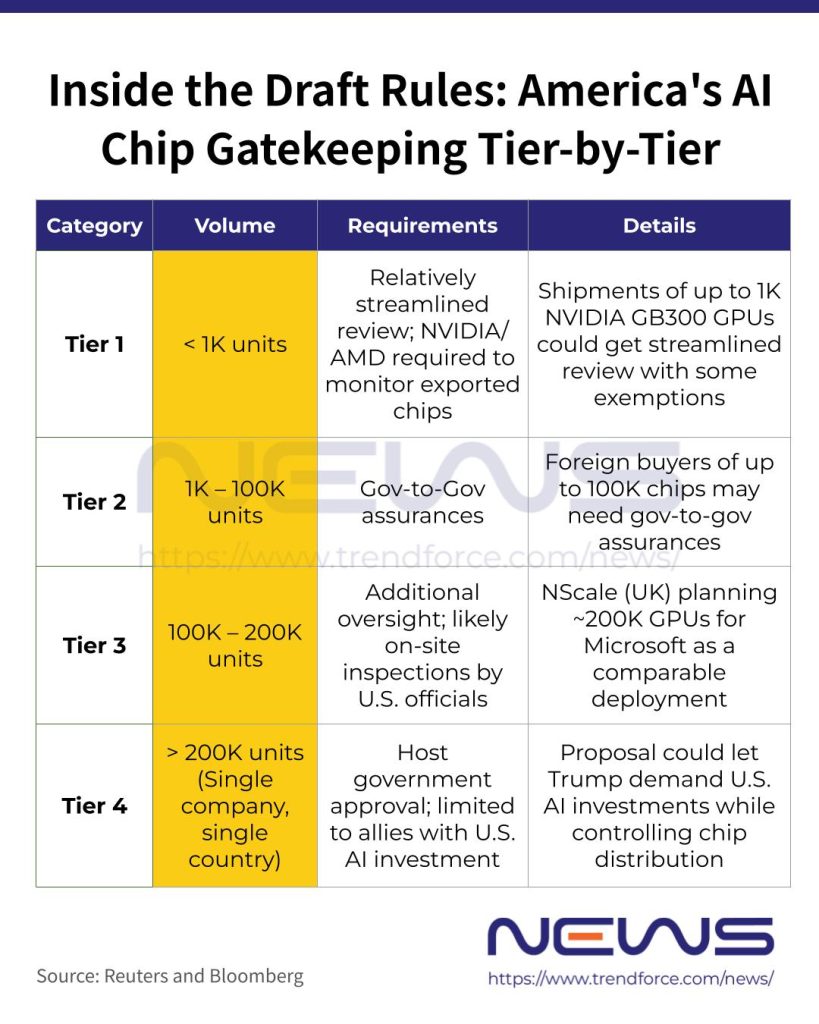
Reuters, citing the draft document, adds that to qualify for an exemption, chipmakers such as NVIDIA or AMD would need to monitor the chips after export, while buyers would be required to run software preventing the processors from being linked into large-scale clusters.
Notably, Reuters reports that even small AI chip shipments—under 1,000 units—could require export licenses, with larger purchases likely subject to stricter conditions. For instance, foreign companies seeking up to 100,000 chips may need government-to-government assurances before shipments are approved.
For installations approaching 200,000 chips, the proposal could introduce an additional layer of oversight, including on-site inspections by U.S. export-control officials, Reuters explains.
A previous Bloomberg report provided more concrete details, noting that shipments of up to 1,000 units of NVIDIA’s latest GB300 GPU would face a relatively streamlined review, with certain exemption pathways available.
According to Bloomberg, for massive deployments—exceeding 200,000 GB300 GPU units owned by a single company in one country—the host government would also need to participate in the approval process. The U.S. would reportedly grant such exports only to allied nations that offer strict security commitments and make “matching” investments in American AI infrastructure, though the draft rule does not specify a required investment ratio.
For comparison, UK-based AI infrastructure provider NScale is planning to supply roughly 200,000 GPUs to Microsoft across four data center sites in the U.S. and Europe, Bloomberg reported.
Read more
(Photo credit: The White House’s X)
Please note that this article cites information from Reuters, Bloomberg, and U.S. Department of Commerce’s X.