[News] Huawei to Show Atlas 950 SuperPoD Overseas for First Time, Challenges NVIDIA on Cluster Scale
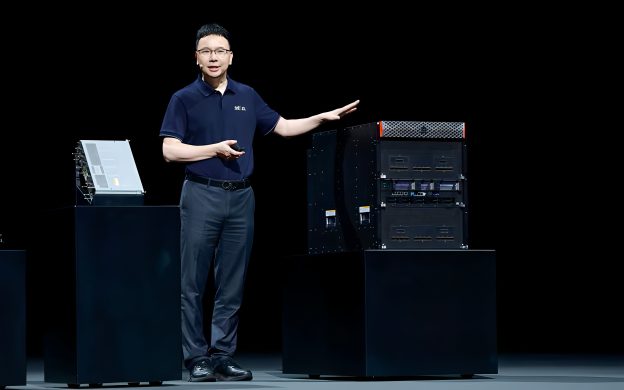
Huawei is expected to present its most advanced AI supercomputer outside China for the first time. According to Nikkei, the company plans to unveil its Atlas 950 SuperPoD at the Mobile World Congress (MWC) in Barcelona. Designed for AI data center deployments, the Atlas 950 SuperPoD integrates 8,192 of Huawei’s Ascend 950 DT chips, marking the firm’s latest high-performance AI infrastructure offering.
The event will provide Huawei with an opportunity to introduce its AI solutions to overseas customers, with the SuperPoD scheduled for commercial release in the fourth quarter of 2026, the report adds. In addition to the Atlas system, Huawei will also showcase the TaiShan 950 SuperPoD, a general-purpose computing platform, along with next-generation servers including the TaiShan 500 and TaiShan 200.
Cluster-Scale AI: Inside Huawei’s Atlas 950 SuperPoD
At full deployment, Huawei said the Atlas 950 SuperPoD will consist of 128 compute cabinets and 32 communication cabinets. As highlighted in the report, all servers are interconnected through optical interconnect technology and Huawei’s proprietary networking solutions to enhance data throughput and overall computing efficiency.
As Nikkei highlights, Huawei has developed a new interconnect architecture for the SuperPoD called UnifiedBus, positioned as its answer to NVIDIA’s NVLink. The two companies share a similar design philosophy, linking compute servers and switches through proprietary interconnect technologies. For example, NVIDIA’s GB300 NVL72 connects 72 Blackwell Ultra GPUs with 36 Grace CPUs, leveraging its in-house NVLink to enable high-speed data exchange.
In terms of performance metrics, the Atlas 950 also marks a substantial leap. According to Guancha, the system delivers 8 exaFLOPS of FP8 performance and 16 exaFLOPS of FP4 performance, with interconnect bandwidth reaching 16PB/s. Guancha notes that the total interconnect bandwidth of a single Atlas 950 system exceeds today’s peak global internet bandwidth by more than tenfold.
Cluster Power Over Chip Power: Huawei’s AI Strategy
In September, according to Nikkei, Huawei’s rotating chairman Eric Xu said the company may not match NVIDIA’s performance on a per-chip basis, but aims to surpass its U.S. rival at the cluster level by integrating vast numbers of chips into unified computing systems. He noted that NVIDIA plans to introduce its NVL144 platform in the second half of 2026, while Huawei’s Atlas 950 SuperPoD will deploy 56.8 times more NPUs than NVIDIA’s GPUs and deliver 6.7 times greater computing power.
Beyond system architecture, Huawei is also accelerating its domestic semiconductor push. Nikkei outlines that the company plans to launch several next-generation AI processors this year, including the Ascend 950PR and Ascend 950DT. Sources cited by the report say the latest Ascend chips will be manufactured using SMIC’s N+3 process technology, an enhanced iteration of its most advanced domestically developed node.
Read more
- [News] Huawei Unveils Ascend 950 with In-House HBM in 2026, Touts SuperPoD to Rival NVIDIA
- [News] Huawei Reportedly Plans 2026 Ascend 950 Sales in South Korea, Targeting Cluster-Level Deployments
(Photo credit: Huawei)