[News] China’s GPU Vendors Roll Out New Architectures and Products, Taking Aim at NVIDIA
At the start of 2026, China’s GPU industry has entered a phase of intensive innovation, with multiple domestic vendors unveiling self-developed architectures and new products targeting specific market segments.
Iluvatar CoreX Unveils Gen-4 GPU Architecture Roadmap
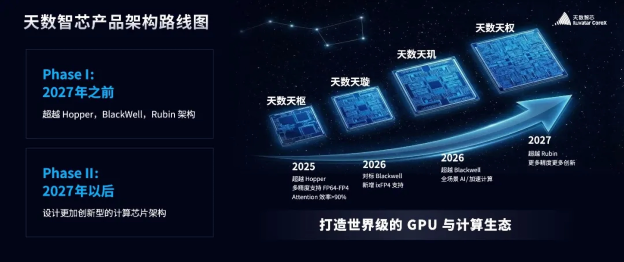
On January 26, Iluvatar CoreX released its fourth-generation GPU architecture roadmap, outlining an ambitious plan to surpass NVIDIA’s Rubin architecture by 2027.
In 2025, the Iluvatar Tianshu architecture outperformed NVIDIA Hopper;
In 2026, the Iluvatar Tianxuan architecture will benchmark NVIDIA Blackwell. Also in 2026, the Iluvatar Tianji architecture aims to surpass Blackwell; In 2027, the Iluvatar Tianquan architecture is planned to exceed NVIDIA Rubin; Beyond 2027, the company will shift its focus toward breakthrough computing chip architectures.
Meanwhile, Iluvatar CoreX launched the “Tongyang” series of edge and endpoint computing products. The entire Tongyang lineup delivers verified, real-world dense computing performance, covering the 100–300 TOPS range. In benchmark tests across computer vision, natural language processing, and inference tasks for large models such as DeepSeek 32B, the TY1000 reportedly outperforms NVIDIA’s AGX Orin across the board.
The Tongyang portfolio includes:
TY1000: a pocket-sized computing module featuring a 699-pin interface that integrates enterprise-grade computing power for easy deployment;
TY1100: equipped with an ARM v9 12-core CPU and a self-developed GPU, offering robust performance and diversified configuration options;
TY1100_NX: featuring expanded memory capacity and strong cost-performance, positioned as a compact yet powerful edge device;
TY1200: delivering up to 300 TOPS of performance in a compact form factor, tailored for cutting-edge scenarios such as AI PCs and embodied intelligence.
On January 8, 2026, Iluvatar CoreX was listed on the Hong Kong Stock Exchange. As China’s first company to achieve mass production of general-purpose GPUs for both training and inference, it had delivered more than 52,000 GPUs to over 290 customers and completed more than 900 industry deployments as of June 2025.
Sunrise Releases Next-Generation Inference GPU Qiwang S3
On January 27, Hangzhou-based GPU company Sunrise disclosed its three-year product roadmap and launched its next-generation inference GPU, Qiwang S3, alongside the Huanwang SC3 super-node solution for large-model inference and a dedicated inference cloud initiative.
Sunrise follows a development rhythm of “mass-produce one generation, release one generation, and pre-research one generation.” Under this strategy: In 2026, the company will commercialize the cost-effective inference GPU Qiwang S3; In 2027, it plans to launch the high-performance inference GPU Qiwang S4; In 2028, it aims to release the secure and controllable inference GPU Qiwang S5, clearly defining its development path in the inference GPU market over the next three years.
The newly launched Qiwang S3 is China’s first GPGPU to adopt an LPDDR6 memory solution. It supports flexible multi-precision computing from FP16 down to FP4, while offering four times the memory capacity of its predecessor. In mainstream large-model inference scenarios, including full-scale DeepSeek V3/R1 deployments, the per-token inference cost is reduced by approximately 90% compared with the previous generation, translating into more than a tenfold improvement in cost efficiency.
Founded in 2020, Sunrise originated from SenseTime’s large-chip division.
MetaX Launches Xiso X-Series Scientific Intelligence GPU
On January 27, Metax Technologies officially introduced its new GPU brand and product line, the Xiso X-series. Designed specifically for scientific intelligence applications, the Xiso X-series GPUs are deeply optimized for advanced research scenarios.
At the hardware architecture level, the Xiso X206 features full-precision mixed computing capabilities, supporting multiple precision formats to meet the diverse accuracy and efficiency requirements of different scientific workloads.
On the software side, the Xiso X206 is powered by Metax’s self-developed MXMACA software stack, offering full compatibility with mainstream GPU programming models and scientific computing frameworks, while supporting internationally recognized ecosystem interfaces.
In conjunction with Metax’s scientific computing platform, the Xiso X206 can support traditional high-performance computing workloads such as climate and weather modeling, computational fluid dynamics, ocean circulation analysis, and molecular dynamics simulations. At the same time, it provides computing power for AI-for-Science (AI4S) applications, including materials prediction, life sciences research, and advanced meteorological and oceanographic studies.
(Photo credit: Iluvatar CoreX)