[News] China’s Illuvatar CoreX Unveils Bold GPU Roadmap, Reportedly Eyeing NVIDIA’s Rubin by 2027
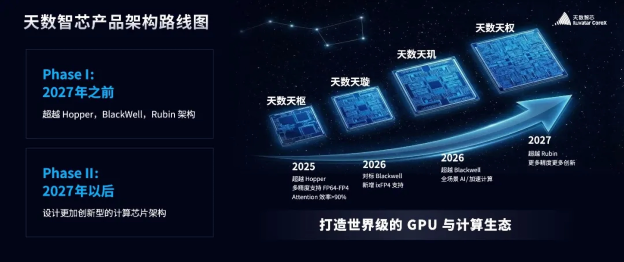
Amid China’s push for chip self-sufficiency, another domestic GPU player is stepping into the spotlight with bold ambitions. According to ijiwei and Mydrivers, Illuvatar CoreX on January 26 unveiled its fourth-generation GPU roadmap, laying out an aggressive plan to surpass NVIDIA’s Rubin architecture by 2027.
As per the company, its roadmap unfolds as follows: its Tianshu architecture has outperformed Hopper (H200 series) in 2025; Tianxuan is set to rival Blackwell (B200) in 2026; Tianji will surpass Blackwell later this year; and Tianquan will exceed Rubin in 2027. Beyond 2027, development will reportedly pivot toward breakthrough computing chip architectures.
Meanwhile, Illuvatar Corex has launched its “Tongyang” edge computing series, with the TY1000 demonstrating performance that reportedly surpasses NVIDIA’s AGX Orin in tests for computer vision, natural language processing, and the DeepSeek 32B large model, Mydriver notes.
Bold Claims, Sparse Details
Wccftech highlights that Illuvatar CoreX stands out among Chinese GPU makers by branding itself as the country’s first GPU company dedicated entirely to high-performance computing (HPC), rather than splitting its focus between consumer and AI markets. The firm also claims it already offers products comparable to NVIDIA’s Ampere generation, including the TianGai-100 and TianGai-150, though public information on these chips remains scarce, Wccftech adds.
As previously reported by Mydrivers, Iluvatar CoreX’s TianGai-100 reportedly delivers a TPP performance density of 2,352, while the TianGai-150 reaches 3,040. The report pointed out that benchmarking against NVIDIA’s H200 would require a TPP performance density of about 15,832, while matching the B200 would call for roughly 36,000. This implies Iluvatar CoreX would need to lift compute performance by around five to twelve times from current levels, the report noted.
As Wccftech reports, Illuvatar CoreX has unveiled an ambitious new roadmap this time but shared few technical details. The company is reportedly building a fully native GPU architecture under its ‘Tianshu Zhixin’ platform, yet key specifications remain under wraps.
Notably, Illuvatar CoreX is not the only Chinese AI chip firms claiming to challenge NVIDIA. Wccftech highlights that Huawei’s upcoming Atlas 950 and 960 SuperPod systems are designed to pack up to 8,192 Ascend 950 chips per rack and are positioned as a rival to NVIDIA’s NVL144.
However, the report notes that more broadly, China’s AI chip startups still face a structural hurdle: the lack of a fully developed semiconductor ecosystem. Without sufficient manufacturing scale and supply-chain support, even advanced architectures risk remaining largely conceptual rather than commercially competitive, the report says.
Read more
- [News] China’s Iluvatar CoreX Reportedly to Unveil 2026–28 GPU Roadmap, Targeting NVIDIA H200, B200
- [News] China’s Moore Threads Unveils Huashan AI Chip, Reportedly Takes Aim at NVIDIA’s Hopper
(Photo credit: Iluvatar CoreX)
Please note that this article cites information from ijiwei, Mydrivers, Wccftech, and Iluvatar CoreX.