[News] HBF Promises Massive Capacity but Could Reportedly Cost More Than HBM, With Bandwidth at Just ~60% of HBM
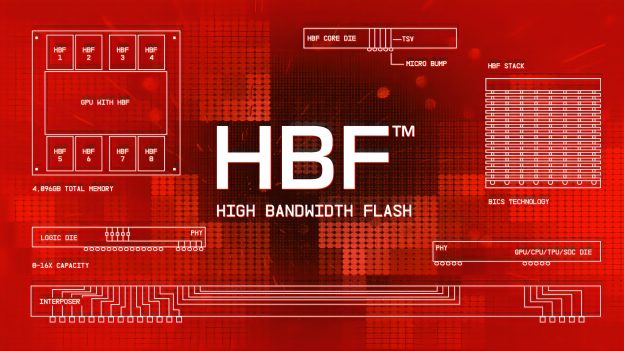
HBF has emerged as a closely watched new memory technology, promising far greater capacity than HBM at a similar cost. However, its potential role may be more limited than initially expected. According to Tom’s Hardware, GPU IP company OXMIQ Labs said at Hot Chips 2026 that High Bandwidth Flash (HBF) is unlikely to replace High Bandwidth Memory (HBM) across the vast majority of workloads. Reuters adds that OXMIQ was founded by former Intel chief architect and AMD executive Raja Koduri and develops licensable chip architecture and software aimed at lowering AI computing costs.
HBF’s Capacity Gains Come at a Bandwidth Cost
As noted by Tom’s Hardware, HBF is based on 3D NAND, with its main advantage lying in capacity rather than performance. It could offer 8–16 times more capacity than HBM at roughly the same cost. OXMIQ therefore argues that HBF should be viewed as a high-capacity memory technology rather than a lower-cost substitute for HBM, with its advantages concentrated in workloads that require large amounts of memory but are less bandwidth-intensive.
OXMIQ illustrated this trade-off by modeling a 72-GPU rack running the 1-trillion-parameter Kimi-K2 model at FP4. At the same cost and power, replacing HBM with HBF increases memory capacity roughly 14x, from 20.7 TB to 294.9 TB, but provides only about 0.6x the aggregate bandwidth, at 922 TB/s versus 1,584 TB/s for HBM. As the report notes, HBF’s larger capacity could significantly reduce the number of GPUs needed simply to fit very large models, with one HBF-equipped GPU potentially doing the capacity job of eight HBM-equipped GPUs. However, as inference throughput rises, HBF’s lower bandwidth becomes a bottleneck, and OXMIQ estimates that HBM can ultimately deliver a lower cost per token.
HBF’s Potential Use Cases and Adoption Challenges
Rather than treating HBF as a slower replacement for HBM, OXMIQ sees it as a high-capacity memory tier for less frequently accessed data, while frequently used data remains in HBM. According to Tom’s Hardware, potential applications include storing large but infrequently accessed MoE expert pools and KV caches. These use cases play to HBF’s strength in providing large memory capacity without requiring consistently high bandwidth.
However, using HBF alongside HBM would require significant changes to today’s inference software. OXMIQ says frameworks such as vLLM would need dedicated HBF support to manage data placement and prefetching while accounting for HBF’s limited write endurance. This also raises questions over broader adoption. Because OXMIQ sees clear benefits only for certain workloads, AMD and NVIDIA may have limited incentive to support HBF broadly given the added complexity of managing multiple memory tiers, Tom’s Hardware adds.
The analysis comes as HBF moves closer to commercialization. Sandisk and SK hynix released the first open HBF specification through the Open Compute Project in August, covering capacities of up to 512GB and bandwidth of up to 3.0 TB/s. As noted by StorageReview, Sandisk also revealed at its August Investor Day that its first HBF memory die has been taped out, with initial HBF inference product samples targeted for 2027.
Read more
- [News] Sandisk Reportedly Tapes Out First HBF Product, Targets 2027 Samples and 2028 Production
- [News] SK hynix, SanDisk Debut HBF Standard to Challenge AI Memory Bottlenecks with Google, Tenstorrent Support
(Photo credit: Sandisk)