[News] From EUV to Backside Cooling: How Middle East Tensions Could Squeeze Bulk Gas Supply for Chipmaking
As the Iran–U.S. conflict escalates, concerns are rising over disruptions to critical supplies from the Middle East, including semiconductor bulk gases. According to TechNews, beyond oil, some global semiconductor bulk gas production also originates from the region. Whether the conflict will disrupt bulk gas supply and, in turn, impact the semiconductor industry has become a key market concern.
TechNews notes that gases used in chipmaking are broadly categorized into bulk gases and specialty gases, with bulk gases often regarded as the “blood” of fabs. Although they do not exhibit the same high reactivity as specialty gases, they are consumed in large volumes and require extremely high purity—typically 9N (99.9999999%) or higher—to ensure process yields.
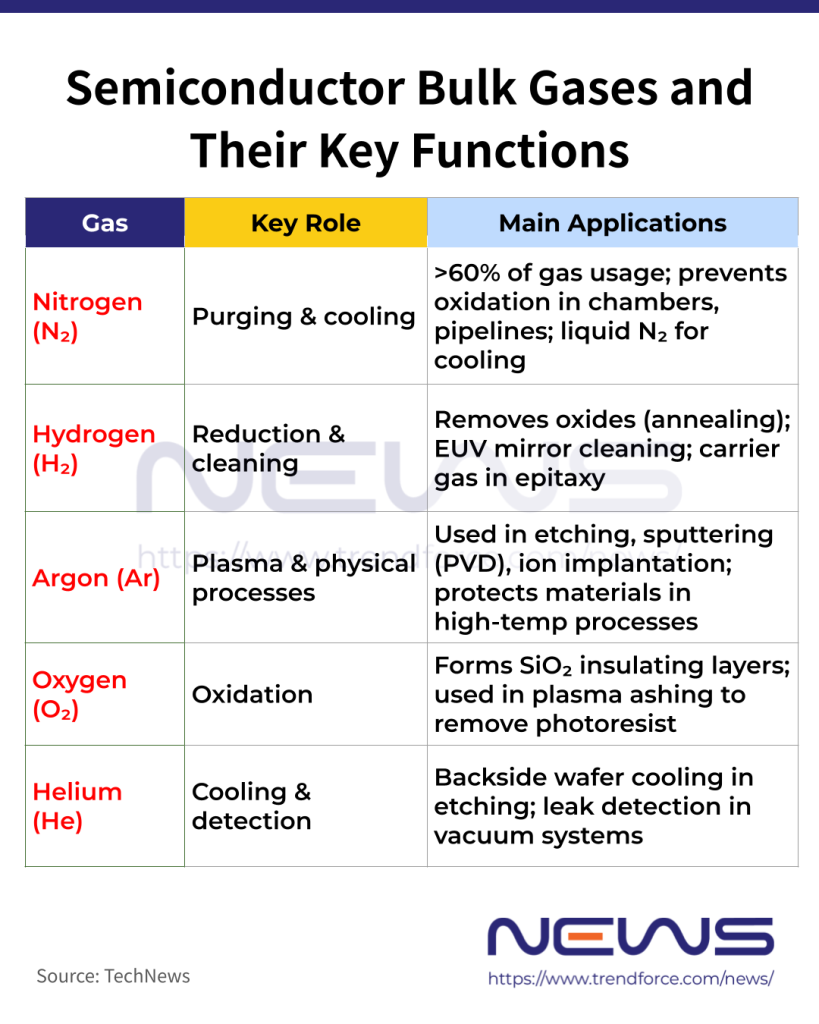
Key Bulk Gases in Semiconductor Manufacturing
As per TechNews, the main bulk gases currently used in semiconductor manufacturing include:
Nitrogen (N₂): accounts for the largest share of gas usage in semiconductor fabs, making up more than 60% of total consumption. It is mainly used to purge reaction chambers, pipelines, and FOUPs (wafer carriers) to prevent oxidation. Liquid nitrogen is also widely used for cooling equipment requiring extremely low temperatures.
Hydrogen (H₂): is increasingly important in advanced processes, primarily for reduction reactions. It is used in high-temperature annealing to remove oxides from wafer surfaces. Notably, in EUV light source maintenance, hydrogen cleans tin deposits from mirrors in EUV lithography systems, critical for tool operation. It is also used as a carrier gas in epitaxy to assist silicon deposition.
Argon (Ar): is used as a medium for plasma and dry etching. As a highly stable inert gas, it is mainly applied in physical processes. This includes plasma generation, where argon is ionized in sputtering (PVD) and ion implantation to bombard targets or clean wafer surfaces. It is also used for insulation and protection, preventing erosion of graphite components during high-temperature silicon crystal growth.
Oxygen (O₂): is used to form oxide layers. In thermal oxidation, oxygen grows a silicon dioxide (SiO₂) insulating layer on the wafer surface. In plasma ashing, oxygen plasma is used to carbonize and remove photoresist.
Helium (He): an excellent thermal conductor. Its small molecular size and high thermal conductivity make it critical for backside cooling, such as in etching, where helium is introduced between the wafer and chuck to quickly dissipate heat and prevent deformation. It is also used for leak detection, as its small molecules can identify even minor leaks in vacuum systems.
As noted by The Korea Herald, Korean manufacturers sourced 64.7% of their helium from Qatar in 2025, according to the Korea International Trade Association. Samsung Electronics and SK hynix, the world’s two largest memory producers, said they hold sufficient helium inventories to withstand several months of disruption. However, industry officials cautioned that a prolonged crisis could tighten supply and drive up costs.
In Taiwan, sourcing is relatively more diversified. According to TechNews, about 30% of helium imports come from Qatar and another 30% from the U.S., with the remainder sourced from other regions, including China. Liberty Times also notes that TSMC has long diversified its procurement of materials such as helium, with inventory exceeding two months. Risks are therefore expected to be manageable and production unaffected, though the company will continue to closely monitor developments.
Read more
- [News] Under Qatar’s Shadow: Helium Crunch Hits South Korea Harder, Putting Samsung, SK hynix, TSMC in Spotlight
- [News] Middle East Energy Turmoil Raises Chip Risks, Spotlight on TSMC Power Use and Bromine for DRAM
(Photo credit: FREEPIK)