Popular Keywords



About TrendForce News
TrendForce News operates independently from our research team, curating key semiconductor and tech updates to support timely, informed decisions.
[News] NVIDIA May Offer First Look at Feynman at GTC 2026, TSMC A16 and Taiwan Supply Chain in Focus

NVIDIA may showcase previously unseen AI technology at NVIDIA GTC 2026, which some speculate could be related to the Feynman chip. According to TechNews, Feynman is a core product that NVIDIA is actively developing and plans to officially launch in 2028. It will also be the company’s first chip manufactured using a 1nm-class process. The report notes that NVIDIA’s current AI chips already rely heavily on Taiwanese suppliers across much of the supply chain, and the launch of Feynman is expected to bring significant benefits to Taiwan’s semiconductor industry.
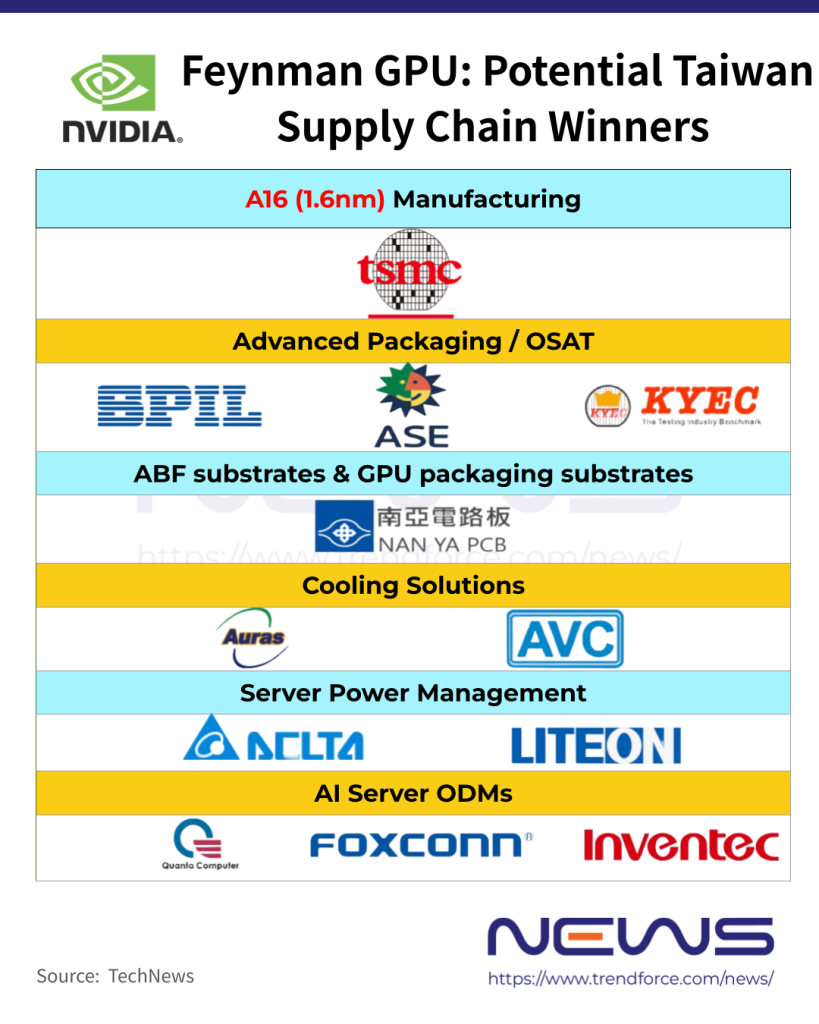
As the report indicates, the biggest beneficiary is expected to remain TSMC. To meet NVIDIA’s demand, TSMC has been expanding production capacity for its A16 (1.6nm) process and plans to begin mass production in the second half of 2026.
Feynman to Boost Taiwan’s Advanced Packaging Supply Chain
Beyond TSMC, Feynman is also expected to benefit other Taiwanese firms. As TechNews notes, the production of GPUs requires highly advanced packaging and testing technologies, driving strong growth across Taiwan’s OSAT supply chain. Major Taiwanese OSAT companies expected to benefit include ASE, SPIL, and KYEC. The report notes Taiwanese companies supplying ABF substrates and GPU packaging substrates, such as Nan Ya PCB, are also expected to see a surge in order demand.
Rising AI GPU Power Puts Cooling and Power Supply in Focus
Meanwhile, as computing power continues to rise, the power consumption of AI GPUs is climbing sharply. The current NVIDIA Blackwell GPU architecture already approaches 1000W, and the future Feynman GPU could push power usage even higher. This makes cooling and power management critical in server design, creating significant opportunities for related Taiwanese hardware suppliers. According to the report, key beneficiaries in the cooling segment include Auras Technology and AVC, while major beneficiaries in the power supply segment include Delta Electronics and Lite-On Technology.
In addition, NVIDIA’s GPUs will be integrated into AI servers, and Taiwan currently serves as the global hub for AI server manufacturing. The report notes that in the hardware upgrade wave potentially driven by Feynman, the server ODMs expected to benefit the most include Quanta, Wistron, Inventec, and Foxconn.
NVIDIA May Diversify Feynman Supply Chain Beyond Taiwan; Intel Said to Be Considered
Despite the dominant role of Taiwan’s supply chain in Feynman’s production, the report points out that NVIDIA may be diversifying its supply chain. According to Wccftech, major tech firms such as NVIDIA are reportedly considering outsourcing less complex, lower-risk chips to Intel—such as Feynman’s I/O die on 14A or 18A, along with EMIB advanced packaging—to help safeguard volume ramp-up should Intel face yield or capacity constraints, while keeping GPU core production anchored at TSMC.
Notably, as indicated by Wccftech, Feynman could mark the first integration of Groq’s LPU hardware stack, as latency becomes a critical focus for GPU developers. The report notes that while the exact architectural details remain unclear, LPUs could potentially be offered as an on-package option with Feynman, though doing so would significantly increase design and manufacturing complexity.
Read more
- [News] NVIDIA GTC 2026 in Focus: Feynman Reportedly on TSMC A16, Samsung & SK hynix to Showcase HBM4
- NVIDIA Compute Architecture Paves the Way for Scale-Up Optical Interconnects; CPO Penetration in AI Data Centers Expected to Rise Steadily, Says TrendForce
(Photo credit: NVIDIA)