Popular Keywords



About TrendForce News
TrendForce News operates independently from our research team, curating key semiconductor and tech updates to support timely, informed decisions.
[News] Cold LED Screens Gain Traction, with LED Driver ICs put to the Limelight
As the global display industry evolves, LED displays are shifting from a singular pursuit of physical performance toward a renewed emphasis on energy efficiency. In earlier years, competition centered on peak brightness, color saturation, and ever-shrinking pixel pitch. However, with the full arrival of the ultra-high-definition era, heat generated by high power consumption has become a growing source of “thermal anxiety,” constraining further industry advancement.
In recent years, leading display makers—including Leyard, Unilumin, Ledman, and Absen—have promoted “cold LED screen” technologies as core product differentiators, aiming to enhance system stability and lifespan by reducing panel temperature. Meanwhile, consumer brands such as Hisense and TCL have highlighted energy savings and precise thermal control as key selling points in their latest RGB-Mini LED and SQD Mini LED TVs, signaling that efficiency has evolved from a secondary metric into a foundational industry consensus.
Behind this transition lie both the global push toward carbon neutrality and the regulatory enforcement of China’s mandatory energy-efficiency standard for displays (GB 21520-2023). In this context, LED driver ICs—serving as the “gatekeepers” that regulate energy distribution across millions of pixels—are being redefined in terms of value contribution and strategic importance.
Ultra-HD Intensifies the Power–Performance Trade-Off, Elevating Driver IC Significance
As LED displays progress toward sub-P1.0 and even finer pixel pitches, pixel density is rising geometrically. The surge in LEDs per unit area severely compresses thermal dissipation space, while accumulated heat not only raises panel temperature but also triggers cascading physical effects.
For instance, red LED chips are highly temperature-sensitive: every 1 °C rise in ambient temperature can reduce luminous efficiency by roughly 1%. Localized temperature differentials across large displays can therefore cause visible color non-uniformity and white-balance drift.
Prolonged high-temperature operation also accelerates encapsulant yellowing and thermal fatigue in driver-IC packaging materials, sharply reducing mean time between failures. In high-load scenarios such as virtual production or command centers—where displays operate at high brightness for extended periods—thermal failure may even lead to system shutdowns. Resolving the tension between display uniformity and system reliability has thus become urgent.
From a power-consumption perspective, shrinking pixel pitch increases pixel density exponentially. Yet improved luminous efficacy and reduced operating current in miniaturized LEDs slow—or even reverse—the growth of total LED power share. By contrast, the proportion of power consumed by traditional 16-channel driver ICs rises sharply, which emerge as the primary efficiency bottleneck.
According to LED driver-IC vendor XM-Plus, in certain ultra-fine-pitch products below P0.7, the combined power share of driver ICs and related circuitry can climb from the conventional 15–30% to 50% or higher, depending on brightness conditions. Driver ICs therefore directly determine display temperature, performance, and lifetime.
If driver-IC conversion efficiency improves by 10%, the impact on full-screen energy efficiency can far exceed gains from LED chip luminous efficacy alone. Take XM-Plus’ XM11206G, released in 2024: through an energy-saving architecture, static black-screen power per pixel is reduced by 20% versus the previous generation—yielding meaningful power and thermal benefits when scaled to 8-million-pixel 4K displays.
Policy tailwinds reinforce this shift. The GB 21520-2023 standard, effective June 1, 2024, sets explicit efficiency thresholds and rating classifications for displays. As a result, adopting high-efficiency driver ICs is no longer optional optimization but a regulatory and market prerequisite.
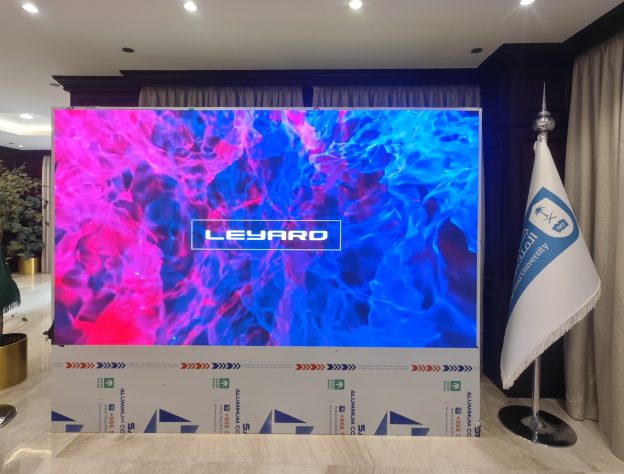
(Photo credit: Leyard)