Popular Keywords



About TrendForce News
TrendForce News operates independently from our research team, curating key semiconductor and tech updates to support timely, informed decisions.
[News] DeepSeek Expands Context Tenfold as Zhipu Rolls Out New Model in China’s AI Race

China’s AI model race is accelerating. According to South China Morning Post, Chinese AI start-up DeepSeek has upgraded its flagship model with a significantly expanded context window and more up-to-date knowledge, fueling anticipation for its next major release.
As part of the upgrade, the report says the model’s context window has been expanded from 128,000 tokens to over 1 million—a nearly tenfold increase expected to strengthen its ability to process and respond to complex prompts. Its knowledge cut-off has also been extended from July 2024 to May 2025, adding nearly a year of new information and allowing users to access more recent data.
However, the upgrade does not introduce multimodal visual understanding capabilities, and the model remains focused on text and voice interactions, as noted by Ifeng Tech.
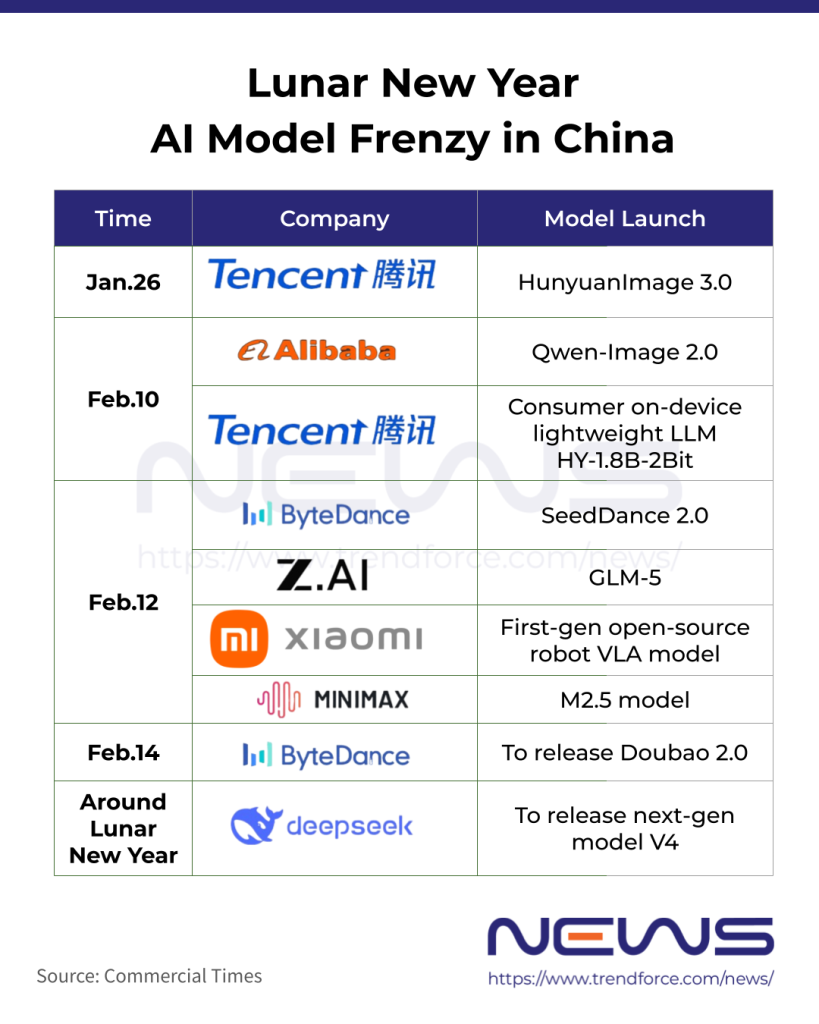
South China Morning Post adds that the update comes amid mounting speculation over DeepSeek V4, as Chinese developers race to roll out new models. Bloomberg further notes that Alibaba is also expected to unveil its flagship Qwen-3.5 model in the coming weeks.
Intensifying Rivalry in China’s AI Arena
Against this backdrop of accelerating launches, South China Morning Post also highlights that DeepSeek’s upgrade coincided with the debut of a new flagship model from Chinese AI startup Zhipu AI on the same day. The report notes that Zhipu AI’s GLM-5 offers enhanced coding and agentic capabilities, driven by a doubling of its parameter count and the adoption of DeepSeek Sparse Attention, a technique designed to balance performance with computational efficiency.
Strong market interest has followed. As reported by Bloomberg, Zhipu AI has increased the price of its GLM Coding Plan by 30% this week to capitalize on surging demand. According to Shanghai Securities News, China’s domestic large model players had previously competed mainly on price, but Zhipu’s price hike this time suggests a clear improvement in the technical strength and market competitiveness of Chinese models.
Meanwhile, ITHome also reports that Zhipu’s GLM-5 has been optimized for deep inference compatibility across a range of domestic Chinese computing platforms, including Huawei’s Ascend, Moore Threads, Cambricon, Kunlunxin, and MetaX. The broad hardware alignment is expected to support efficient deployment across increasingly diverse computing environments.
The competition is not limited to text-based models. TikTok parent ByteDance has also drawn strong praise for its upcoming video-generation model, Seedance 2.0, which remains in testing, according to Bloomberg. Positioned as a rival to OpenAI’s Sora, the model has produced a series of striking demo videos that have circulated widely online.
Read more
- [News] China Steps Up AI Push: Alibaba Latest Qwen Model Nears U.S. Rivals; Moonshot Advances
- [News] Chinese AI Models Reportedly Hit ~15% Global Share in Nov. 2025, Fueled by DeepSeek Open-Source Push
(Photo credit: Zhipu)
Please note that this article cites information from South China Morning Post, Ifeng Tech, Bloomberg, Shanghai Securities News, and ITHome.