Popular Keywords



About TrendForce News
TrendForce News operates independently from our research team, curating key semiconductor and tech updates to support timely, informed decisions.
[News] China Opens Anti-Dumping Investigation into Key Chip Material Dichlorosilane from Japan
As China accelerates its push for domestic chipmaking tool self-sufficiency, aiming for 50% of equipment in any new capacity to come from local suppliers, the country is also stepping up efforts to reduce reliance on critical semiconductor materials. On January 7, China’s Ministry of Commerce announced the launch of an anti-dumping investigation into dichlorosilane (SiH₂Cl₂) imports from Japan.
The move follows an application by Tangshan Sanfu Electronic Materials, which submitted preliminary evidence showing that between 2022 and 2024, imports of dichlorosilane from Japan surged in volume while prices fell by 31%, a trend the company describes as a clear case of dumping.
Tangshan Sanfu also said that over the same period, Japanese products accounted for nearly 72% of China’s dichlorosilane market on average, remaining at an exceptionally high level. It identified Shin-Etsu Chemical, Air Liquide Japan G.K., and Mitsubishi Chemical Group Corporation as among the major suppliers to the Chinese market.
China’s Ministry of Commerce announced that the anti-dumping investigation will cover July 1, 2024, to June 30, 2025, while the industry injury review goes back to January 1, 2022. Authorities said the probe will follow legal procedures, protecting all stakeholders, and is expected to conclude by January 7, 2027, with a possible six-month extension if needed.
Dichlorosilane as Key Material in Chip Manufacturing
Notably, according to EE Times China, dichlorosilane is mainly used in thin-film deposition—including epitaxial, SiC, silicon nitride, silicon oxide, and polysilicon films—for logic, memory, analog, and other chips, as well as silicon-based precursors and polysilazanes. Its high purity directly affects chip performance and yield, making it a high-tech, high-value-added material with strong technological barriers, the report adds.
As EE Times highlights, the global high-end dichlorosilane market has been dominated by Japanese companies such as Shin-Etsu Chemical and Sumitomo Chemical. While China is the world’s largest semiconductor market, its domestic production of high-end electronic chemicals once accounted for only 15–20%, forcing many Chinese chipmakers to rely heavily on imports, the report suggests.
However, the report notes that in recent years, domestic companies such as Tangshan Sanfu Co., Ltd. and Yoke Technology have made technological breakthroughs, producing 6N-grade (99.9999% purity) or higher dichlorosilane, and have successfully passed verification by major Chinese chip manufacturers.
Read more
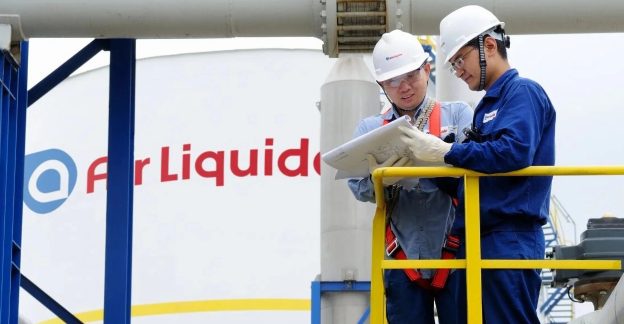
(Photo credit: Air Liquide)
Please note that this article cites information from China’s Ministry of Commerce and EE Times China.