Popular Keywords



About TrendForce News
TrendForce News operates independently from our research team, curating key semiconductor and tech updates to support timely, informed decisions.
[News] China Reportedly Promotes Domestic Chip Tool Adoption Under 50% Rule, Pressuring Korean Suppliers
China has been moving to strengthen technological self-reliance in semiconductor equipment, a shift that is increasingly seen as putting pressure on Korean companies. According to Hankyung, citing sources, the Chinese government is said to be encouraging domestic tool adoption through a so-called “50% rule,” under which chipmakers are expected to purchase one locally made tool for every foreign-made unit they import.
While China continues to source non-substitutable equipment from Europe and other regions, the report says, citing industry sources, that Korean-made tools are increasingly being replaced by lower-cost Chinese alternatives.
As a result, Korean equipment makers have been among the hardest hit by the 50% rule. According to the report, Zeus posted first-to-third-quarter sales of KRW 284.5 billion, down 14% year-on-year, while GST saw revenue over the same period fall 1.65% to KRW 254.9 billion, despite increased exports to the U.S. and Taiwan.
China’s Equipment Drive and the Pressure on Korean Suppliers
China has stepped up investment in its semiconductor equipment sector. As the report notes, since 2014 it has established two rounds of the National Integrated Circuit Industry Investment Fund, or “Big Fund,” totaling 339 billion yuan, and launched a third 340 billion yuan fund last year. The report adds that China views materials, components, and equipment as the weakest links in its semiconductor ecosystem and plans to allocate more than half of the funding to these areas.
Despite China’s heavy investment in the sector, the report notes that in advanced process equipment below 7nm, the so-called “Big Five”—ASML, Applied Materials, Lam Research, KLA, and Tokyo Electron—continue to control more than 90% of the market, while Chinese suppliers remain largely limited to legacy processes of 14nm and above. As a result, Chinese chipmakers seeking to comply with the 50% rule tend to target relatively less complex Korean equipment.
China’s Rising Equipment Players
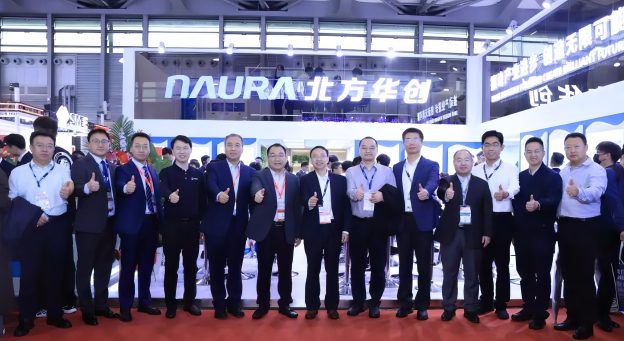
China’s domestic semiconductor equipment makers are gaining momentum. The report notes that SiCarrier, a startup related to Huawei, unveiled more than 30 tools, covering diffusion, deposition, optical inspection, and metrology. Shanghai Micro Electronics Equipment (SMEE) also attracted attention by showcasing a 28-nanometer deep ultraviolet (DUV) lithography tool. Meanwhile, Naura, China’s largest semiconductor equipment supplier, presented ion implantation tools—an area long dominated by U.S. companies.
Read more
- [News] China’s ACM Reportedly Lands Memory Giant Orders; Eyes HBM4-Compatible Cleaning Systems by 2026
- [Insights] China’s Chip Equipment Sector Lands ¥13B in Jan–Oct 2025: 7 Deals That Defined the Surge
(Photo credit: Naura)
Please note that this article cites information from Hankyung.