Popular Keywords



About TrendForce News
TrendForce News operates independently from our research team, curating key semiconductor and tech updates to support timely, informed decisions.
[News] Trump Greenlights NVIDIA H200 Export to China: Chip Reportedly 6x H20 Power, with 25% Fee
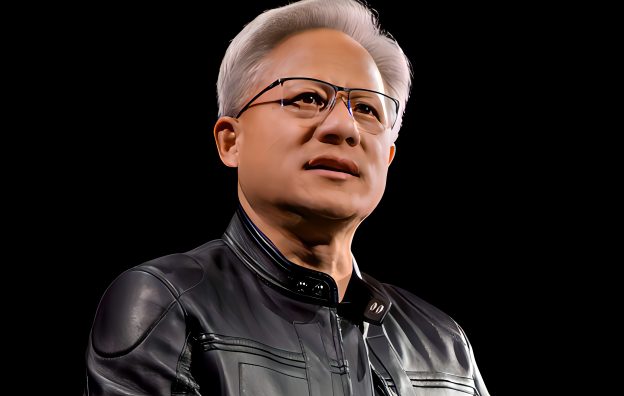
After a protracted tug-of-war, Washington has approved the export of NVIDIA’s H200 AI processors to China, with each unit subject to a 25% tariff-like fee, Reuters and Bloomberg report.
President Donald Trump announced the move Monday on his social media platform, Truth Social, noting that he has already informed Chinese President Xi Jinping, who “responded positively.”
As Reuters highlights, the U.S. Commerce Department is finalizing the specifics of the new arrangement, and that the same framework will extend to other AI chipmakers, including AMD and Intel.
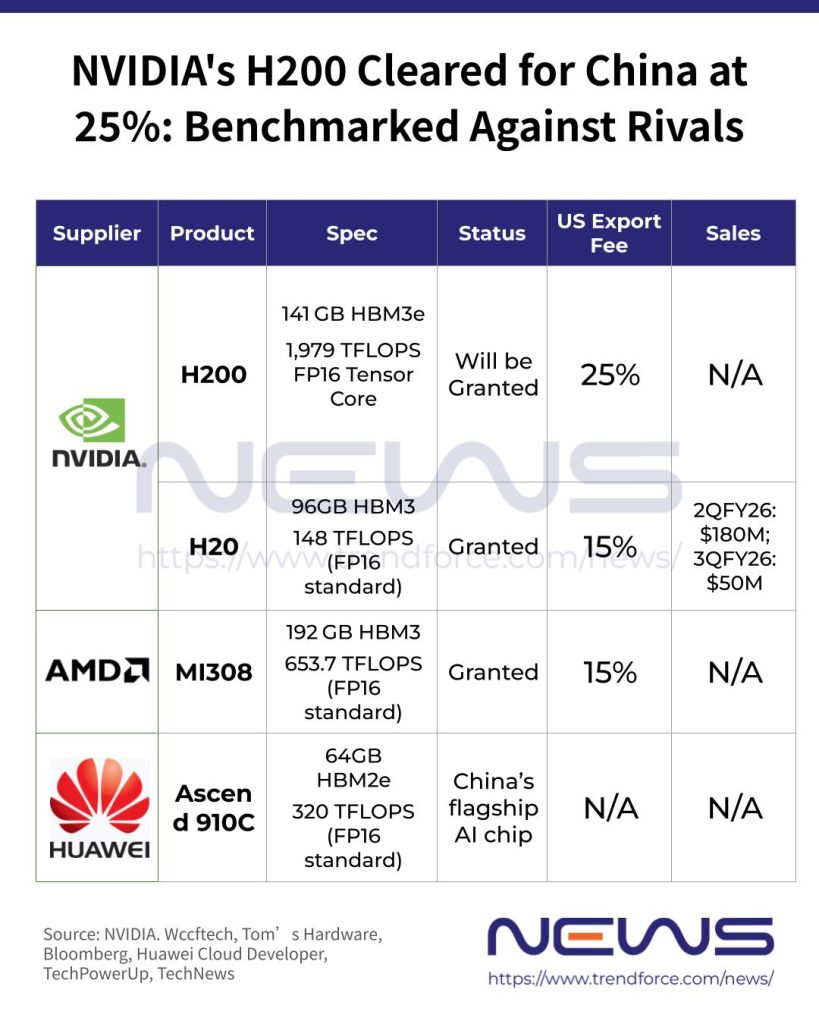
Bloomberg explains that back in August, NVIDIA secured approval to sell its H20 chip to China, while AMD received the green light for its MI308 processor. Under that earlier framework, which Trump promoted at the time, companies would have paid 15% of their China sales to the U.S. government.
According to Trump, NVIDIA’s U.S. customers are already moving forward with the company’s advanced Blackwell chips—and soon the Rubin line—neither of which are included in this latest export agreement. He also did not specify how many H200 units would be authorized for shipment or what restrictions might apply.
Performance Showdown: H200 vs H20 and Blackwell
Though the authorized H200 lags behind Blackwell and Rubin chips, it far outperforms the export-compliant H20. According to Reuters, citing a Sunday report by the non-partisan Institute for Progress (IFP), the H200 delivers nearly six times the performance of the H20—the most advanced AI chip legally exportable to China.
The IFP report adds that Blackwell chips run about 1.5 times faster than the H200 for training and five times faster for inference. NVIDIA’s own tests reportedly suggest Blackwell can outperform H200 by up to tenfold on certain tasks.
On the other hand, Tom’s Hardware points out that NVIDIA’s H200 is a 2022-era processor that, while no longer cutting-edge, still packs strong performance and includes 144 GB of HBM3 memory, a critical spec for training large AI models.
As per the report, Huawei now offers accelerators and rack-scale systems capable of competing with NVIDIA’s H200 and even the GB200 NVL72. Still, many Chinese firms continue to favor NVIDIA hardware, largely because their AI development pipelines are deeply built around the company’s CUDA software ecosystem, Tom’s Hardware notes.
Will China Say Yes?
However, Tom’s Hardware notes a delicate balance. The report suggests that on one hand, China is more likely to approve H200 imports than the H20, since the H200 is a full-featured NVIDIA GPU rather than a deliberately limited, export-only model. Its arrival could significantly speed up China’s AI development, outpacing any current domestic chip, the report adds.
On the other hand, the report also cautions that Beijing’s approval is far from guaranteed, as broad access to the H200 might undermine the progress of China’s homegrown AI-chip initiatives, giving regulators reason to proceed cautiously.
Read more
- [News] US Lawmakers Seek 30-Month Ban on Advanced AI Chips to China, Hitting NVIDIA H200 and Blackwell
- [News] Trump Might Approve 50% Scaled-Down NVIDIA Blackwell for China — Still Beats All Local Chips
- [News] NVIDIA Posts Record Q3 on Blackwell Ultra, Eyes Strong Q4 — H20 Sales Stall at $50M
(Photo credit: NVIDIA)
Please note that this article cites information from Reuters, Bloomberg, Tom’s Hardware, and Truth Social.