Popular Keywords



About TrendForce News
TrendForce News operates independently from our research team, curating key semiconductor and tech updates to support timely, informed decisions.
[News] Trump’s AI Action Plan Launches, But Key Details Like Chip Location Verification Remain Unclear
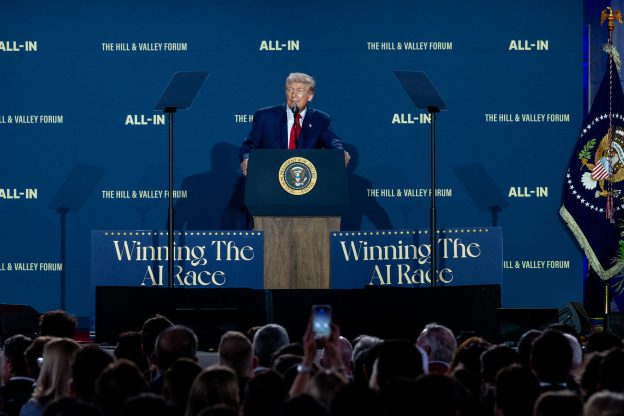
Trump on Wednesday unveiled the long-awaited AI Action Plan, built on three pillars to boost AI development. But key details mentioned—like chip location tracking and new export controls on semiconductor sub-systems—are still up in the air. Here’s a quick breakdown of the major takeaways on AI chips and the broader semiconductor industry, based on media reports and The White House document.
Location Verification for AI Chips Recommended
As Reuters points out, the Trump administration proposed export controls to verify the location of advanced AI chips—a move welcomed by Congress. The recommendation, according to the report, is part of a broader AI blueprint aimed at expanding AI hardware and software exports to U.S. allies, while easing environmental regulations to fast-track new AI data center construction.
Notably, the report suggests that expanding AI product exports could boost major players like NVIDIA and AMD, as well as CSP giants Google, Microsoft, OpenAI, and Meta. But at the same time, the AI Action Plan stresses keeping advanced U.S. AI chips out of foreign adversaries’ hands—where location verification features could play a crucial role, as per Reuters.
However, key questions still linger about how the technology will work and what it will cost, the report notes. According to a May Reuters report, a bill by U.S. Representative Bill Foster targets two main goals: making sure chips stay in approved locations under export licenses, and shutting them down if they aren’t properly licensed.
Loopholes in Semiconductor Export Controls Recognized
This could also be the first time Trump acknowledges potential loopholes in current semiconductor export controls. The AI Action Plan, according to the document, recommends creating new controls for semiconductor manufacturing sub-systems. While the U.S. and its allies regulate major manufacturing systems, many component sub-systems remain unchecked, the plan notes.
Michael Kratsios, head of the White House science office, said the Commerce and State departments will team up with industry to deliver “secure, full-stack AI export packages”—including hardware, models, software, and standards—to trusted allies worldwide, as per Reuters.
However, as TechCrunch suggests, the AI Action Plan offers little detail on how it will forge global AI alliances, coordinate export controls with allies, or work with U.S. firms on chip location tracking. Instead, it focuses on laying the groundwork for long-term AI chip export rules, with more specific guidelines probably expected in the coming weeks.
Read more
- [News] What to Expect from Trump’s Upcoming AI Action Plan: Three Key Focuses Unveiled
- [News] Trump Axes Biden’s AI Diffusion Framework, Targets Huawei, China’s AI Models and Chip Diversion
(Photo credit: The White House’s X)
Please note that this article cites information from Reuters, TechCrunch, and The White House.