Popular Keywords



About TrendForce News
TrendForce News operates independently from our research team, curating key semiconductor and tech updates to support timely, informed decisions.
[News] If Trump Scraps AI Diffusion Rules: 3 Things to Watch – Chip Diversion, Middle East Moves and More
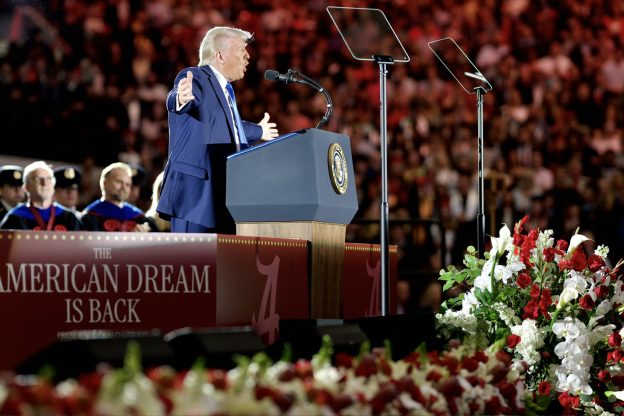
Before Biden’s three-tier AI chip curbs comes into effect, Trump reportedly plans to hit the brakes. According to Bloomberg and Reuters, the AI diffusion rule will not take effect on May 15 as previously scheduled, with Trump pushing to revamp chip export policy.
As per the reports, the Commerce Department’s Bureau of Industry and Security called the Biden AI rule “too complex and bureaucratic,” while claiming to replace it with a simpler rule that boosts innovation and ensures U.S. AI leadership. Here’s what the buzz says about the measures Trump might introduce.
No More Tiered System; New Focus on Chip Diversion
Reuters suggests that though a timeline for the new rule has yet to be provided, Trump officials are considering replacing the tiered system with a global licensing approach based on government-to-government agreements.
The U.S.’s three-tiered control framework applies globally. According to the Center for Strategic and International Studies (CSIS), Tier 1 includes 18 key allies, such as Australia, Canada, Taiwan, the Netherlands, Japan, and South Korea, which have nearly unrestricted access to advanced GPUs. About 120 countries were in Tier 2, facing chip limits, while Tier 3 blocked nations like China, Russia, Iran, and North Korea from accessing advanced U.S. AI chips.
However, as per Bloomberg, the new rules could target countries like Malaysia and Thailand for diverting chips to China.
Better Terms for Middle East Countries
Meanwhile, as Trump gears up for a Middle East trip from May 13 to May 16, the move is good news for countries like the UAE and Saudi Arabia, which have faced U.S. restrictions but now see a chance to renegotiate better terms, as noted in the Bloomberg report.
Under Biden’s AI diffusion rule, these countries were in Tier 2, limiting AI compute deployments to just 7% of a company’s global total—likely stalling their ability to attract future AI investments.
However, Bloomberg also brings up concerns that since 2023, these nations, along with parts of Southeast Asia and the Persian Gulf, have dealt with chip export controls—meaning that a delay in the AI diffusion rule won’t automatically ease NVIDIA’s licensing requirements for data centers there.
Anyhow, Trump may announce the start of a potential government-to-government AI chip agreement during his Middle East trip, Bloomberg suggests.
NVIDIA Poised to Benefit?
While the AI diffusion rule sought to impose different restrictions on shipping advanced AI chips from companies like NVIDIA, AMD, and Intel, these chipmakers welcome Trump’s decision to drop the plan.
According to CNBC, NVIDIA welcomed the policy shift. The company’s spokesperson noted that “with the AI Diffusion Rule revoked, America will have a once-in-a-generation opportunity to lead the next industrial revolution and create high-paying U.S. jobs, build new U.S.-supplied infrastructure, and alleviate the trade deficit,” the report adds.
AMD and NVIDIA CEOs have opposed the AI diffusion rule, with Lisa Su advocating for a balance between security and chip access, while Jensen Huang warned of the losses from being shut out of the Chinese AI market, which will be worth about $50 billion in a few years, as per CNBC.
However, for now, NVIDIA still suffers from Trump’s export restriction on the shipment of H20 to China, which leads to a $5.5 billion quarterly charge.
Read more
- [News] U.S. AI Chip Controls Are Coming— A Breakdown of the Tiered Restrictions
- [News] Trump Reportedly Plans Overhaul of Biden-Era AI Export Tiers in Favor of Direct Country Agreements
(Photo credit: The White House)
Please note that this article cites information from Bloomberg, Reuters, CNBC and Center for Strategic and International Studies (CSIS).