LEDinside: Southeast Asia LED Lighting Market Scale and Trends in 2016
LED Lighting Scale Improved Rapidly, with Penetration of 37% in 2016
 |
The Future Trend is Optimistic, and Southeast Asia will become a major export market for Chinese Manufacturers
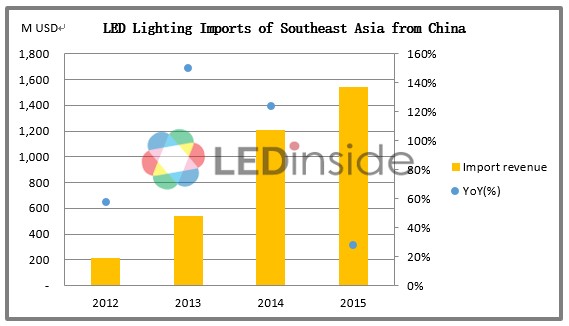
LEDinside expressed, observing the LED lighting product imports of Southeast Asian Nations from China, the total import revenue of the six major countries reached USD 1.54 billion in 2015. All countries achieved rapid growth in imports in 2013 and 2014, while the growth slowed in 2015 due to factors including exchange rate and economic environment.
 |
Although affected by the overall economic environment in 2015, the growth in market and import scale slowed down, it is expected that LED lighting penetration and import revenue in Southeast Asia will continue to improve rapidly in the next few years due to policy incentives and growth in replacement demand. Consequently, Southeast Asia is becoming a major target market for Chinese manufacturers to export LED lighting products.
This report has compiled various data regarding related SEA government and industry agencies, local business partners, import and export figures, to identify and analyze key market variables and offer projections. The study also integrates Market research and firsthand interview of manufacturers or agencies to examine and validate key factors, and offer recommendations, solutions and comprehensive analysis based on these findings.
Due to low labor cost and abundance of natural and human resources, SEA has become one of the most economically dynamic region with immense market potentials. SEA holds a key role in future political and economic positions. General lighting demands have grown as living standards rise in SEA countries, and energy conservation awareness and demands emerge. This will eventually lead to the proliferation and growth of the LED lighting industry.
The lighting market scale of the six major SEA countries which referred to in this report was estimated USD 4.8 billion in 2015, while LED lighting market is expected to reach USD 1.5 billion. LED lighting has a very high market and import growth rates, and LED lighting penetration rate has gradually increased. Despite the slow down of growth speed in 2015 due to overall economic condition, it is estimated in the next few years, government policies and incentives will continue to spur lighting replacement demands. SEA LED lighting market penetration and import volume is expected to soar. SEA market has gradually become the main export market for Chinese lighting manufacturers.
Imported Chinese lighting products, can be classified into five types in the SEA lighting industry supply chain: 1. Chinese manufacturers supply lighting components to local lighting manufacturers. 2. Semi-finished products are imported from China and locally assembled. 3. Imported light sources are assembled locally. 4. Chinese manufacturers playing the role of Original Design Manufacturer (ODM) and shipping the products to SEA countries. 5. Chinese manufacturers distribute their products through wholesale channels or construction projects. In general, due to the lack of local manufacturing capability, international brands such as Philips, GE and Toshiba have the largest market share in SEA countries, followed by major local manufacturers.
The indoor LED lighting products certification standards and regulations in SEA market are relatively low compared to mature markets, such as Europe and the U.S., with the exception of construction projects. By and large, low lumen and high C/P ratio products are favorable in SEA lighting market. Nevertheless, municipal projects such as streetlight constructions have certain product specifications and energy efficiency effects. In addition, the prices of LED lighting products vary across SEA countries.
SEA countries have developed national LED standards that are based on IEC regulations to meet each country’s specific needs. In addition, upon the establishment of ASEAN Economic Community, the ASEAN Harmonized Electrical and Electronic Equipment Regulatory Regime (AHEEERR) will be implemented as guidance for electronic equipment policies and standards. Electronic devices can be sold in other ASEAN countries upon receiving approval in one of the ASEAN countries. The introduction of uniform standards undoubtedly benefits the market of Southeast Asia. Besides, SEA countries have set energy conservation targets and initiated several energy saving projects, which lead to local demands for new energy saving lighting products. This has in turn raised new products quality and performance.
Association of South East Asian Nations (ASEAN) Economic Community is established in 2015, and has become the second global single market aside from EU. ASEAN nations have signed bilateral agreements with China, some of the agreements have lowered tariff or tariff-free on LED products. The lifting of tariffs frees investment and finance flows, plus human resources and transportation facilities and infrastructures. All these can become points of entry into the ASEAN market for Chinese LED lighting manufacturers. Lighting manufacturers have also implemented different strategies, for instance package manufacturers have taken the opportunity to enter local lighting manufacturers supply chain or invested in local factories. Lighting OEMs have also shifted towards new modes of transport that have shortened freight time and distance by directly ship products to emerging markets. Southeast Asian market lighting manufacturers can adapt a single agent, or they can construct local factories and make Southeast Asia their manufacturing hub.
For these manufacturers which are planning to enter SEA market, it need to choose the right distribution channel based on the brand and channel condition; take initiatives to develop and maintain good relations with government; prepared product certification and examination to meet local market requirements; plan for products’ retail prices and specifications in accordance to local market demand. Manufacturers have to focus on their own market positioning based on their company strategy and every aspect mentioned above. Whether it is high end or low end product positions, distribute through construction project or retail, acting as an brand or ODM / OEM, choosing the right positioning strategy is a key factor in entering SEA market.
| For further information about the report, please contact: | |||
| Global Contact: | |||
|
Grace Li +886-2-8978-6488 ext 916 E-mail :Graceli@trendforce.com |
|||
| Taipei: | ShenZhen: | ||
|
Eric Chang Tel : +886-2-8978-6488 ext 822 E-mail : Eric.chang@trendforce.com |
Perry Wang Tel : +86-755-82838931 ext.6800 E-mail : Perrywang@trendforce.cn |
||
| For further information about the advertising, please contact: | |||
| Global Contact: | Taipei: | ||
|
Melissa Ye Tel : +886-2-8978-6488 ext 823 E-mail : Melissaye@trendforce.com |
Christina Tsao Tel : +886-2-8978-6488 ext 824 E-mail : Christinatsao@trendforce.com |
||