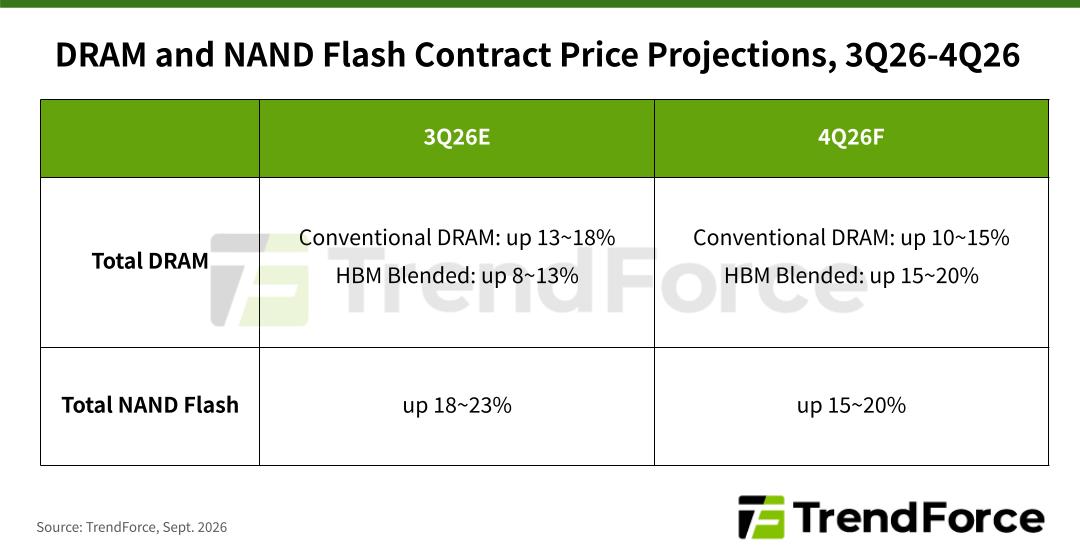
Driven by AI infrastructure, server storage demand surges, prompting manufacturers to shift capacity and advanced nodes. Conversely, consumer electronics languish due to high costs, inflation, and supply squeeze. Contract price growth slows markedly amid buyer resistance, while spot markets weaken, leading to a polarized market entering a plateau.
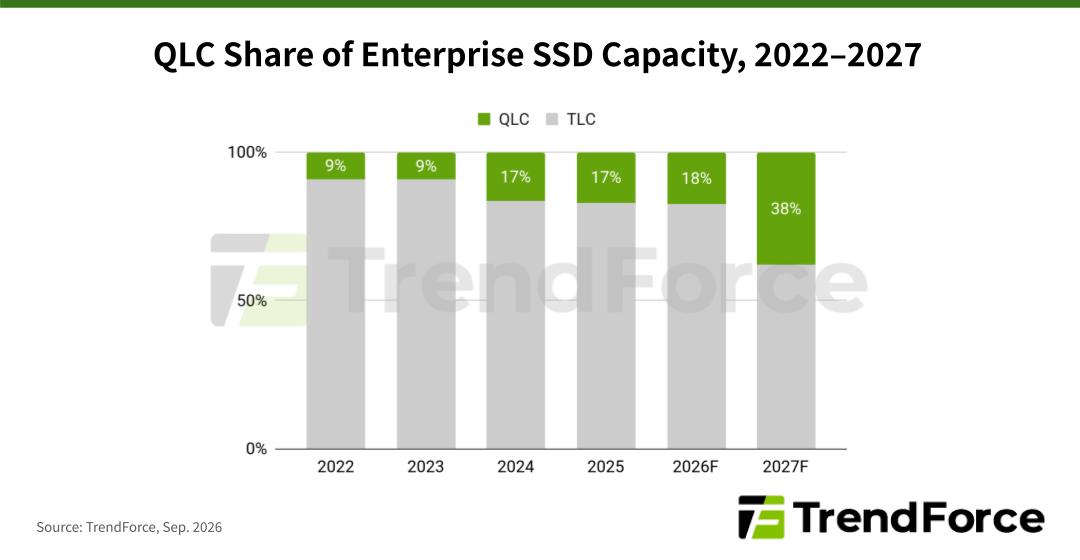
As memory giants realign capacity toward high-value advanced processes, mature node capacity faces severe compression. This structural shift has caused severe shortages in legacy chips, compelling industrial and automotive customers to adopt SLC as an alternative amid critical MLC deficits. Under the twin pressures of demand spillover and supply disruptions, SLC prices are expected to witness an explosive, structural rally in 2H, shifting the market dynamics from shipment-driven to price-driven.
Manufacturers prioritize high-margin sectors, facing buyer resistance in consumer markets due to cost ceilings, which plateaus 3Q26 contract prices and weakens spot markets. However, a major tech earnings surge highlights that infrastructure demands will outpace supply long-term. Advanced architectures and strategic long-term customer agreements are restructuring the industry, shifting memory from a volatile cyclical commodity into a highly predictable, high-profit business driven by structural technology needs.
Driven by AI server demand, 3Q26 memory contract prices continue to rise. However, due to high baselines and consumer cost limits, overall price growth will decelerate.
Contract prices have peaked at historic highs, severely compressing margins for downstream module makers. Coupled with weak end-market demand, buyers are strongly resisting higher quotes and adopting defensive procurement strategies. Consequently, market growth has stalled, shifting into a high-price, low-volume consolidation phase. Although certain scarce products experience minor supply-driven gains, mainstream high-capacity products remain stagnant with limited near-term upside potential.
Driven by AI, automotive, and networking demands, the flash memory market faces structural shortages. Manufacturers shifting capacity to advanced nodes stalls mature output, pushing contract prices toward historic highs amid worsening supply deficits.
2Q26 smartphone memory price negotiations have once again resulted in substantial price hikes. Multiple consecutive quarters of steep increases have left brands unable to absorb the costs, weighing on end-device production. As a result, 3Q26 is expected to see a muted peak season. On the spot market, elevated costs, buyer hesitation, and price expectation gaps have led to a sharp decline in transaction volumes. Brands have also slowed their procurement strategies to maintain cash flow stability.
Due to front-loaded bulk procurement in the first half of the year, consumer electronics will face a weak peak season in the second half, with contract price growth slowing down. The spot market is in a stalemate over pricing. While suppliers maintain extremely low inventory through strict production control, PC, smartphone, and module makers adopt conservative procurement due to weak demand and component shortages. Conversely, cloud service providers keep stocking up for AI, offering solid demand support.
As AI power and heat surge, legacy storage faces thermal bottlenecks. Giants driving thin, blade-like form factors to optimize airflow and surface area. While legacy builds dominate short-term due to business reality, next-gen interfaces will speed the shift, making new form factors vital infrastructure.
The contract market growth slows into a plateau due to weak terminal demand and high costs, while the spot market stabilizes amidst cautious sentiments and low trading volumes. Despite escalating geopolitical sanctions, YMTC successfully breaks through bottlenecks by upgrading technologies, expanding capacity, and pivoting strategic focus. This effectively fulfills local consumer demand and consolidates the foundation of a self-sufficient Chinese semiconductor supply chain.
Research Areas:
Industry News