


Global Power Demand Capacity for Data Centers Expected to Rise 31% YoY in 2026; Grid Supply Gap to Widen in 2028, Says TrendForce
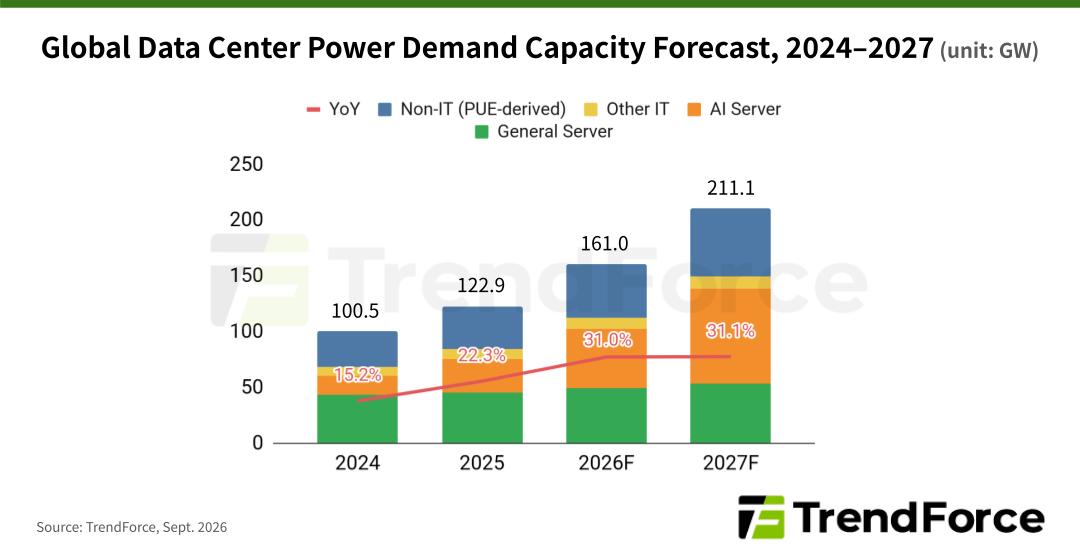
TrendForce’s latest AI server industry research reports that CSPs are accelerating infrastructure deployments to meet surging demand for AI applications. TrendForce estimates that global data center power demand capacity will reach 161 GW in 2026, up approximately 31% YoY. AI servers will be the primary driver of this growth, accounting for an estimated 33.4% of total demand capacity.
TrendForce divides data center power demand capacity into four major categories: general servers, AI servers, other IT equipment, and non-IT equipment such as cooling and power supply systems.
Global data center power demand capacity reached 122.9 GW in 2025 and is estimated to rise to 161 GW in 2026. In 2027, continued CapEx expansion by CSPs and sustained overall server shipments are expected to keep annual growth in data center power demand capacity above 30%.
TrendForce notes that improvements to electrical and mechanical efficiency in data centers have reduced the additional facility load associated with each unit of IT power consumption. However, rapid deployment of IT equipment—led by AI servers—along with simultaneous growth in power demand from non-IT equipment, is prompting data center operators to begin planning for high-voltage direct current (HVDC) power architectures to improve end-to-end power distribution efficiency.
AI servers accounted for nearly 25% of total data center power demand capacity in 2025, with their share rising to approximately 33.4% in 2026. This share could potentially exceed 40% in 2027. By comparison, the share attributable to general servers is expected to decline from around 40% historically to 25.6% in 2027.
Global data center power supply-demand capacity gap estimated at 268 GW by 2030
While power demand at data centers continues to grow rapidly, expansion of grid supply has failed to keep pace. TrendForce estimates that grid deliverability was sufficient to accommodate growth in data center power demand capacity through 2025. However, supply and demand are expected to begin diverging in 2026, with the gap expected to widen significantly from 2028 onward.
By 2030, global data center power demand capacity is projected to reach 490.7 GW. Assuming all other electricity demand is fully met, grid capacity available to data centers is estimated at only 222.6 GW. This leaves a supply-demand gap of 268 GW.
TrendForce notes that this gap should be understood from two perspectives: First, data center electricity demand can be met not only by the grid but also through behind-the-meter, on-site generation developed by operators. Since this capacity is not included in estimates of grid capacity available to data centers, the calculated gap does not reflect the extent to which on-site generation could offset the shortfall. The headline gap may therefore be larger than the actual shortage.
Second, delays in grid interconnection and transmission and distribution infrastructure can create genuine power supply shortages.
In the U.S., which currently hosts the world’s largest concentration of data center deployments, a significant portion of data center demand through 2028 is expected to be grid-connected, with behind-the-meter power emerging as an additional solution. Consequently, projects already planned for grid connection are likely to receive power on schedule.
However, after 2028, delays in grid power delivery are expected to become more frequent, substantially contributing to the growing gap between data center power supply and demand capacity. According to current grid data, TrendForce projects that the U.S. data center power supply-demand gap will surpass 170 GW by 2030. Whether this gap can be further reduced through additional behind-the-meter generation and grid power improvements remains uncertain.
For more on the latest technology industry news and trends, please visit News.