

SpaceX’s Adoption of Qualcomm 5G Chipsets Could Significantly Reduce the Cost of Deploying Tens of Thousands of Base Stations, Says TrendForce
SpaceX and Qualcomm recently announced a multi-year supply agreement under which SpaceX will widely adopt Qualcomm’s Dragonwing 5G base station chipset solutions. TrendForce believes the partnership will significantly reduce SpaceX’s base station deployment costs while simplifying system integration across equipment from multiple vendors, thereby accelerating the large-scale commercial rollout of its 5G network.
TrendForce notes that integrating terrestrial 5G base stations powered by Qualcomm’s Dragonwing platform with a low Earth orbit (LEO) satellite constellation compliant with 3GPP Non-Terrestrial Network (NTN) standards could effectively address two major limitations of conventional satellite connectivity: link budget losses associated with indoor coverage and capacity constraints in high-density user environments.
Under this architecture, terrestrial base stations would handle high-density traffic offloading in urban areas while strengthening indoor coverage. Meanwhile, the satellite constellation would provide wide-area connectivity and extend service to coverage gaps. Together, these complementary networks would enable coordinated operation through a space-terrestrial heterogeneous network (ST-HetNet), supporting a comprehensive range of telecommunications services.
Pre-integrated O-RAN solutions help SpaceX reduce dependence on traditional equipment vendors
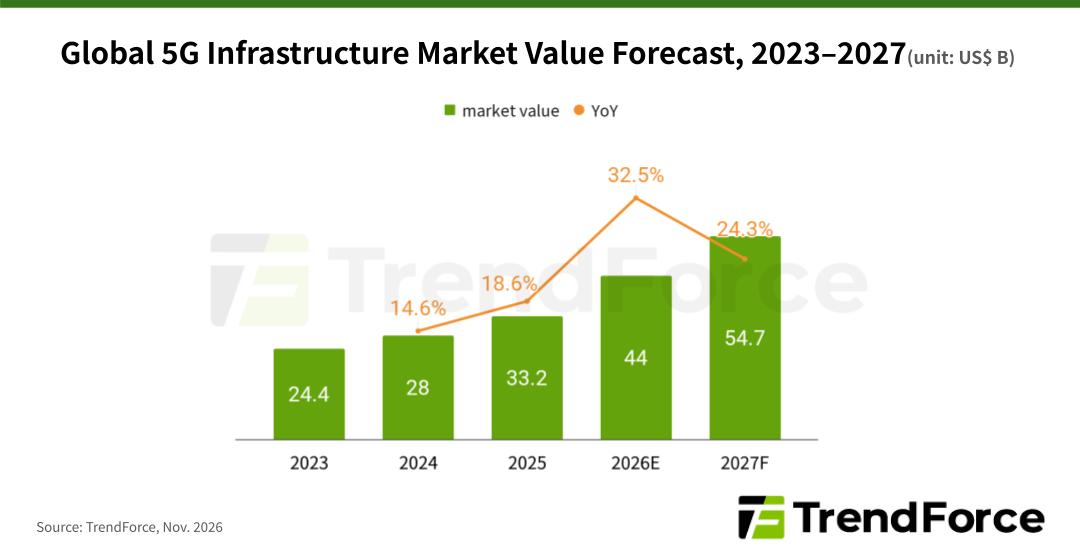
TrendForce projects the global 5G infrastructure’s market value will reach US$55 billion in 2027, up 24.3% YoY, as 5G applications diversify, subscriber numbers rise, and 5G fixed wireless access (FWA) gains traction.
SpaceX is actively expanding into the U.S. mobile communications market, moving away from the proprietary radio access network (RAN) architectures traditionally dominated by telecommunications equipment giants such as Ericsson and Nokia.
Instead, the company has opted for Qualcomm’s 5G base station chipsets, designed for open RAN (O-RAN) architectures. These solutions enable rapid integration of third-party radio units (RUs) and distributed units (DUs), with interoperability supported by standardized open fronthaul interfaces. This approach could substantially reduce the cost of deploying tens of thousands of 5G base stations across the United States. Another key factor behind SpaceX’s decision to partner with Qualcomm is the chipset platform’s ability to enable seamless integration between terrestrial 5G base stations and satellite backhaul links serving remote areas.
Traditionally, telecommunications operators deploying O-RAN networks have faced interoperability challenges when sourcing distributed units (DUs), radio units (RUs), and centralized units (CUs) from different equipment manufacturers. This is because variations in vendor implementations can create signal compatibility issues that complicate network integration and slow deployment.
This time, SpaceX is standardizing its base stations around Qualcomm’s 5G chipset solutions. Qualcomm will complete the integration and interoperability testing of RU-DU fronthaul interfaces before the equipment leaves the factory, helping ensure stable signal transmission during actual network operations. By reducing the complexity of multi-vendor integration, this pre-integrated approach is expected to enable faster and more efficient large-scale network deployment.
Spectrum acquisitions and tower leasing create new supply chain opportunities
Since 2025, SpaceX has progressively acquired a combined 65 MHz of mid-band spectrum from EchoStar, supporting its efforts to expand beyond satellite broadband into direct-to-cell (D2C) connectivity and satellite-enabled vehicle communications.
In October 2026, the company further strengthened its spectrum portfolio by acquiring critical 800 MHz mobile communications spectrum from Grain Management. Furthermore, SpaceX secured access to approximately 80,000 base station sites through leasing arrangements with independent tower operators, accelerating its push toward commercial mobile communications services in the United States.
While SpaceX and Qualcomm work together to accelerate the rollout of mobile communications infrastructure, suppliers of 5G base station components are also positioned to gain new business opportunities.
TrendForce expects established partners within Qualcomm’s ecosystem to be among the primary beneficiaries. Potential suppliers include Amphenol for base station antenna development and Qorvo for power amplifiers (PAs), while American Tower and Crown Castle could provide tower leasing and site infrastructure support.
For more on the latest technology industry news and trends, please visit News.