Global TV Shipments Decline 3.6% YoY in 3Q26 as Brands Target Premium Mini LED and RGB Mini LED Markets, Says TrendForce
TrendForce's latest TV industry research indicates that global TV brand shipments regained some momentum in 3Q26 as manufacturers gradually stepped up inventory preparations ahead of the year-end promotional season.
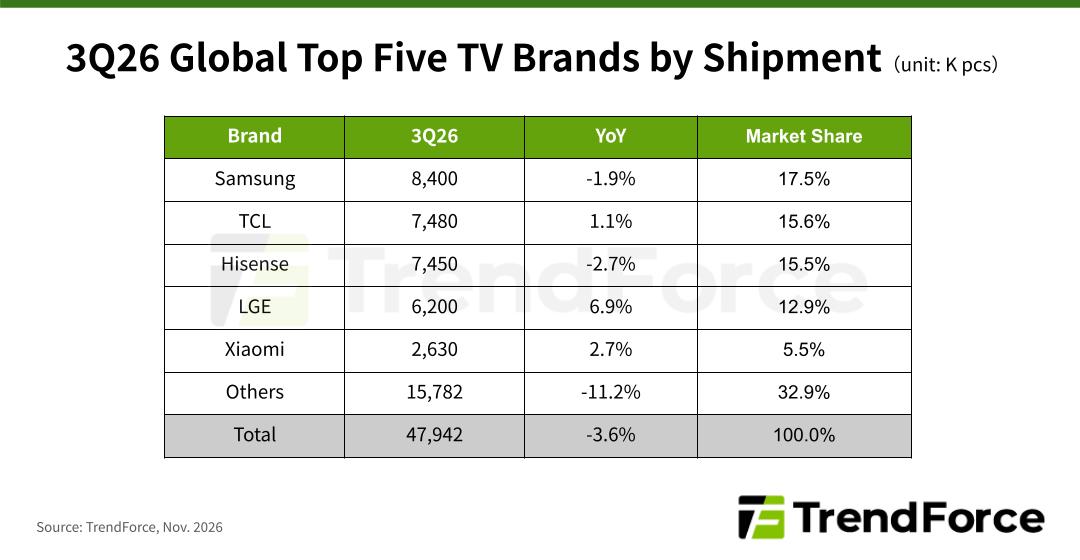
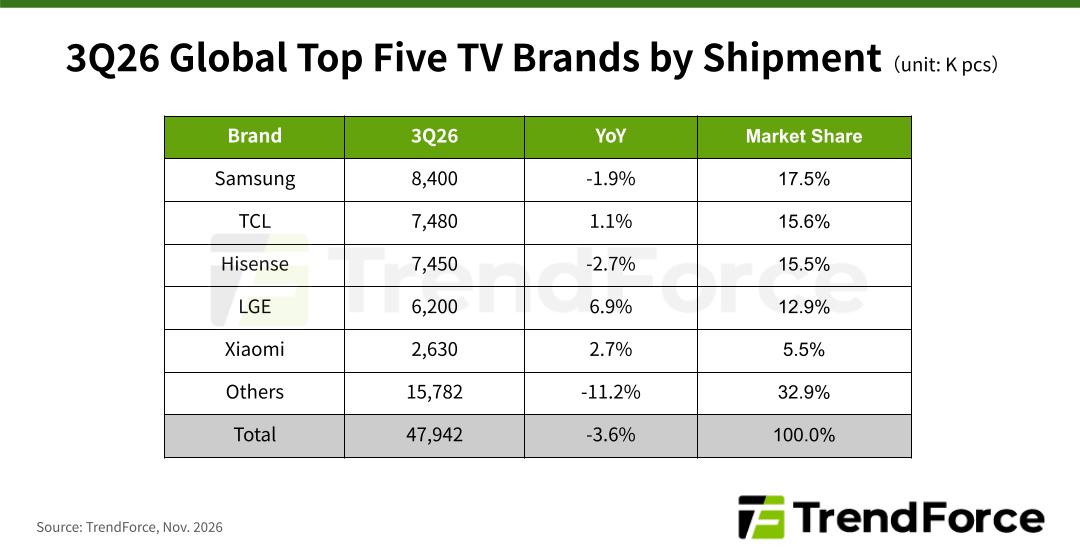
Shipments reached 47.94 million units, rising 2.8% QoQ but declining 3.6% compared with the same period in 2025. Persistent global inflation, rising memory prices, and escalating production costs have continued to weigh on the market, prompting brands to maintain a cautious approach to shipment planning and inventory management.
TrendForce expects Black Friday and other year-end promotional campaigns to lift TV shipments by 8% QoQ in 4Q26, although volumes will still be down 4% YoY.
Throughout 2026, soaring memory prices have placed considerable pressure on TV manufacturers' profitability. Brands have sought to cushion the impact of higher production costs by introducing larger screen sizes and upgrading product specifications to raise ASPs. However, these efforts have struggled to offset persistently weak consumer demand. As a result, global TV shipments are forecast to decline 1.4% YoY to 193.48 million units for the full year.
Looking ahead to 2027, memory prices are expected to remain on an upward trajectory, while display panels and other upstream components face similar cost pressures. Against this backdrop, TrendForce projects that global TV brand shipments will fall another 1.2% YoY to 191.17 million units.
Samsung retains global shipment lead as Hisense narrows the gap with TCL
Samsung retained its leading position in 3Q26 with shipments of 8.4 million units, despite a 1.9% YoY decline. Rising memory costs and subdued market demand weighed particularly heavily on shipments of smaller-screen models, limiting the company's overall growth momentum.
TCL ranked second with shipments of 7.48 million units, up 1.1% YoY. The company has continued to strengthen its product portfolio through an emphasis on Mini LED technology, larger screen sizes, and mid- to high-end models, which has lifted its product mix and ASPs.
This strategy has translated into double-digit revenue growth across North America, Europe, and emerging markets, highlighting TCL's success in expanding its international presence.
Hisense followed closely behind with global TV shipments of 7.45 million units in 3Q26, down 2.7% YoY. With just 30,000 units separating Hisense from TCL, competition between the two leading Chinese brands continues to intensify on the global stage.
Throughout 2026, Hisense has aggressively expanded its presence in Mini LED and ultra-large-screen TVs. According to its financial disclosures, global sales of TVs measuring 100 inches and above surged 77.4% YoY in the first three quarters, while Mini LED TV sales climbed 75.5% YoY.
Mini LED TV penetration approaches 15% in 2026, with RGB Mini LED shipments surpassing 2 million units
The global Mini LED TV market is entering a period of accelerated expansion. While Chinese brands TCL, Hisense, and Xiaomi have spearheaded adoption over the past several years, Samsung, LG Electronics (LGE), and Sony have broadened their Mini LED product portfolios in 2026, providing a further boost to market growth.
TrendForce estimates that global Mini LED TV shipments will reach 28.78 million units in 2026, representing a remarkable 116% YoY increase and bringing market penetration close to 15%.
Samsung is expected to reclaim the top position in global Mini LED TV shipments as it captured 26% market share for the full year. Meanwhile, LGE's accelerated expansion of its Mini LED lineup is projected to propel shipments by more than 800% YoY to 1.75 million units, elevating the company to fourth place worldwide.
This rapid growth signals a gradual broadening of LGE's premium TV strategy beyond its traditional emphasis on OLED, as the company establishes a stronger foothold in the Mini LED segment.
Meanwhile, the introduction of RGB Mini LED and Micro RGB TVs by major manufacturers has opened a new front in the competition for the premium TV market.
Benefiting from its early investment in the technology, Hisense is expected to lead the global RGB Mini LED TV market with a 33% share in 2026, followed by Samsung and Sony in second and third place, respectively. Together, these three brands are projected to account for more than 75% of global shipments.
TCL, by contrast, has chosen a different technological path for its premium products, focusing on Super Quantum Dot (SQD) technology. By combining blue Mini LED backlighting with quantum dot technology to enhance color performance, TCL is differentiating its approach from RGB Mini LED solutions, which employ red, green, and blue Mini LEDs as backlight sources.
With leading brands actively promoting these emerging technologies, TrendForce forecasts that global shipments of RGB Mini LED TVs, including Micro RGB models, will surpass 2 million units in 2026.
This development reflects a broader shift in the premium LCD TV market. Competition is no longer centered solely on Mini LED backlight specifications and the number of local dimming zones, but is increasingly extending to differentiation in backlight architectures and color technologies.
For more on the latest technology industry news and trends, please visit News.