China Accounts for 56% of Global Optical Module Manufacturing; Short-Term Supply Chain Decoupling Unlikely Under Potential U.S. Restrictions, Says TrendForce
According to recent media reports, the U.S. Federal Communications Commission (FCC) is drafting a proposal that would expand its Covered List to restrict imports of new-model optical transceivers manufactured in China.
TrendForce notes that since the proposal has not yet been officially released, several key issues remain unclear, including the definition of “new models,” the criteria for determining “Chinese manufacturers” (e.g., company nationality, inclusion on the Covered List, or manufacturing location), and whether any transition period will be provided. Therefore, it is believed to be too early to interpret the proposal as a comprehensive ban on Chinese optical transceivers.
In the short term, U.S. customers will find it difficult to eliminate reliance on optical transceivers manufactured in China. Over the longer term, however, pressure from these policies is expected to encourage U.S. data center operators to diversify toward contract manufacturers outside China and adopt next-gen semiconductor optical interconnect technologies to reduce dependence on China’s dominant manufacturing capacity.
Proposed FCC restrictions could extend beyond optical transceivers to CPO, NPO, and switch supply chains
TrendForce points out that the proposal’s implications extend beyond whether Chinese optical transceivers can enter the U.S. market. A more important issue is whether network switches and other end products incorporating these components will continue to receive FCC equipment authorization, and whether or not U.S. CSPs will eventually remove Chinese vendors from their supplier lists.
The FCC previously used the Covered List to restrict companies such as Huawei, ZTE, and Hikvision, and has recently expanded those measures by prohibiting new equipment from listed companies from obtaining FCC authorization.
If similar restrictions are extended to optical transceivers, it would mark the first time U.S. regulatory controls directly reach the optical interconnects supply chain for AI data centers. Products potentially affected would extend beyond pluggable optical transceivers to include co-packaged optics (CPO) and near-packaged optics (NPO) optical engines that are integrated into network switches.
Current information points to the U.S. possibly adopting a transitional approach that allows existing authorized products to remain in use while imposing stricter scrutiny on new models. Chinese-manufactured optical transceivers that have already received FCC authorization may therefore remain unaffected in the near term, whereas future products could undergo more rigorous review—or even require approval from additional U.S. government agencies before entering the market.
TrendForce believes the proposed policy reflects the U.S. government’s broader objective of reducing AI data center dependence on China’s optical interconnects supply chain. However, the final scope of the measures and their implementation timeline remain subject to change as U.S.-China relations evolve.
High reliance on China’s supply chain means rapid policy implementation could widen near-term supply gaps
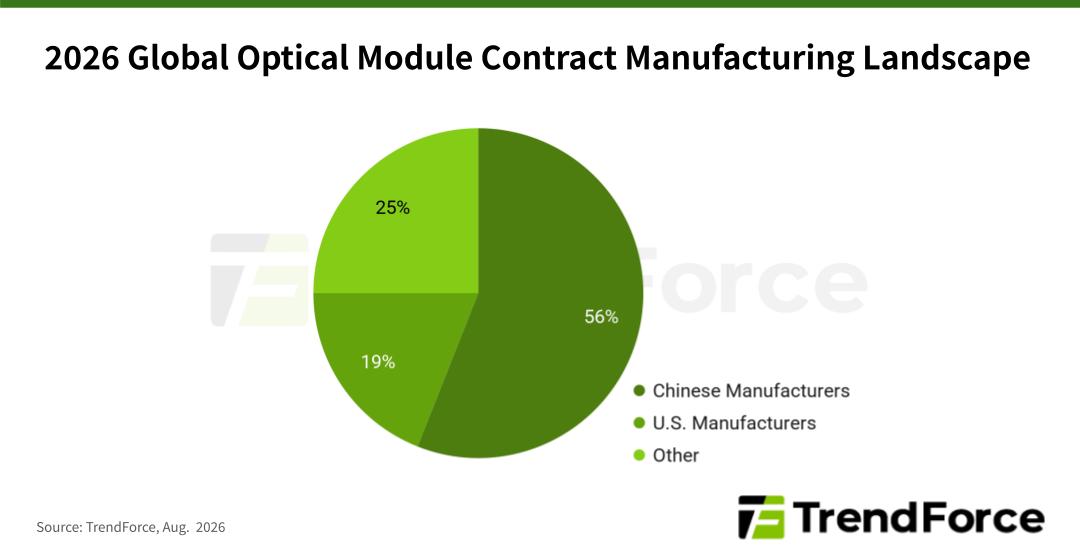
TrendForce estimates that Chinese optical module makers will account for approximately 56% of global contract manufacturing capacity in 2026. Export-oriented suppliers serving the North American market, including Innolight, Eoptolink, and Cambridge Industries Group (CIG), will collectively represent approximately 46% of global manufacturing capacity.
The global optical interconnect supply chain for AI data centers remains highly dependent on China’s module manufacturing, packaging, and testing capabilities. This would make alternative manufacturing capacity, customer qualification, and product migration difficult to scale up simultaneously in the short term if the U.S. government were to impose restrictions covering a broad range of companies and products. As a result, lead times and costs could increase, potentially slowing AI data center deployment and disrupting the global supply chain for AI-related components.
AI data center optical interconnects currently remain heavily reliant on the manufacturing capabilities of Chinese suppliers. Additionally, laser light sources used in optical transceivers continue to depend heavily on indium phosphide (InP) substrates and epitaxial wafer production.
Consequently, decoupling AI optical interconnect manufacturing from China will be difficult in the near term. Should the Chinese government respond with countermeasures by tightening exports of upstream materials such as InP wafers and laser epitaxial wafers, short-term supply-demand gaps could widen further.
However, the rapid growth of demand for AI data centers has also created significant opportunities for Chinese optical module makers. TrendForce observes that many Chinese supplier are expanding production capacity by leveraging years of accumulated expertise and manufacturing advantages in optical interconnects.
Take the industry’s most supply-constrained components—electro-absorption modulated lasers (EMLs) and continuous-wave (CW) lasers—as an example. Chinese manufacturers accounted for only 16.05% of global production capacity in 2025. This share is expected to increase to 27.58% by 2028 according to current expansion plans. How this additional capacity will ultimately be absorbed will become an important issue for the industry to address.
Under increasing U.S. policy restrictions, new Chinese suppliers are likely to face growing difficulty accessing export markets. As a result, newly added capacity will primarily serve domestic Chinese demand. This will further intensify price competition and overcapacity within the local market, while accelerating the divergence between export-oriented and domestic supply chains.
For leading Chinese contract manufacturers, accelerating investments in production facilities in Southeast Asia or the United States will become an important strategy for maintaining customer orders from North America.
However, relocating only final assembly overseas may not be sufficient to satisfy U.S. regulatory requirements. Chinese manufacturers will also need to establish non-China sourcing for key components, traceable country-of-origin management, and independent firmware, testing, and supply chain systems to reduce compliance concerns among the FCC and U.S. CSPs.
For more on the latest technology industry news and trends, please visit News.