[News] Micron Develops Edge Inference Memory, 2H28 Production Seen as HBM Potential Grows in Humanoids
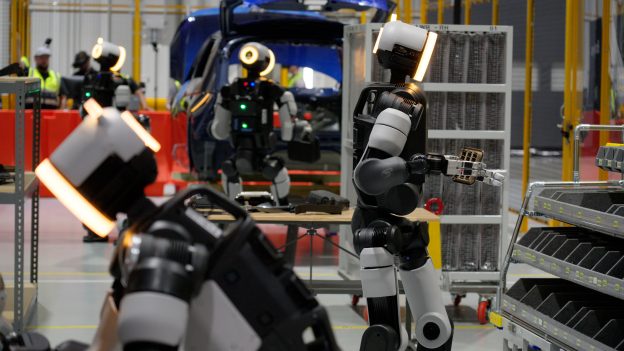
The AI boom is extending beyond high-performance computing (HPC) into physical AI, opening new opportunities for memory makers beyond HBM, particularly in humanoid robotics. According to The Elec, Micron Vice President Lee Cheol revealed at SEDEX 2026 in South Korea that the company is developing edge inference memory (EIM) for physical AI applications, with mass production expected in the second half of 2028 by industry observers.
What Is EIM?
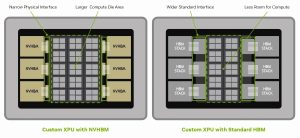
Designed to accelerate AI inference, Micron’s EIM reportedly stacks low-power DRAM (LPDDR) atop a logic die to improve data processing efficiency. Unlike processing-in-memory (PIM), which integrates computing units directly into memory, EIM’s computing architecture has yet to be disclosed though, according to The Elec.
The technology aims to reduce latency and boost bandwidth between AI processors and memory, although Micron has not revealed specific performance targets, The Elec notes, adding that the company is also exploring ways to incorporate EIM into LPDDR6.
Humanoid Robots Could Drive a New Wave of Memory Demand
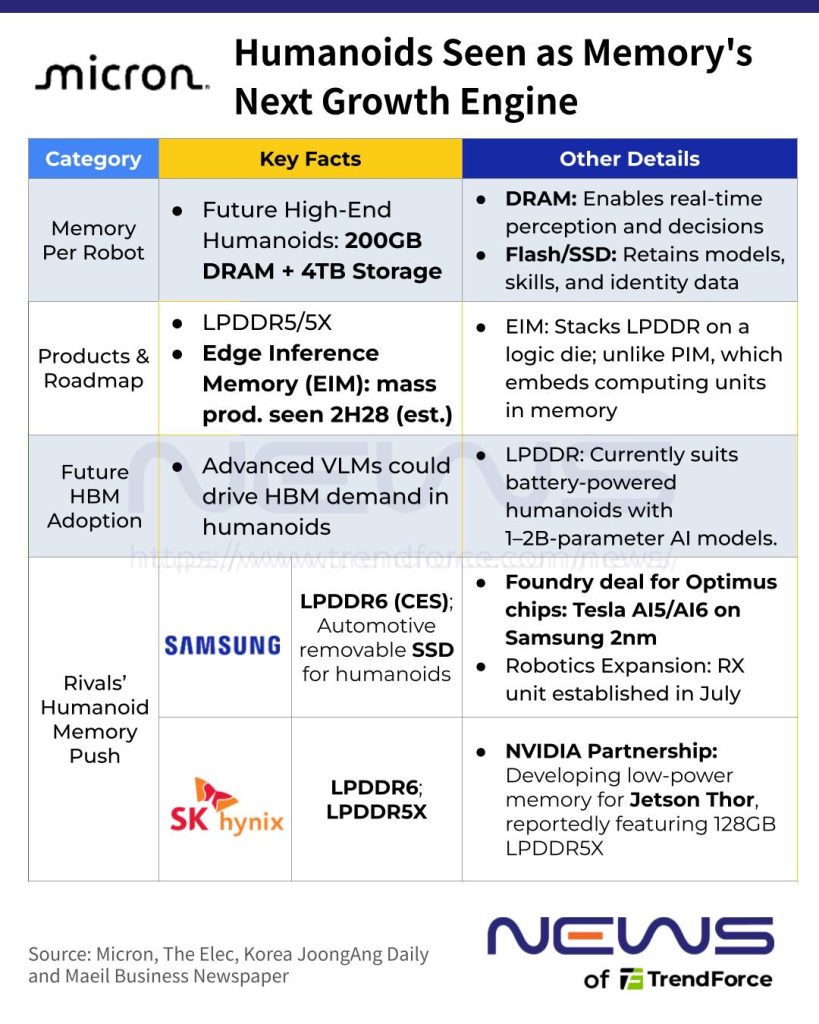
Micron’s EIM push comes as it sees memory requirements rising sharply with advances in humanoid robotics. At its September earnings call, Micron estimated that each humanoid could require more than 200GB of DRAM and several terabytes of NAND flash, with several physical AI customers already sampling next-generation products, as cited by BigGo Finance.
The Elec offers a closer comparison: Micron expects future high-performance humanoids to need around 200GB of DRAM and 4TB of storage, up sharply from the 12GB and 256GB, respectively, found in today’s service robots.
Beyond growing memory content per robot, rising shipments could provide another boost. Morgan Stanley estimates humanoid robot deliveries could reach 250,000 to 1.2 million units in 2030 before climbing to around 930 million annually by 2050, according to BigGo Finance. At the upper end of the 2030 forecast, that would translate into roughly 240 million GB of DRAM demand based on Micron’s per-unit estimates.
Micron Eyes HBM Shift as Humanoid AI Models Grow
For now, energy-efficient LPDDR remains well suited to battery-powered humanoids, whose AI models typically contain around 1 billion to 2 billion parameters and require relatively modest memory bandwidth, according to Micron Vice President Lee Cheol, as cited by The Elec.
But as more sophisticated vision-language models (VLMs) push bandwidth requirements higher, LPDDR alone may eventually fall short, opening the door for HBM in high-performance humanoid robots, Lee said.
Samsung, SK hynix Eye Humanoid Market with LPDDR
Micron is not alone in targeting the emerging humanoid market. Samsung and SK hynix are also positioning their low-power memory technologies for physical AI. According to Korea JoongAng Daily, both firms showcased next-generation LPDDR technologies, including LPDDR6, at CES 2026, underscoring their ambitions in robotics.
Beyond LPDDR, Samsung is extending its automotive storage expertise into humanoid robotics, adapting a removable solid-state drive (SSD) originally developed for vehicles to physical AI applications, the report suggests. SK hynix, meanwhile, is working with NVIDIA on low-power memory for its Jetson Thor robotics computing platform, which reportedly features 128GB of LPDDR5X, Korea JoongAng Daily notes.
Yet the race for humanoid memory may prove more crowded than the HBM market. Unlike HBM, where Samsung and SK hynix hold stronger positions, LPDDR offers greater room for Chinese competitors to challenge their Korean rivals, according to Hankook Ilbo. Among them, CXMT is gaining attention after announcing last month that its LPDDR6 technology had been adopted in Xiaomi’s 18 Fold smartphone, signaling growing competition in next-generation low-power memory.
Read more
- [News] Micron Sees Tighter Memory Supply Through FY28: When Will the Big Three’s New Capacity Arrive?
- China’s Humanoid Robot Market to Reach CNY 15 Billion in 2026 as Commercial Validation Begins, Says TrendForce
(Photo credit: Boston Dynamics)